

Fonterra's very likely to cut its milk price forecast for farmers soon and it is looking like this season's milk price will be below the break-even point for many farmers, according to Westpac economists.
In a Dairy Update, Westpac senior agri economist Nathan Penny has slashed his own forecast for the current season milk price by over a dollar.
Giant dairy co-operative Fonterra has made an opening milk price forecast for the season that started last month of between $7.25-$8.75 per kilogram of milk solids, giving a 'mid-point' price of $8.
Penny, who has tended to be something of a milk price 'bull' - but has a good track record at picking the price - has now lowered his forecast to $7.80 from $8.90.
Last week, following another lacklustre GlobalDairyTrade auction result, ANZ agricultural economist Susan Kilsby, dropped her forecast by 50c and now has a price of $7.75.
It means that economists at the country's four biggest banks are now all forecasting a milk price below the midpoint of Fonterra's own forecast.
Penny noted that it’s still early days in the season "and a wide range of milk prices are possible".
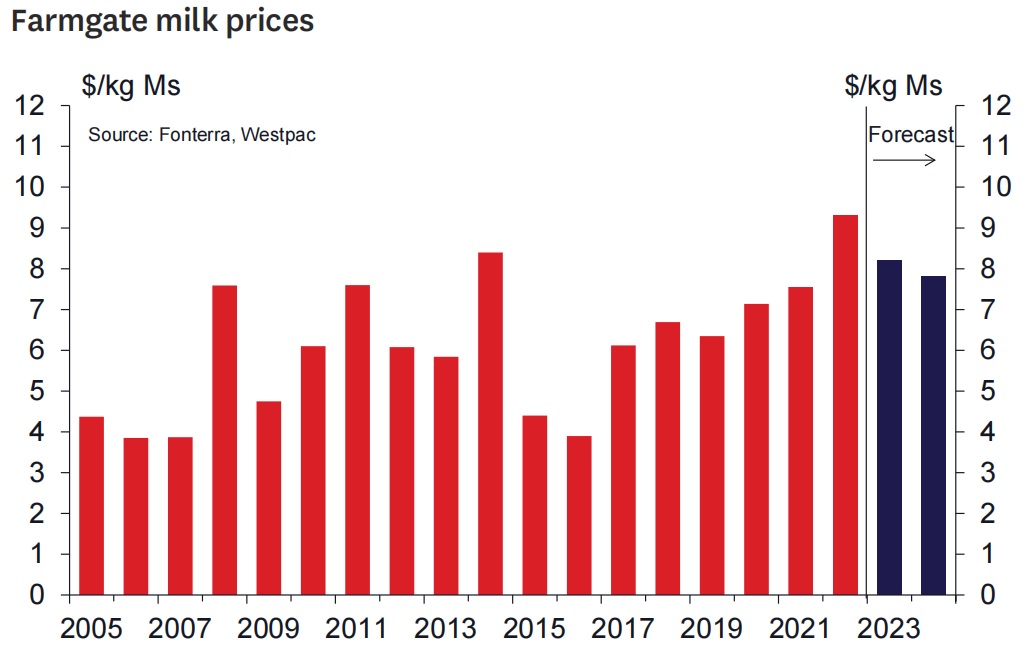
"In that sense, Fonterra’s forecast range is a useful tool. Using their $1.50/kg range and our [$7.80] forecast as the midpoint, would give a range of $7.05/kg to $8.55/kg (Fonterra’s current range is $7.25/kg to $8.75/kg).
"With that in mind, Fonterra is likely to lower their forecast range at their next announcement. If anything, we suspect that Fonterra might lower their range a touch below what we have indicated above. Note Fonterra is due to update its forecast range by the end of next month," Penny said.
He said that for many farmers, this season’s milk price is likely to be below their break-even point.
"A back of the envelope calculation, with total operating expenses of $6.80/kg and debt servicing costs of $1.50/kg would put farmers total outgoings at $8.30/kg - i.e. $0.50/kg above our milk price forecast.
"Note that break-even estimates vary widely by farm (and also in the calculation method), so that some farms may have larger deficits, while some may still even be in surplus.
"That said, farm balance sheets are generally strong. With that in mind, plus the experience gained during previous downturns, we expect that farmers are well-placed to manage through this milk price cycle."
The chief catalyst for the forecast revision is the unexpectedly sluggish Chinese economy, Penny said.
"We have made significant downward revisions to our forecasts for Chinese economic growth this year. As recently as last month, we expected economic growth for 2023 of 6.2%. Since then, we have made consecutive downward revisions to 5.7%, and now 5.2%.
"As a result (chiefly) of weak Chinese demand, the downward price trend in global dairy prices has been sustained much longer than we expected. Prices have fallen at 10 of the 14 auctions held this year, with prices down 22% in annual change terms. In contrast, we had expected that prices would have bottomed by now, if not begun to turn higher."
While continued soft Chinese demand accounts for most of the price weakness, other factors are playing a role, Penny said.
Firstly, a bumper autumn for New Zealand has boosted global dairy supply temporarily.
"Indeed, April and May production was up a combined 7.7% compared to the same period a year ago – both months set record highs. This late autumn surprise was enough to offset the very weak spring and thus lift production for the entire season above last season’s level."
Secondly, and as he has previously discussed, Penny said New Zealand has not been well-placed to benefit from relatively high cheese prices.
"We still expect global dairy prices to eventually recover late this year (if not early next year). However, that means prices will remain low through the peak spring months of production and thus while prices will recover, it’s now likely that the price recovery comes too late in the season to prevent a lower milk price."
We welcome your comments below. If you are not already registered, please register to comment
Remember we welcome robust, respectful and insightful debate. We don't welcome abusive or defamatory comments and will de-register those repeatedly making such comments. Our current comment policy is here.