
Farmers remuneration for their workload is often very low compared to other professions, but the "love for the land' and historical asset growth compensated this shortfall for many.
But will farmers in the future work for peanuts when land values ease and profits fail to respond?
Many in the public sector receive huge remuneration packages that often seem exorbitant for those on the land. Proponents suggest the market soughts out the rate, but some big pay rates exist even in companies of poor performance.
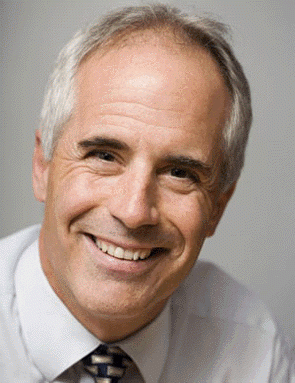
Andrew Ferrier has been CEO of NZ biggest company and been in the helm when dairy has had a spectacular turn around in fortunes.
Are you happy with the $1.5million pay increase this CEO has received this year?
Fonterra's chief executive Andrew Ferrier got a $1.5 million pay rise last year even while the dairy company had a freeze on wages, as executives benefited from incentives paid for prior years. Ferrier’s total pay was between $5.1 and $5.11 million in the year ended July 31, assuming he is the firm’s highest earner, up from a $3.62 million-to-$3.63 million range a year earlier, according to the 2010 annual report. The 41 percent increase is his biggest since 2005, when Ferrier got a 53 percent increase reports Stuff.
"We had a salary freeze in place for senior management where we didn’t move the base salaries – what’s contributed to the rise was the incentive scheme” from the prior financial year, human resources manager Jennifer Kerr said. The 16-month pay freeze ended this month, she said. Ferrier’s pay rise reflected a 2009 financial year when Fonterra slashed debt and boosted distributable profit even as milk prices slumped amid the global financial crisis.
His pay has more than tripled since he took over as CEO in 2003 on an annual stipend of $1.64 million to $1.65 million and he has collected about $22.9 million in his seven years with the company.
The increases come in a busy year for Fonterra after it boosted net profit 12 percent to $685 million while cutting its net debt by $700 million. The dairy exporter, which has enjoyed a rebound in international dairy prices from a trough in July last year, reaffirmed its forecast pay-out at $6.60 a kilogram of milk solids and lifted its expected distributable profit to a range of 40 to 50 cents a share from 30 to 50 cents. It convinced shareholders to agree to a new capital structure that will introduce a fund letting them trade shares in the cooperative among themselves, as well as opening a pathway for outside investors to get exposure to Fonterra.
We welcome your comments below. If you are not already registered, please register to comment
Remember we welcome robust, respectful and insightful debate. We don't welcome abusive or defamatory comments and will de-register those repeatedly making such comments. Our current comment policy is here.