
 By Bruce Wills
The good thing about farming is that you never know what Mother Nature will throw at you next.
Last Sunday, after taking in some rest and relaxation thanks to the musical Hairspray, I headed to Rotorua for the NZ Agricultural Aviation Association conference.
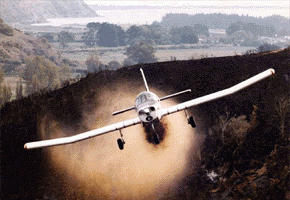
It always struck me that if we ever reintroduced armed fighter aircraft, our aerial top dressers would be the pilots to recruit.
These are aviators who take off from postage stamp sized austere strips and deliberately fly towards the ground.
For many farmers aerial top dressing is the most practical and for some, the only practical way to apply fertiliser.
Yet the topsy-turvy returns in farming have resulted in equally topsy-turvy fertiliser application.
Of course, once you string together two good seasons, you end up with a lot of farmers who want their fertiliser applied yesterday.
I guess the optimal solution is a two-way relationship between pilots and farmers. Farmers must plan and budget for aerial top dressing, which gives the aviation industry confidence to invest in equipment, tools and technology.
Let’s face it, nutrient caps are coming and no farmer wants to see expensive fertiliser drifting towards water.
More so, if it may impact your nutrient budget and this is where precision aerial top dressing comes into play.
The standards have been developed by the Fertiliser Quality Council in its Aerial Spreadmark Code but to really get results, means ending the stop-start nature of farmer demand.
It is also one area when an ounce of courtesy can go a long way; like informing your neighbours when and what you are applying.
As agricultural pilots fly at the envelope’s edge, farmers need to remember our responsibilities under the Health and Safety in Employment Act.
While the aviation industry has developed Aircare to improve safety, there are too many subpar farm strips and fertiliser bins.
Maybe it is time for us and the Government to re-release safety guidelines for farm strips and facilities. I guess it is getting codes of practice in place to ensure the safety of pilot and machine while stopping competition from lessening safety.
Perhaps Aircare may eventually grade strips and facilities because the cost of aerial application needs to reflect how efficient our strips and bins are. It is why I created an all-weather, 700 metre lime topped strip.
With secure bins located near to the road, my pilot can land, load and take off within a few minutes.
Our farm is a tough one to service, being seven kilometres long by three wide and incorporating QEII covenanted land bordered by pine trees. Just to add to the complexity are eleven power pylons; these pilots are the real deal.
Monday night’s eruption of Mt Tongariro did its impression of aerial top dressing, by thinly spreading ash over a wide area.
While Tongariro was stirring into life, I was in Auckland for the EDS ‘growing green conference’. I first got wind of the eruption after 4am in a text from Federated Farmers and with no panicked call from home, always a good sign, I checked in just after daylight to find our farm off the Taupo-Napier highway to be ash-free.
As Federated Farmers staff checked further afield, most farms reported specs or nothing; much of the ash falling on National Park or forested areas.
It is fair to say the media went stir crazy over this; one suggested to Federated Farmers stock were dying while another wanted images of lava spewing onto paddocks.
Few people realise Lake Taupo is the product of the world’s largest explosion in the past 70,000 years.
With Tongariro, the media were struggling to find ash outside the immediate vicinity and the sad thing is they seemed disappointed in that.
Farmers well know from Ruapehu in 1995/96, volcanoes are as predictable as the Warriors league team.
Was Tongariro ‘breaking wind’ or clearing its throat for something bigger?
We don’t know so that is a big reason to err on the side of caution.
There is now plenty of excellent advice from the Ministry for Primary Industries, US Geological Survey and several guidance notes are on Federated Farmers website.
Plaudits must also go to Massey University’s Volcanic Risk Solutions, the Fertiliser and Lime Research Centre and the University of Canterbury’s Natural Hazards Research Centre. They have issued sage advice reminding farmers in the central and lower North Island to check their farms for preparedness and resilience.
Tongariro is also a humbling reminder that while we think we have mastery of this earth, really, we don’t.
Maybe, we’ll need those airstrips for more than top dressing after all.
-------------------------------------------------------------
Bruce Wills is the President of Federated Farmers. You can contact him here »
We welcome your comments below. If you are not already registered, please register to comment
Remember we welcome robust, respectful and insightful debate. We don't welcome abusive or defamatory comments and will de-register those repeatedly making such comments. Our current comment policy is here.