
By Mike Joy*

A scientific breakthrough made a hundred years ago is at the heart of the problem. The Haber-Bosch process enabled the use of fossil energy to transform atmospheric nitrogen into a form that plants can use. The resulting product, nitrogen fertiliser, enabled the Green Revolution, a massive increase in food production. Previously, nature had fixed atmospheric nitrogen mainly through leguminous plants, blue-green algae and lightning. But now, using fossil energy, the flux of anthropogenic nitrogen into the atmosphere, soils and water has increased tenfold over all natural sources.1
Synthetic nitrogen has allowed the human population to reach double the 3.5 billion that could have been sustained without it. Since the discovery, population growth and the increase in nitrogen fertiliser production have been in sync.2 Now we are on track to reach a world population of more than nine billion by 2050, nearly three times what could have been supported without synthetic nitrogen.
As with a wonder drug that only later you discover has terrible side effects, the Haber-Bosch process opened up a Pandora’s Box of problems. By exploiting in a single century energy built up over millennia, we have radically altered the ecological balance of agricultural systems.
The distortion triggered a proliferation of livestock so that the food system is now responsible for more than a quarter of all anthropogenic greenhouse gas (GHG) emissions, is the dominant driver of deforestation and biodiversity loss, and is a major user and polluter of water resources.3 Nitrogen is not the only fossil-derived part of the problem: oil is another culprit. On top of the nitrogen footprint, our industrial food production system now uses over 10 calories of oil energy to plough, plant, fertilise, harvest, transport, refine, package, store/refrigerate and deliver one calorie of food to be eaten by humans.4
A graphic example of the human food domination of the planet is that in the last 100 years the biomass of domestic animals on the planet quadrupled. By the beginning of this century 98 per cent of the total biomass of mammals was humans and the animals that feed them, leaving only two per cent as wild animals.5
Demand for nitrogen fertiliser is expected to continue to increase by four per cent annually,6 but easily obtained gas is declining, so this production will increasingly rely on fracked wells for gas. Fracked gas has many environmental issues and is very inefficient compared to conventional wells: fracked gas wells leak 40 to 60 per cent more methane.7 Also, as fossil gas supplies diminish, their extraction becomes more energy-intensive. The energy return on investment for gas is declining, so at some point we must face the dilemma that we have a population many times higher than can be nourished without fossil energy.
One of the main reasons synthetic nitrogen fertiliser has so many impacts is that most of it doesn’t end up where it was intended. Only around 17 per cent of the amount applied as fertiliser makes it into crops or animal products consumed by humans.8 The rest is lost to the environment where mostly it does harm. The bulk of the reactive nitrogen (a term used for a variety of nitrogen compounds that support growth directly or indirectly) leaks into aquatic systems where it does damage mainly through accelerated eutrophication. This is an unnatural excess of nutrients that often drives algal blooms, which have many impacts, often the worst being a reduction of available oxygen in water, killing aquatic life. This eutrophication, primarily from agricultural sources, has contributed to the many eutrophic lakes and rivers, but it doesn’t end there — the rest makes it to oceans. Theses nutrients in oceans have created more than 400 oceanic dead zones worldwide, primarily in Europe, the eastern and southern US, and South East Asia. These dead zones cover a total area of 245,000 square kilometres, similar to the total land area of New Zealand. Part of the inefficiency of nitrogen fertiliser is that livestock are wasteful in their conversion: in the EU livestock consume around 85 per cent of the 14 million tonnes of nitrogen in crops harvested or imported there, but only 15 per cent goes to feed humans directly.9
Another example of leakage is nitrogen fertiliser loss to the atmosphere. The Intergovernmental Panel on Climate Change (IPCC) estimates that for every 100 kilograms of nitrate fertiliser applied to soil, one kilogram ends up in the atmosphere as nitrous oxide, a GHG 300 times more potent than CO2, and the most ozone-depleting gas. This creation of nitrous oxide can be seen in a 17 per cent increase since the pre-industrial era from below 270 parts per billion in the atmosphere to more than 320 parts per billion now.10
'A net loss to society'
While nitrogen fertiliser increases production, the negative impacts — including the costs to clean up and costs to human health — are huge. EU farmers add 11 million tonnes of reactive nitrogen in fertiliser annually, giving them a direct benefit of €20–80 billion when long-term gains are included. However, the cost to society of this excess nitrogen is estimated to be between €70 billion and €320 billion per year, based on estimates of the price of damage to human health and ecosystems and biodiversity loss.11 Thus, the costs far outweigh the value that nitrogen fertilisers add.
In New Zealand the ratio of nitrogen costs to gains is likely to be similar — put simply, they constitute a net loss for society. One facet of the environmental costs of nitrogen pollution of freshwaters can be quantified by what it costs to remove it from waterways such as lakes. Trials in Lake Rotorua showed it cost a minimum of $250 to remove one kilogram of nitrogen from the lake,12 whereas to not use a kilogram of nitrogen fertiliser on farm would mean a loss of revenue for the farmer of around $6.13 The Bay of Plenty Regional Council is currently paying farmers to de-intensify their farming in the lake catchment order to stop 100 tonnes of reactive nitrogen entering the lake (the estimated amount that must be reduced to stop the lake clarity declining). The regional council has a $40 million tax and ratepayer clean-up fund for the lake.
Analysis has been done by the Stockholm Institute into ‘planetary boundaries’ to find the tipping points that must not be exceeded for humankind to continue to exist.14 Its analysis showed that of the 10 boundaries identified, three have already been drastically surpassed: biodiversity, the nitrogen cycle and climate change. The nitrogen cycle is more than three times the safe limit; biodiversity loss is more than 10 times the limit; and with CO2 at 400 parts per million in the atmosphere climate change is well past the 350 parts per million boundary.
The global food system, boosted by synthetic nitrogen, is responsible for more than a quarter of all human-induced GHG emissions. Livestock are responsible for around 15 per cent of all anthropogenic GHG emissions, 37 per cent of all anthropogenic methane emissions, and 65 per cent of all nitrous oxide emissions.15 Within the livestock sector almost half of the emissions are in the form of methane; the remaining part is almost equally shared between nitrous oxide and CO2. Of the livestock production emissions, the majority are from beef (41 per cent) and dairy cattle (20 per cent).
Breaking down the livestock emissions further, ruminants are far and away the biggest problem, responsible for about 12 per cent of all GHG emissions.16 In 2011 the estimated 3.6 billion domestic ruminants globally were responsible for more than 80 per cent of the total livestock-related GHG emissions.17
While livestock provide a third of the dietary protein for humans, especially in developing countries, they have a massive environmental footprint over and above the considerable climate-change implications. Livestock are responsible for an estimated 55 per cent of the sedimentation of waterways through accelerated erosion, 37 per cent of pesticide use, 50 per cent of all antibiotic use, 64 per cent of ammonia loss and a third of the anthropogenic loads of nitrogen and phosphorus to freshwater resources.18 Livestock are also very inefficient at energy conversion; they consume 77 million tonnes of protein contained in feedstuff that could potentially be used for human nutrition, but supply only 58 million tonnes of protein in food products for humans.
Of all human land uses, livestock occupies the largest share, around 70 per cent of all agricultural land and one-third of the land surface of the planet. Twenty to 30 per cent of the ice-free area is used for grazing, and around a third of cultivated land area is used for their feed and forage.19 Between 1980 and 2000, 83 per cent of agricultural land expansion in the tropics occurred at the expense of forests, and livestock were a major contributor.20 However, at sustainable densities livestock have ecological benefits: they create human food from inedible sources, can conserve grassland ecosystems, help recycle nutrients and can provide many social benefits.21
Incompatable increases and declines
The ability of the planet to provide enough food for the extra 80 million mouths to feed every year is likely to decline. Two trajectories are converging, and, if they meet, the future will be bleak. The first trajectory is decline: of the amount and quality of available land, of fossil-fuel availability to make nitrogen fertiliser, of water quality, and of wild fisheries. The second trajectory is increase: of human population, of animal products in diets, and of food wastage. Climate change is speeding up the convergence of the two trajectories. Given that one major driver pushing us over the planetary boundaries is our current food system, especially the livestock sector, the solution must be to radically change the way we live and what we eat.
While there are technological and efficiency gains to be made through precision agriculture and irrigation, and there is great potential for reductions in food waste as mitigation options, most agricultural GHG emissions are intrinsic to the current livestock-centred agricultural system. Furthermore, as population and diets increase, the small gains are negated by a net increase in production volume and associated impacts. Because most methane emissions come from ruminants and nitrous-oxide emissions from fertilisers, they can be addressed only by reducing the animal component of food, particularly ruminants.
Reducing meat consumption can have many positive effects for the environment and human health. High levels of meat consumption in developed countries are strongly correlated with rates of diseases such as obesity, diabetes, some cancers and heart disease. Reducing meat and replacing it with high-protein plant foods is associated with significant health benefits.22 A recent study found that adopting diets in line with global dietary guidelines could avoid 5.1 million human deaths per year by 2050.23 Even greater benefits could come from vegetarian diets (avoiding 7.3 million deaths) and vegan diets (avoiding 8.1 million deaths, and billions of animal deaths). Approximately half of the avoided deaths would come from a reduction of red-meat consumption, with the other half due to a combination of increased fruit and vegetable intake and a reduction in calories, leading to fewer people being overweight or obese.
Nitrogen-footprint studies clearly reveal the differences in impacts with different diets: the per capita nitrogen footprint in the United States is 41 kg N/yr whereas in the Netherlands it is 25 kg N/yr. These differences are mainly a result of the US diet being more meat-oriented than that of the Netherlands, which emphasises dairy, eggs and fish.
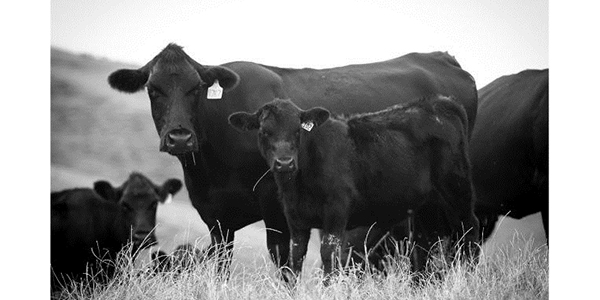
Who, us? Do we have to accept that reducing meat consumption has positive effects for the environment and human health? Sarah Ivey/AngusPure NZ
Dietary choices can hugely influence environmental impacts of food: red meat has the highest eutrophication potential, followed by dairy products, chicken/eggs and then fish. The cereal and carbohydrate food group has the lowest nutrient footprint among all food sub-groups. Producing, processing, transporting and packaging one kilogram of red meat generates on average 150 grams of nitrogen-equivalent emissions, whereas to supply one kilogram of cereal/carbohydrates results in around just 2.6 grams of nitrogen-equivalent emissions.24
Depending on the system, livestock can use copious amounts of water. Mostly it goes to irrigate crops. There have been many estimates of litres per kilogram of protein, but most agree that at least eight times more water is used per kilogram for a meat diet than is needed for a vegetarian diet.25 Livestock systems also in many cases limit the quality of available water through eutrophication.
Another limitation to feeding the world’s population is the availability of land to grow food. Many studies have shown much less land is required if protein goes directly to humans rather than via animals. A comprehensive study of the area of land required to feed humans over a range of diets in the US found that a vegetarian diet used on average one-eighth of the area needed for an omnivorous diet. But livestock farming can take place on land not suitable for crop production, so making comparisons is difficult.
A them-or-us choice
Here in New Zealand, synthetic nitrogen is applied as urea and its use has increased dramatically over the past few decades. Its importation, mainly from the Middle East, steadily increased from 58 tonnes in 1990 to more than 600,000 tonnes in 2016; approximately another third (260,000 tonnes) is produced from Taranaki gas fields. This increase in nitrogen fertiliser use has been matched by livestock intensification, illustrated by a 460 per cent increase in dairy exports between 1990 and 2010.26 The impacts on the environment of this intensification are obvious. Almost daily in summertime there are new stories of rivers, lakes and ground water becoming unswimmable and undrinkable. Freshwater monitoring shows quality and quantity impacts in all intensively livestock-farmed areas;27 and freshwater pollution events are exacerbated by climate change with predicted drying on the East Coast and more extreme rainfall events.
Most of the media coverage around climate change has focused on CO2 emissions, with transport and energy receiving the biggest coverage. This is odd, given that the non-CO2 emissions are proportionally more than those of the entire global transport system:28 they contribute about one-third of total anthropogenic CO2-equivalent emissions and 35 to 45 per cent of climate forcing resulting from those emissions.29
In New Zealand the climate-change implications of livestock receive little publicity. So far the only response from government is to look for technological fixes for methane emission from ruminants. Rather than push for reductions in livestock numbers, the Ministry for Primary Industries predicts growth in livestock numbers and production, and the government is calling for and funding growth in animal agriculture with its Primary Growth Partnerships. The only significant sign of recognition of the issues of livestock farming has come from New Zealand’s biggest farmer, the state-owned enterprise Landcorp, which recently announced it would stop using imported palm-kernel expeller and become carbon-neutral within a decade.
Many studies in other parts of the world show that more people can be fed from the same land area — and with significantly lowered environmental and health impacts — when livestock numbers are reduced. There are areas of New Zealand where livestock and forestry are the only options, but there are large lowland areas where more diverse farming systems not dominated by livestock could see a much more sustainable outcome. A switch away from livestock and synthetic nitrogen would mean that we could feed more people a healthier diet, preserve waterways and increase the chances of having a liveable atmosphere. While New Zealand may be relatively immune to many global crises, climate change is not one of them.
If we continue on our present path, GHG emissions from food and agriculture will dramatically increase, with a predicted 80 per cent increase by mid-century, due to population growth and dietary changes moving toward animal-based foods that are more emissions-intensive. If we do nothing by 2050, food-related GHG emissions could account for up to half of the total emissions. We have ignored non-CO2 emissions for too long now — and the biggest component of those emissions is from livestock, particularly ruminants. It is simply a ‘them or us’ choice: if we don’t drastically reduce livestock from our diets, as we reduce other GHG emissions, we have no future.
Notes:
1 UNEP and WHRC, Reactive Nitrogen in the Environment: Too Much or Too
Little of a Good Thing (Paris: UNEP, 2007).
2 J. W. Erisman, M. A. Sutton, J. Galloway, Z. Klimont and W. Winiwarter, ‘How
a Century of Ammonia Synthesis Changed the World’, Nature Geoscience 1 (2008): 636–39.
3 S. J. Vermeulen, B. M. Campbell and J. S. I. Ingram, ‘Climate Change and
Food Systems’, Annual Review of Environment and Resources 37 (2012); H. Steinfeld et al., ‘Livestock’s Long Shadow’ (Rome: FAO, 2006); F. N. Tubiello et al., ‘Agriculture, Forestry and Other Land Use Emissions by Sources and Removals by Sinks: 1990–2011 Analysis’ (Rome: FAO, 2012).
4 R. A. Neff, C. L. Parker, F. L. Kirschenmann, J. Tinch and R. S. Lawrence,
‘Peak Oil, Food Systems, and Public Health’, American Journal of Public Health 101 (2011): 1587–97.
5 V. Smil, The Earth’s Biosphere: Evolution, Dynamics, and Change (Cambridge,
MA: MIT Press, 2003).
6 FAO, ‘World Fertiliser Trends and Outlook to 2018’ (Rome: FAO, 2015).
Available at: http://www.fao.org/3/a-i4324e.pdf.
7 Mark Fischetti, ‘Fracking Would Emit Large Quantities of Greenhouse
Gases’, Scientific American, January 2012. Available at: http://www. scientificamerican.com/article/fracking-would-emit-methane/.
8 http://www.whrc.org/policy/PDF/Reactive_Nitrogen_sml.pdf.
9 Mark A. Sutton, Clare M. Howard, Jan Willem Erisman, Gilles Billen,
Albert Bleeker, Peringe Grennfelt, Hans van Grinsven and B. Grizzetti, The European Nitrogen Assessment: Sources, Effects and Policy Perspectives (Cambridge, UK: Cambridge University Press, 2011).
10 S. P. Park, K. A. Croteau, D. Boering, D. Etheridge, D. Ferretti, P. J. Fraser, K. R. Kim, P. B. Krummel, R. L. Langenfelds, T. D. van Ommen, L. P. Steele and C. M. Trudinger, ‘Trends and Seasonal Cycles in the Isotopic Composition of Nitrous Oxide Since 1940’, Nature Geoscience 5 (2012): 261–65.
11 M. A. Sutton, O. Oenema, J. W. Erisman, A. Leip, H. van Grinsven and W. Winiwarter, ‘Too Much of a Good Thing’, Nature 472 (2011): 159–61.
12 K. J. Foote, M. K. Joy and R. G. Death, ‘New Zealand Dairy Farming: Milking Our Environment for All Its Worth’, Environmental Management 56 (2015): 709–20.
13 Mike Joy, Polluted Inheritance: New Zealand’s Freshwater Crisis (Wellington: Bridget Williams Books, 2015).
14 J. W. Rockstrom, K. Steffen, A. Noone, F. S. Persson, E. F. Chapin, T. M. Lambin, et al., ‘A Safe Operating Space for Humanity’, Nature 461 (2009): 472–75.
15 P. J. Gerber, H. Steinfeld, B. Henderson, A. Mottet, C. Opio, J. Dijkman, A. Falcucci and G. Tempio, ‘Tackling Climate Change through Livestock — A Global Assessment of Emissions and Mitigation Opportunities’ (Rome: FAO, 2013).
16 H. Westhoek et al., The Protein Puzzle (The Hague: PBL Netherlands Environmental Assessment Agency, 2011); P. Havlik et al., ‘Climate Change Mitigation through Livestock System Transitions’, Proceedings of the National Academy of Sciences of the United States of America 111 (2014): 3709–14.
17 M. Herrero, P. Havlik, H. Valin, A. Notenbaert, M. C. Rufino, P. K. Thornton, M. Bluemmel, F. Weiss, D. Grace and M. Obersteiner, ‘Biomass Use, Production, Feed Efficiencies and Greenhouse Gas Emissions from Global Livestock Systems’, Proceedings of the National Academy of Sciences of the United States of America 110 (2013): 2088–93.
18 H. Steinfeld, ‘Livestock’s Long Shadow: Environmental Issues and Options’ (Rome: FAO, 2006).
19 H. H. Janzen, ‘What Place for Livestock on a Re-greening Earth?’, Animal Feed Science and Technology 166–67 (2011): 783–96.
20 H. K. Gibbs, A. S. Ruesch, F. Achard, M. K. Clayton, P. Holmgren, N. Ramankutty and J. A. Foley, ‘Tropical Forests Were the Primary Sources of New Agricultural Land in the 1980s and 1990s’, Proceedings of the National Academy of Sciences of the United States of America 107 (2010): 1632–37.
21 Janzen, ‘What Place for Livestock’, 2011.
22 W. J. Craig, A. R. Mangels and American Dietetic Association, ‘Position of the American Dietetic Association: Vegetarian Diets’, Journal of the American Dietetic Association 109, no. 7 (2009): 1266–82.
23 M. Springmann, H. C. J. Godfray, M. Rayner and P. Scarborough, ‘Analysis and Valuation of the Health and Climate Change Co-benefits of Dietary Change’, Proceedings of the National Academy of Sciences of the United States of America 113 (2016): 4146–51.
24 X. Xue and A. E. Landis, ‘Eutrophication Potential of Food Consumption Patterns’, Environmental Science & Technology 44 (2010): 6450–56.
25 Janzen, ‘What Place for Livestock’, 2011.
26 Foote et al., ‘New Zealand Dairy Farming’, 2015.
27 Parliamentary Commissioner for the Environment, ‘Water Quality in New Zealand: Land Use and Nutrient Pollution’ (Wellington: Parliamentary Commissioner for the Environment, 2013). Available at: http://www.pce. parliament.nz/media/1275/pce-water-quality-land-use-web-amended.pdf.
28 Steinfeld, ‘Livestock’s Long Shadow’, 2006.
29 S. A. Montzka, E. J. Dlugokencky and J. H. Butler, ‘Non-CO2 Greenhouse Gases and Climate Change’, Nature 476 (2011): 43–50.
Mike Joy is a senior lecturer in ecology and environmental science at the Institute of Agriculture and the Environment at Massey University. This article is an essay in Massey University's 2017 New Zealand Land & Food Annual - No free lunch. It is reposted here with permission. The New Zealand Land & Food Annual 2017, Edited by Claire Massey, published by Massey University Press, RRP: $39.99, available in bookshops nationwide.

We welcome your comments below. If you are not already registered, please register to comment
Remember we welcome robust, respectful and insightful debate. We don't welcome abusive or defamatory comments and will de-register those repeatedly making such comments. Our current comment policy is here.