
By Keith Woodford*

There is increasing recognition that 24/7 paddock wintering of cows is not the way forward for New Zealand dairy. The challenge is to find solutions. These solutions need to achieve good environmental management, they need to be animal friendly, and they also need to make economic sense.
Over recent months I have been on a personal journey of learning about composting barns. That journey is ongoing and I have more to learn. But I am now at a point where I am confident that composting barns can be a major part of the strategic solution for New Zealand dairy. They can be win-win-win for the environment, for animals, and for profitability.
There is one important qualification to the above statement. It is that none of us yet have all of the answers for New Zealand conditions. Also, there is evidence that some farmers are going into composting barns with a poor understanding of the critical factors for success.
With a composting barn, if things go wrong they can go really wrong. In that situation, what should be sweet smelling, dry and warm compost, which cows love to lie in, turns to smelly sludge. At that point, it is ‘out with the sludge’, and back to square one. But if the basic design of the shed is wrong, things will go wrong again.
If working well, the compost stays in the barn for 12 months. It then gets taken out, left for some further decomposition, and used as valuable fertiliser.
For success, the key requirement is to first get the infrastructure right, and then manage the barn so as to maintain an environment that favours aerobic bacteria (the good fellows) rather than anaerobic bacteria (the bad fellows).
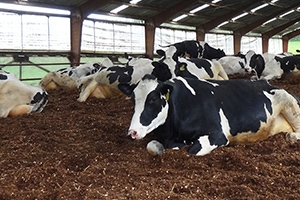
The distinguishing concept of a composting barn is that composting occurs in situ. The cows roam freely in the barn and lie on a mix of wood chips and straw, with the wood-chip component being critical.
It would be nice if the cows could be toilet trained but they can’t. So, the cows defecate and urinate directly into their beds. However, as long as there is adequate ventilation combined with daily mechanical aeration, then the beds remain dry, warm and sweet smelling.
Composting barns are not new, but it is only in the last few years that the requirements to make the system work have become better understood.
The first time I took much notice of composting barns was close on ten years ago, when I heard that Fonterra had constructed some at Hangu, the first of their China farms. From all accounts, it was less than successful. For their subsequent farms at Yutian and also at the third hub, they have gone to the tried and tested American free-stall system. It is to Yutian, rather than Hangu, where they take visitors who are lucky enough to be allowed to visit their China farms.
Knowing something of the problems at Hangu, I subsequently cautioned an international corporate client of mine in another part of the world from building composting barns. I remain cautious in relation to dairy corprorates going that way until more experience is gained, because of the need for hands-on monitoring and early recognition if something is not quite right.
Of course, that proviso of hands-on monitoring is relevant to any farm. It needs someone on-site who is passionate about making it work. A probe thermometer and moisture meter should be basic tools.
The key event that set me on the composting journey was a visit in May of this year to two composting barns in Oregon, separately owned by the Cowan and Bennett families. I was there in Oregon with a team from construction company Calder Stewart and our main focus was to learn about hybrid systems that combine barns with grazing. But as so often on such trips, the key insights came out of left field. In this case it was composting barns.
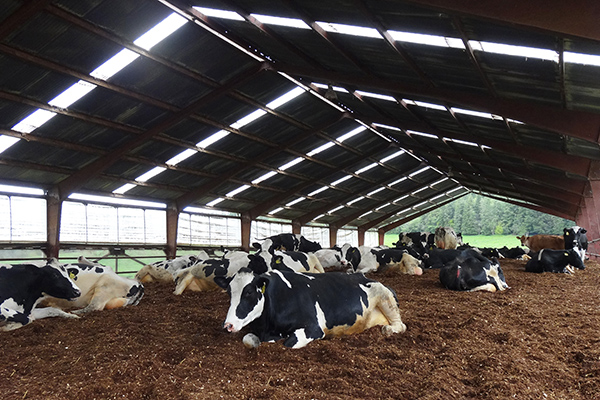
Bennett composting barn in high-rainfall Western Oregon
What I saw there were two barns that were working well. At the Bennetts farm, I saw robot-milked cows that had a post-milking choice of whether they went to a free-stall barn or a composting barn. Most were going to the composting barn. The compost was dry and sweet smelling and the cows were clean. The Bennetts described how their replacement rates and somatic cell counts had both dropped since building the compost barn.
On returning to New Zealand, I started talking to Waikato-based consultants Sue Macky and Bryan McKay about their experiences with composting barns. Bryan quickly pointed out to me that it was better to talk about ‘composting barns’ rather than ‘compost barns’. This is to reduce confusion between these and other systems where the cow poo and urine are collected, with the liquid then squeezed out, and the dry poo then used as cow bedding.
I have seen this second system working very well in the Netherlands in association with free-stall barns, and it too has potential here in New Zealand. However, it is fundamentally different to in-situ composting which is the focus of this article.
So, to avoid confusion I now use the term ‘composting’, but note much of the overseas literature still calls them ‘compost’ barns.
Sue Macky subsequently introduced me Tony Allcock who is one of her Waikato-based clients. Tony farms with his wife Fran and son Lucas, and they are now into the fourth year with a composting barn.
I arrived at the Allcock farm with cold feet on a miserable wet winter day, but after standing in the barn for a few minutes my feet warmed up nicely. That is what happens in a composting barn which is working properly.
The Allcocks’ barn is designed so that liquid can flow out of the compost and into the dairy effluent management system. In practice, there is no liquid; it all evaporates away.
I am aware of other barns where either the liquid does not evaporate, or where it evaporates but then descends in a condensation rain event. It is all about getting the design right.
Shifting to a composting barn has required a fundamental shift of farming system for the Allcocks. They have moved from a typical NZ grazing system to one where the cows spend part of every day in the barn and part grazing outside.
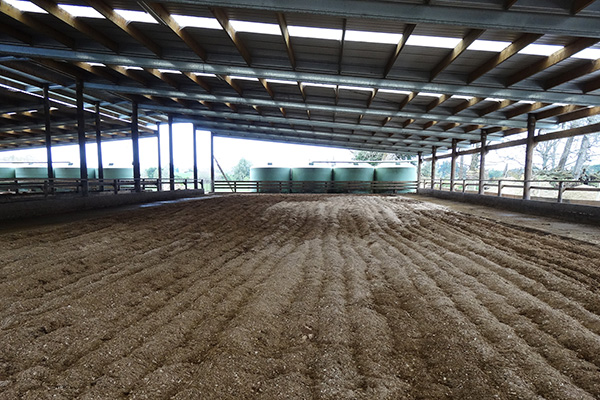
The Allcock Waikato composting barn, freshly aerated, with cows about to return from grazing
Under the old system, the production varied between 88,000 and 99,000 kg milksolids per year. Since making the change, production was 128,000 kg in the first year, 134,000 kg in the second year and 147,000 kg in the third year. The target going forward is 180,000 kg.
Nearly all of the production increase has come from higher production per cow rather than increased cow numbers. Production per cow has lifted from about 380 kg milksolids to 544 kg last year.
Tony described to me how in total they have spent $900,000 on the new system, including lots of concreting in the surrounds, and also the purchase of a feed mixer wagon and small tractor for aerating the compost. The roof structure itself is well under half the total cost.
By my calculations, the total capital spend has been $18 per additional kg of milksolids, based on last season’s production. This will drop further using this year’s increased production.
The two most important feed components are pasture and home-grown maize silage. Additional feed includes some PKE and soy, but by my calculations over 80% of the feed is produced on-farm.
I have yet to do a full economic analysis of the transition to a hybrid system comprising pasture grazing plus a composting barn. But everything I have seen so far tells me that the outcomes are triple bottom line in relation to reducing the nitrogen leaching from cow urine, being very strong on cow welfare, and also stacking up as a financial investment.
The Allcocks still farm with seasonal calving. However, 12-month milking with its increased biological feed conversion efficiency combined with off-season premiums would certainly be feasible.
In moving towards broader acceptance of composting barns, there are lots of issues to consider. Sue Macky has strong concerns that some farmers are failing to recognise the key requirements for success and in some cases are getting things horribly wrong. It can be a Kiwi trait to try and figure things out ourselves without learning from those who have gone before.
Some of the basic mistakes relate to insufficient compost area per cow, insufficient wood chips or shavings, insufficient open wall height, insufficient roof pitch, lack of roof venting, wrong placement of drinking troughs (they should be outside the composting area), and group sizes too large.
One of the issues I am currently exploring is where all the bedding is going to come from if everybody starts building composting barns. This has potential to be the greatest constraint. On-farm coppiced poplars, or other fast-growing species such as eucalypts, might be part of the way ahead. Industrial hemp also makes excellent bedding. Our research institutions need to step up and get involved.
*Keith Woodford is an independent consultant who holds honorary positions as Professor of Agri-Food Systems at Lincoln University and Senior Research Fellow at the Contemporary China Research Centre at Victoria University. His articles are archived at http://keithwoodford.wordpress.com. You can contact him directly here.

We welcome your comments below. If you are not already registered, please register to comment
Remember we welcome robust, respectful and insightful debate. We don't welcome abusive or defamatory comments and will de-register those repeatedly making such comments. Our current comment policy is here.