

Questions are being raised over whether there is any real need for the Reserve Bank (RBNZ) to tighten bank lending restrictions, effectively aimed at preventing first-home buyers from doing too much high-risk borrowing.
The RBNZ is consulting on its proposal to halve, to 10%, the portion of bank lending that’s allowed to go to owner-occupiers with deposits of less than 20%.
Currently, first-home buyers make up much of banks’ ‘high loan-to-value ratio (LVR) lending’ allowance, so will be hit hardest by the change, proposed to take effect on October 1.
While the RBNZ makes the case that first-home buyers are more at risk in the event of a property market downturn, its data suggests they aren’t putting the stability of the financial system as a whole at risk.
“If there is a compelling financial stability case, it isn't made in this [consultation] document,” Michael Reddell, who formerly held a number of senior roles at the RBNZ, wrote in his Croaking Cassandra blog.
He accused the RBNZ of being overly paternal in its attempt to save first-home buyers from themselves.
“It all just has the feel of more action for action's sake,” he said.
CoreLogic’s head of research, Nick Goodall, likewise questioned whether tightening LVR restrictions was absolutely necessary.
The data
The RBNZ acknowledges LVRs are suited to mitigating the risk of borrowers getting into negative equity - that is, a borrower leaving their bank exposed by owing it more than their house is worth.
Data provided to interest.co.nz by the RBNZ shows that of the mortgages issued in the year to July 2021, $600 million of these would be in negative equity if house prices fell by 10%.
That’s equivalent to 1% of the mortgage lending done in that year and 0.19% of the stock of all mortgage lending, valued at $315.9 billion as at July.
If house prices fell by 20%, $5.1 billion of mortgage lending done in the year to July would be in negative equity. That’s equivalent to 5% of mortgage lending done in that year, and 1.6% of all mortgage lending.
And finally, if house prices fell by 30%, $27.1 billion of mortgage lending done in the year to July would be in negative equity. That’s equivalent to 28% of mortgage lending done in that year, and 8.9% of all mortgage lending.
While Reddell noted these numbers weren’t high, the RBNZ made the case that first-home buyers would be hit much harder if house prices fell.
For example, a 10% fall would see 3% of mortgage lending to first-home buyers in the year to July in negative equity.
A 20% fall would see 22% in negative equity, and a 30% fall would see 64% of mortgage lending to first-home buyers in the year to July in negative equity.
Are banks really that exposed?
However, Goodall said there was a low likelihood of A. House prices falling by more than say 10%, B. First-home buyers being in negative equity, and C. Enough first-home buyers losing their jobs and not being supported by their banks to help them hold onto their homes to the extent this puts the banking system at risk.
Reddell said the RBNZ pointing to first-home buyers being more exposed was “hardly news”.
“The typical first-home buyer has always - at least in liberal financial systems - borrowed at least 80% of the value of the home they are purchasing. It is usually sensible and rational for them to do so (indeed 90% would often be sensible and prudent),” he said.
“If I borrowed 82% of the value of the house, the house fell in value 20%, and I lost my job and had to sell up, the loss to the bank might be not much more than 2% of the loan.”
RBNZ typically doesn’t back down
Goodall said he could see how the RBNZ could justify its proposal based on the fact the share of high-LVR lending to first-home buyers is increasing.
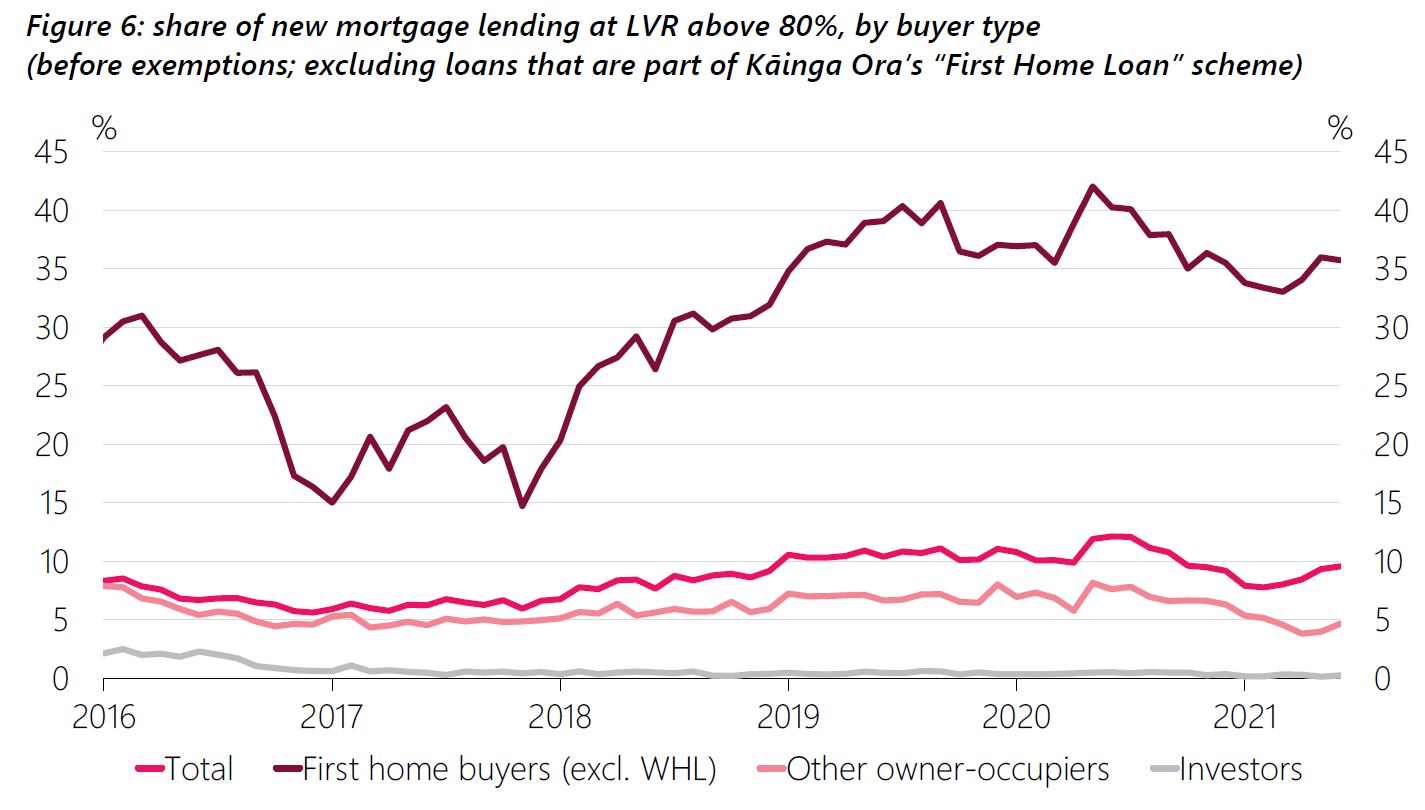
However, Goodall suspected the proposal “won’t be met with very much positivity” by submitters.
Goodall said the RBNZ typically didn’t back down.
“But you just never know, depending on how compelling the feedback is,” he said.
“There’s no doubt the RBNZ is much more concerned about where [house] prices are at than the Government is.”
Reddell maintained the RBNZ wasn’t really interested in taking feedback on board, with the change proposed to take effect less than two weeks before the two-week long consultation ends on Friday.
“With that sort of urgency and disregard for any serious bow in the direction of consultation and reflection, you'd have to assume the Bank had a compelling case for urgent action,” he said.
“But there is nothing of the sort. Instead, they are actually at pains to stress that the financial system is sound at present, so the worry is about what might happen if things went on as they are.”
Robertson comfortable
Interest.co.nz asked Finance Minister Grant Robertson whether he was comfortable with the RBNZ effectively trying to protect first-home buyers from themselves, when the data suggests they aren’t threatening the stability of the system as a whole - for now.
Robertson said the RBNZ’s job in terms of managing financial stability was an “overall systems one”.
“But they will inevitably look at particular groups, because it is important,” Robertson said.
“I think the Reserve Bank’s role is both a macro one, but also to look at individuals.”
Effect of Govt’s instructions to the RBNZ questionable
Robertson was also quick to point out that he hadn’t put the same parameters around the RBNZ using LVR restrictions as he had around it using debt-to-income restrictions.
Robertson last month agreed to give the RBNZ the ability to apply debt serviceability restrictions on banks on the proviso the RBNZ has “regard to avoiding negative impacts, as much as possible, on first-home buyers".
Nonetheless, Robertson in February issued the RBNZ with a directive, requiring it to have regard for the “Government's housing policy” when carrying out its job maintaining financial stability, including setting LVR restrictions.
The “Government’s housing policy” is to "support more sustainable house prices, including by dampening investor demand for existing housing stock, which would improve affordability for first-home buyers”.
Reddell concluded, “Perhaps the Government isn't too keen on first-home buyers being squeezed out. But at least when they are criticised for not fixing the dysfunctional over-regulated housing/land market, they can wave their hands and talk about all the things they and their agencies do, however ineffectual.
“As even the Bank notes, LVR restrictions don't make much difference to prices for long.”
For more on the RBNZ’s case for tightening LVR restrictions, see this story.
We welcome your comments below. If you are not already registered, please register to comment
Remember we welcome robust, respectful and insightful debate. We don't welcome abusive or defamatory comments and will de-register those repeatedly making such comments. Our current comment policy is here.