

The Reserve Bank (RBNZ) says our house prices are still above "sustainable levels" and a continued decline in prices "remains desirable" for long term financial stability.
The RBNZ makes these comments in its latest six-monthly Financial Stability Report.
In the report the RBNZ says house prices in New Zealand continue to decline as mortgage rates rise. Nationally, prices are down 11% from their November 2021 peak, with larger falls in Wellington and Auckland. Negative equity and mortgage servicing arrears are not widespread at present, "but will grow if prices continue to fall and as mortgages reprice to higher interest rates".
"Significantly higher unemployment would lead to further stresses among households, and is the biggest risk to financial stability at present."
Many borrowers from late 2020 to early 2021 fixed their lending at low 1-2 year rates, and are only now gradually repricing onto the much higher interest rates prevailing in the market, the central bank says.
"The value of new mortgages from 2020 and 2021 is estimated at about 40% of the current mortgage stock, with 10 percentage points of this being first-home buyers. Around half of the stock of mortgages on fixed rates is expected to reprice in 2022, increasing serviceability pressure on these borrowers."
The RBNZ says given the recent fall in house prices, the gap between the current price level and its estimates of its sustainable level has narrowed.
"However, our assessment of the sustainable level of house prices has also declined, owing to market expectations for higher long-term interest rates and historically low levels of rental yields, both of which make residential properties relatively less attractive compared to six months ago.
"In spite of the fall in prices so far, rising interest rates have meant that the debt servicing burden for new buyers remains at an historically high level.
"Furthermore the removal of tax deductibility on interest expenses substantially worsens the cash flows generated by investment properties at high levels of gearing."
The central bank says that in the near term, it expects prices to continue to fall towards more sustainable levels as the effects of higher mortgage rates feed through to declining demand for housing.
"A sharp decline from the current price level remains plausible, as the low mortgage rates that drove the recent run-up in prices reverse."
Distressed sales, which have yet to be a large factor in the current downturn, could also reinforce further price declines alongside general negative sentiment.
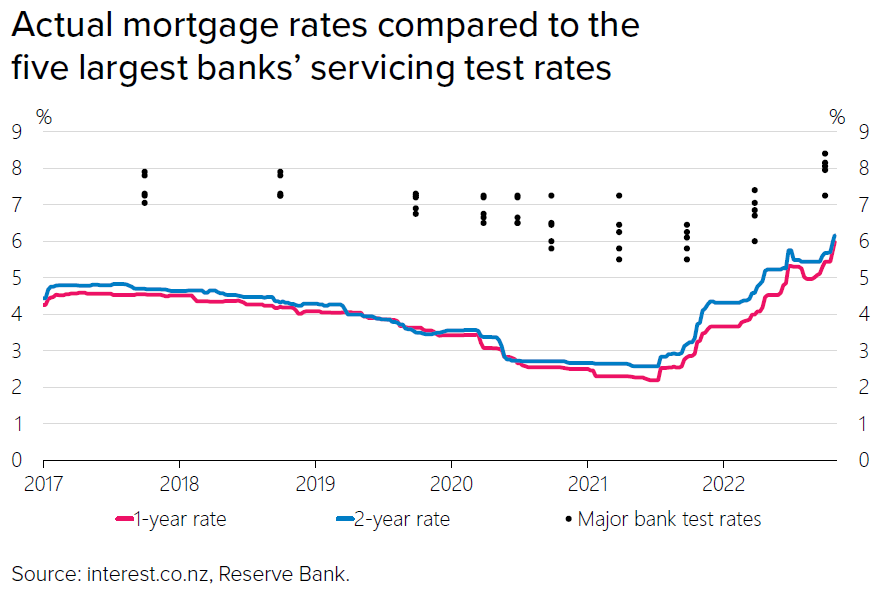
The bank estimates that at average mortgage rates of 5%, the debt servicing ratios of the majority of the 2021 borrowers would remain below 40% of their after-tax incomes. Currently offered mortgage rates of around 6% are significantly higher than a year ago, but are not expected to lead to widespread stresses for these borrowers.
"However, if mortgage rates rise significantly higher than 6%, it is likely that an increasing number of borrowers from 2021 will need to reduce discretionary parts of their consumption in order to continue to service their mortgages. First-home buyers are the most vulnerable as interest rates increase, as they tend to have lower incomes and higher LVRs on average than other owner-occupiers and investors."
The RBNZ estimates that at an interest rate of 7% around 46% of 2021’s mortgage borrowers would need to spend at least half of their after-tax income on interest payments.
Looking ahead, rising debt servicing burdens and a slowing economy will create challenges for households, the bank says.
"In situations where households are struggling to make their repayments but are still earning their usual incomes, lenders are likely to be able to provide relief in the form of term extensions or temporary interest-only periods.
"However, there will be some borrowers who find their mortgage debts to be unsustainable, and will be forced to sell their properties. A significant deterioration in labour market conditions remains a possibility, and would lead to further household debt servicing arrears and increase borrower defaults. This could contribute to fire-sale dynamics and accelerate a decline in house prices. A general reduction in consumption by households in financial difficulty would have negative flow-on effects for businesses’ revenue."
The RBNZ says the repricing of households’ mortgages from historically low levels to current interest rates will slow the volume of consumer spending, combined with declining housing wealth as house prices retreat.
"Among households with mortgages, the average percentage of disposable income dedicated to debt servicing is expected to rise from a recent low of 9% to 20%, based on current mortgage rates. Repayment increases will be particularly significant for many households that first borrowed in the past two years.
"The number of households in financial difficulty will grow as more fixed-rate mortgages reprice, and could increase significantly if mortgage rates rise materially above the servicing assessment rates of around 6% that banks applied through the pandemic period.
"The labour market continues to perform strongly, but a significant deterioration in labour market conditions would lead to household debt servicing stress. In these situations, lenders are likely to be able to provide relief in the form of term extensions or temporary interest-only periods for households unable to fully absorb the repayment increases they may be facing."
The central bank notes that the outlook for residential development has deteriorated in recent months, due to declining prices for existing houses, ongoing construction cost inflation, negative net migration, and rising interest rates. The number of new houses being sold off the plans (pre-sales) has declined "considerably".
"Since a high level of pre-sales is a prerequisite for obtaining finance from lenders, developers are potentially facing a substantial slowdown in activity once currently committed development pipelines are completed. A slowing in residential construction would weigh on broader economic activity and employment. However, continued falls in land prices could help to restore the economic viability of future development projects, limiting the extent of the downturn in building activity."
Despite the recent declines in house prices and worsening in the economic outlook, there are still few indications of widespread financial difficulties in the household sector, the RBNZ says.
The share of loans in arrears and impaired lending for owner occupiers has continued to decline in recent months, while the shares for housing investors have been broadly stable at low levels since mid-2021.
"Among the cohort of mortgage borrowers in 2020 and 2021, data from Centrix, a large credit reporting agency, indicate a pick-up in arrears on other consumer lending products from mid-2022, but a relatively low level of stress overall compared to history and other borrower groups. The currently tight labour market conditions are supporting households’ incomes and debt servicing capacity. However, a sharp increase in the unemployment rate amid a material deterioration in economic conditions could lead to widespread defaults and significant losses for the banking system."
The RBNZ says despite the limited signs of stress so far, some households remain vulnerable to falling house prices.
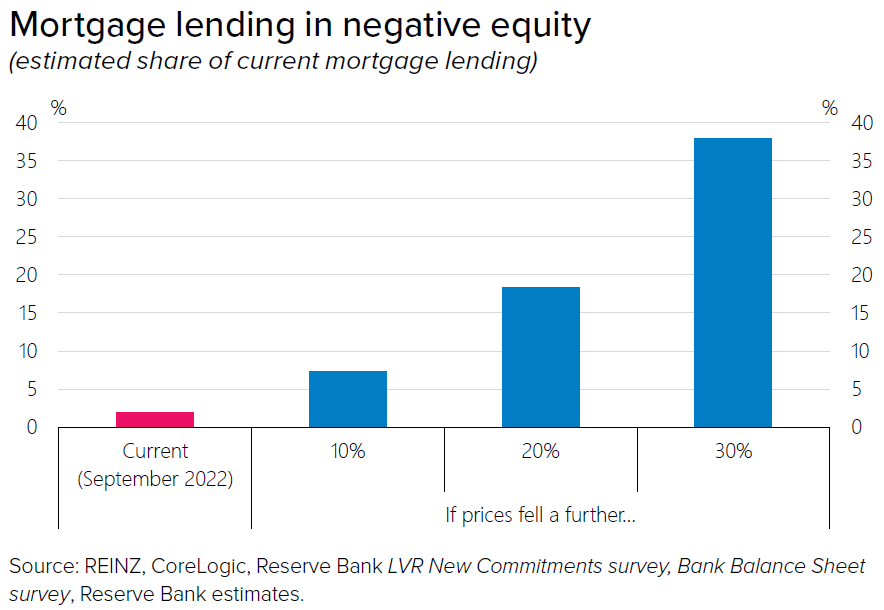
"The borrowers most exposed to negative equity are those who took out loans during the second half of 2021, particularly those at high LVRs [loan to value ratios]. Those who took out loans with high LVRs during this period are particularly exposed, as much of the equity in their properties is likely to have been eroded. At present the share of outstanding lending to borrowers in negative equity remains small, at around 2%, but it could rise considerably if prices were to fall further."
The central bank said it had recently reviewed its LVR settings and assessed the current speed limits in place on high-LVR lending as "remaining appropriate" for the time being.
"An easing in the speed limits would be considered if they were judged to be creating excessively tight lending conditions at a point when we were confident that house prices were around or below sustainable levels."
The bank said it was also continuing to consider how limits on high debt-to-income (DTI) mortgage lending could operate, and are consulting on a regulatory framework with the aim of making final decisions in early 2023.
"We do not see an immediate need to introduce high DTI limits, given the current conditions in the housing market and recent tightening banks have made to their serviceability assessments. However, DTI limits will be an important tool for managing any future build-up of financial stability risks."
Looking at the residential construction sector, the RBNZ says the housing market downturn "creates acute downside risks" for it.
"Buyer enquiries for residential pre-sales have declined heavily as the perceived risks in purchasing off-the-plans properties grows, given declining prices for existing properties and ongoing construction cost inflation. Developers have found it very difficult to meet banks’ pre-sale conditions for finance, leading to a sharp decline in the volume of viable new projects."
Like other businesses, residential developers continue to face a shortage of suitably skilled labour and high inflation in the cost of materials, and with less confidence that any cost escalation can be offset by the final price as would be the case in a rising market. Recently, inflation in the cost of materials has started to ease from high levels, as supply chain bottlenecks have diminished. The number of construction and property development company failures has picked up but remains low relative to the approximately 70,000 registered companies in the sector.
Despite the acute challenges facing the sector, the RBNZ says it has not seen a material deterioration in banks’ asset quality so far, and developers have generally been able to obtain necessary finance to complete existing projects. However...
"A deterioration in loan performance could materialise as loans reprice and firms exhaust the list of viable projects. Residential development loans are inherently high risk, although banks’ exposure to the sector is small. A widespread failure and exit of firms in the construction sector would restrain future growth in housing supply, hindering the rebalancing of house prices with their sustainable levels.
"In turn, this could lead to a future build-up of overvaluation and financial stability risks in the housing market."
This is the statement the RBNZ released with the report:
The rising global interest rates necessary to curb inflation will test New Zealand’s financial resilience, Governor Adrian Orr says in releasing the November 2022 Financial Stability Report
“While our financial system as a whole is resilient, some households and businesses will be challenged by the rising interest rate environment,” Mr Orr says. “It is important that financial institutions take a long-term view when supporting customers and allocating credit to the wider economy,” Mr Orr says.
Global supply chain disruptions, ongoing food and energy supply shocks, scarce labour resources, and the lagged effects of fiscal and monetary policy have all contributed to high inflation.
Central banks have rapidly tightened monetary settings to ensure that inflation expectations remain anchored, but the extent to which economic activity will slow remains uncertain.
There are increasing downside risks to the global economic outlook. Despite New Zealand’s high levels of employment and a sound government fiscal position, we are not immune to these risks, Deputy Governor Christian Hawkesby says.
“Rising household debt servicing costs and declining household wealth will put pressure on domestic spending in the near term, but we are confident that the financial system is well placed to support the economy,” Mr Hawkesby says.
“Banks’ capital and liquidity positions are strong, and our recent stress tests have demonstrated banks’ resilience to severe economic scenarios.”
Financial institutions will need to continue investing in their systems, governance and risk management to build their long-term resilience.
In coordination with our regulatory partners, we are committed to working with the industry to support financial stability while ensuring our priorities are risk-based, evidence-led and outcome-focused.
We welcome your comments below. If you are not already registered, please register to comment
Remember we welcome robust, respectful and insightful debate. We don't welcome abusive or defamatory comments and will de-register those repeatedly making such comments. Our current comment policy is here.