

The launch of New Zealand's Depositor Compensation Scheme (DCS) has been pushed back again, this time by about nine months to the middle of next year.
Launching the latest consultation paper in the ongoing process of establishing the DCS on Monday, the Reserve Bank said; "Once operational in mid-2025, eligible deposits will be protected up to $100,000 per customer, per deposit taker."
Last year the Reserve Bank said the DCS was expected to come into force in October 2024. And prior to that its launch had been targeted for early 2024.
"The DCS was scheduled to be operational by late 2024. Following the passage of the Deposit Takers Act near the end of the previous Parliament, the time needed to consult on important policy details and implement secondary legislation, as well as feedback received from industry on the timeframes needed to operationalise a robust customer-facing DCS, the Minister of Finance [Nicola Willis] now intends to commence the DCS by mid-2025," a Reserve Bank spokeswoman told interest.co.nz.
"We have continued to build the operationality capability to implement the DCS, and this is on track to be ready by the end of 2024. The additional six months will allow time to successfully launch the DCS to the public."
The DCS will provide protection of up to $100,000 per eligible depositor, per deposit taker in the event of deposit taker failure. It will be funded through the DCS fund, which will be raised by levies charged to deposit takers. (See all our previous stories on the DCS here, and an episode of the Of Interest Podcast on it here).
Deposit rate convergence
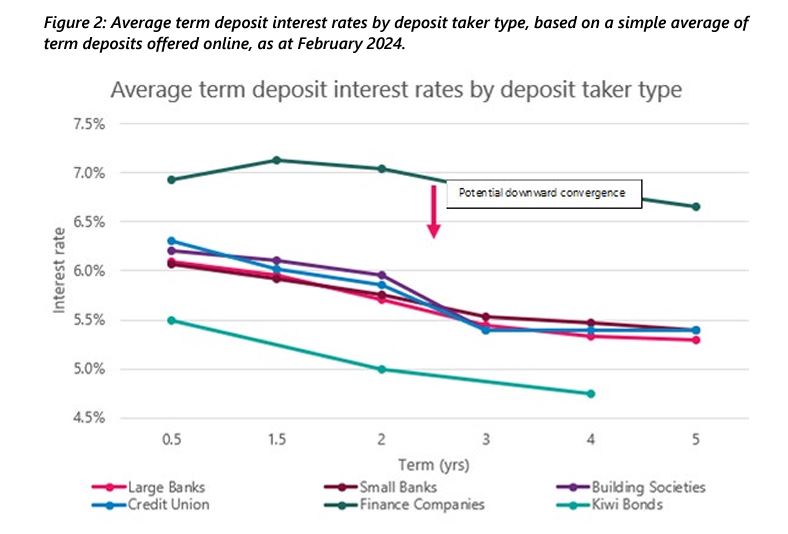
Meanwhile, in the DCS regulations consultation paper issued on Monday, the Reserve Bank says it expects "some level" of deposit rate convergence across different types of deposit takers, as the perceived risk of deposit takers who previously offered higher deposit rates falls into line with other deposit takers due to the protection available to depositors under the DCS.
"For example, interest rates offered by credit unions and building societies for term deposits are generally around 15 basis points higher than comparable rates offered by the major banks. Finance companies, by comparison, offer a much higher premium, often around 120 basis points higher than those offered by major banks. The DCS levy is expected to narrow, but not fully close, those gaps for deposit takers covered by the scheme," the Reserve Bank says.
Credit card & revolving loan funds may be included
The consultation paper also looks at the proposed scope of protected deposits and entitlement conditions. Protected deposits, as defined by the Deposit Takers Act, are NZ dollar denominated “debt securities,” and include current accounts, savings accounts and term deposits. The Act also allows other products offered by deposit takers to be included or excluded as protected deposits through regulations.
"We propose that the definition of protected deposits include credit balances [money owned by customers to be repaid by deposit takers] of specific lending products [such as] credit cards, revolving credit facilities, revolving home loans, as these can be equivalent to current accounts in substance," the Reserve Bank says.
"We also propose an entitlement condition that ensures depositors cannot be paid twice for the same deposit where funds are recovered by a liquidator."
"We propose that trusts are required to provide prescribed documents. This should support the Reserve Bank to act with certainty when making a payout."
The Reserve Bank notes almost all NZ banks provide revolving loan products including both home loans and credit facilities.
"The available funds are always on call, so they do not have to reapply when they need extra funds. From discussions with industry, we understand that a substantial proportion of revolving loan products are generally in positive balance," the Reserve Bank says.
The consultation paper cites the following example: "After 10 years a customer pays off the amount owing on their revolving home loan, then continues to use the product in credit balance. The product otherwise has the features and capabilities of a current account."
Credit cards are mainly used as a form of borrowing, the Reserve Bank acknowledges, however, credit cards can be in credit balance for various reasons, including topping up before international travel, getting a refund from a merchant, or receiving payments from others.
"Reserve Bank credit card survey data as at 30 November 2023 showed $153 million of credit balances on credit cards."
"Only credit balances on these specific borrowing products are proposed to be included in the protected deposit regulations. We do not recommend covering all borrowing products, where a credit balance may occasionally arise due to an error or an inadvertent extra payment (such as on a personal loan), as these products are unlikely to be equivalent to deposits and would be more complex to include. Note that the Deposit Takers Act specifies that debit balances (negative balances such as accounts in overdraft) are disregarded when calculating DCS entitlement," says the Reserve Bank.
Will debentures be protected deposits?
Meanwhile, the Reserve Bank says whether debentures are protected deposits is likely to be determined by whether they are readily tradeable.
"A debenture is a type of debt security between a borrower and a lender, that commonly provides the lender security over the borrower’s assets. A small group of deposit takers, primarily finance companies, commonly issue debentures to depositors. In general, depositors may treat these debentures as ordinary deposits (or be otherwise unaware of their different legal status). Whether debentures are protected deposits is therefore important to clarify."
"Whether debentures are protected deposits is likely to be determined by whether they are ‘readily tradeable’. Tradability can create uncertainty about the appropriate protected balances. For example, if half of a $200,000 balance was in the process of being transferred at the point of failure, it may not be clear if it has become a separately eligible $100,000 deposit in the hands of the new owner," the Reserve Bank says.
Section 457 of the Deposit Takers Act has more detail on what "readily tradable" means.
The Reserve Bank's seeking submissions by May 10.
*This article was first published in our email for paying subscribers. See here for more details and how to subscribe.
We welcome your comments below. If you are not already registered, please register to comment
Remember we welcome robust, respectful and insightful debate. We don't welcome abusive or defamatory comments and will de-register those repeatedly making such comments. Our current comment policy is here.