

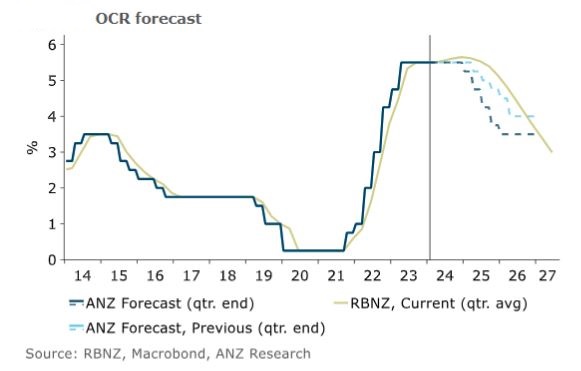
Economists at ANZ New Zealand, the country's biggest bank, have brought forward their forecast for the first in a series of Reserve Bank Official Cash Rate (OCR) cuts to February 2025 from May 2025.
"The Reserve Bank's concern about the run of higher-than-expected domestic inflation is understandable, but we expect that meaningful progress is around the corner. The real economy is very weak and given the vibe of 'soft data' - surveys, leading indicators and the like, we are now more confident in the weak economic outlook enshrined in our most recent Quarterly Economic Outlook. We've been talking for some time about the risks being tilted toward cuts starting earlier than May; we are now rebalancing the risks by moving our forecast to February," ANZ NZ's chief economist Sharon Zollner says.
The OCR's currently at 5.50%, where it has been since May 2023.
It's not the first time the ANZ economists have changed their OCR forecast this year. On January 18 they forecast "a steady sequence" of OCR cuts from August, taking the OCR to 3.5% over 12 months. Then on February 9 they changed their tune, saying they were now forecasting 25 basis points OCR increases on both February 28, and again at the Reserve Bank's April 10 review.
Following the Reserve Bank's February 28 monetary policy review, ANZ NZ's economists acknowledged; "We got this one totally wrong." However, they also said they still thought there was "a very strong chance" the next OCR move would be up rather than down. Nonetheless, they "reluctantly parked" their call for a higher OCR "back in the risk basket, and instead pushed out cuts to mid-2025." This subsequently became a more specific forecast for the first cut in May next year.
'That should do it'
Zollner says before cutting the OCR, the Reserve Bank needs to not only be confident that consumers price index (CPI) inflation is on its way to 2%, but that it can be reasonably expected to then stay within its 1% to 3% target band.
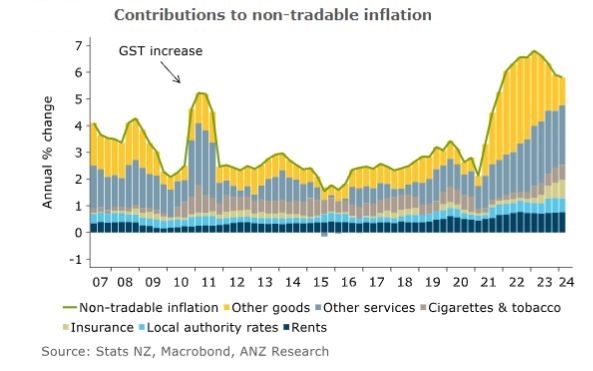
"Various combinations of activity and inflation outcomes could meet those criteria. But by February next year, we are anticipating that the Reserve Bank will have seen fourth quarter CPI inflation at 2.6% year-on-year, [with] non-tradable [inflation] still 4.7% year-on-year, but we are forecasting it to drop sub-4% the following quarter, and unemployment [to rise] through 5%. That should do it, in our view," Zollner says.
The March year CPI was 4%, Statistics NZ said, with the unemployment rate at 4.3%, or 134,000 people. Annual non-tradeable inflation, being inflation from domestic goods and services including rent, council rates, construction, cigarettes & tobacco and insurance, was running at 5.8%, with tradeable inflation, including imported goods such as petrol, at just 1.6%.
The ANZ NZ economists note the housing market "is currently moribund." ANZ NZ is the country's biggest housing lender with exposure of $107.5 billion at March 31.
"Beyond February, we have simply pencilled a 25 basis points cut at each [Reserve Bank monetary policy] meeting. The speed of cutting is not something we have a strong view on at present. Our forecast cuts stop with the OCR at 3.5%, i.e. neutral or thereabouts. Obviously if things really unravel the Reserve Bank is likely to be cutting much more quickly, and on the other side, if inflation doesn’t get all the way to 2%, or bounces meaningfully, cuts may come more slowly or cease," says Zollner.
The neutral OCR is the level at which it's deemed to neither stimulate nor constrain the economy. The Reserve Bank currently puts this at 2.75%.
"In terms of the risks around where rates ultimately settle, noting of course than in practice equilibrium is a purely theoretical construct, to the upside we’re mindful that sticky global inflation could mean it takes higher average interest rates to keep CPI inflation as low as it has been in the past. Conversely, we’re mindful that a negative economic shock could come along, necessitating an OCR well below neutral for a time," Zollner says.
The Reserve Bank itself isn't forecasting an OCR cut until August next year. Financial markets have a cut priced in for November this year. The Reserve Bank is scheduled to next review the OCR on July 10.
Meanwhile, on Thursday Infometrics' chief forecaster Gareth Kiernan changed his forecast for a first OCR cut to February next year from November this year.
"Although we don’t think a further delay in beginning to cut the OCR is necessarily the right move, the [Reserve] Bank’s backward-looking approach to setting monetary policy means that households and businesses will need to wait longer for any interest rate relief," Kiernan.
We welcome your comments below. If you are not already registered, please register to comment
Remember we welcome robust, respectful and insightful debate. We don't welcome abusive or defamatory comments and will de-register those repeatedly making such comments. Our current comment policy is here.