
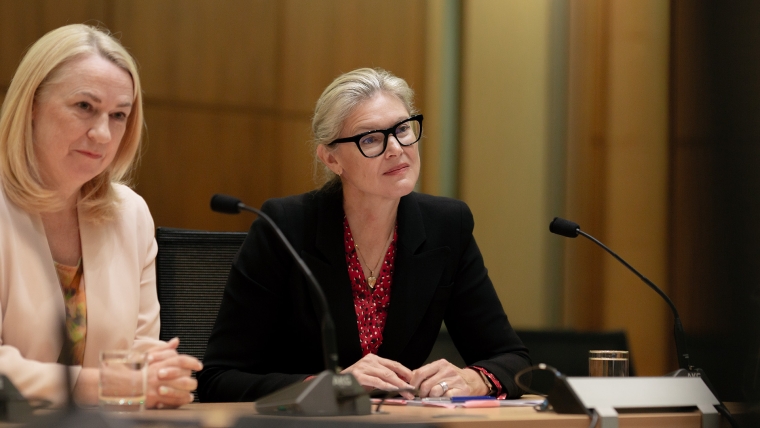
ASB Chief Executive Vittoria Shortt says the big banks are seeing a surge of competition from specialised providers that offer competing products in targeted areas.
Rabobank competes in rural lending, Kiwibank in consumer lending. Sharesies competes with their savings and wealth creation products, buy now pay later in consumer lending, and Apple is challenging payments.
“Every part of the competitive landscape that I look across has got a very different set of competitors, and I think that's fundamentally changing the landscape of competition in this country,” she told Parliament’s Finance and Expenditure Committee (FEC).
“Those competitors I've just mentioned, they're not small, they are material. Rabo is material in rural [banking]; Kiwibank has over a million customers, and buy-now-pay-later has had a material impact on unsecured lending”.
Parliament has been conducting an inquiry into banking competition and profitability, with a focus on rural lending, following a Commerce Commission market study.
The Commission's final report noted the big four banks - ANZ, ASB, BNZ and Westpac - have high and largely stable market shares, holding 85% to 90% of the assets of all registered banks in New Zealand.
While the Government works on implementing the Commission’s recommendations, the FEC has been grilling bank bosses in hearings which sometimes stray towards populism.
A big effort has been made to highlight the large salaries of the chief executives. Shortt was on a $1.2 million base rate, plus bonuses which brought her up to $5.2 million during the 2024 fiscal year.
During an earlier hearing, ANZ chief executive Antonia Watson told the Committee she couldn’t easily summarise her total compensation package but earned $2 million in cash.
Committee members have also pushed for the bank leaders to say their nominal profits out loud, as they are big numbers: $1.364 billion for ASB and $2.135 billion for ANZ.
When asked how that level of profitability was justifiable, ASB chair Therese Walsh—a friend and former colleague of Prime Minister Christopher Luxon—said that was the rate of return required by overseas investors in exchange for capital.
Shortt said about half profit was paid out to shareholders as dividends and the rest was used to develop new products or as capital to support more lending.
In regards to competition, Walsh agreed there was growing pressure from tech businesses looking to capture market share in specific areas of banking.
“The biggest of all is yet to come. If you look around the world it is big tech that is coming in and fundamentally changing banking,” she said.
Apple and Google both have high-profile payment offerings. Apple has taken it one step further and offered users a high-yield savings account.
Amazon also has payments and does small business lending to retailers using its marketplace, Facebook has trialed offering small business loans in developing countries through WhatsApp.
Walsh said it was important for regulators to ensure there was an even playing field that didn’t give big foreign nationals, like Apple and Google, an unfair advantage in the sector.
“We are concerned that … these new entrants will come in and only be interested in the profit pool they perceive as favourable and not deliver all the banking services to all New Zealanders”.
“And secondly, that they are not required to fully participate in New Zealand society; pay taxes, employ people, meet the rules and regulations, etcetera”.
We welcome your comments below. If you are not already registered, please register to comment
Remember we welcome robust, respectful and insightful debate. We don't welcome abusive or defamatory comments and will de-register those repeatedly making such comments. Our current comment policy is here.