
By Raf Manji*
The current challenges to the established financial architecture are not unique to this moment in time, but rather a cycle that has repeated itself throughout history. The question facing us today is what form will the system take when the chips finally settle?
Trade, finance, and war have always travelled together. The Dutch East India Company issued the world's first shares and maintained a standing army. The British East India Company began as a trading monopoly and became the instrument of imperial expansion across Asia.
When Britain tried to force the American colonies to bear the cost of their own military defence through the Currency, Stamp, and Sugar Acts of the 1760s, banning colonial paper money and imposing monetary dependence on London, the result was revolution. The first successful challenge to a dominant power's monetary hegemony was not fought with financial instruments. It was fought with muskets.
That pattern of dominant powers extracting monetary privilege and challengers building alternative institutions has repeated itself across three centuries. We are living through its latest iteration.
The architecture that shaped 80 years
In August 1944, as World War II ground towards its conclusion, economists and finance ministers gathered at Bretton Woods, New Hampshire, to design a new global financial order. The British economist John Maynard Keynes proposed an international clearing union — a system with automatic stabilisers that would penalise surplus countries as much as deficit ones, preventing the accumulation of the kind of imbalances that had helped cause two world wars. The American negotiator Harry Dexter White proposed something different: a dollar-centred system, with the US currency pegged to gold and all other currencies pegged to the dollar.
White won. The US gained what French Finance Minister Valéry Giscard d'Estaing would later call an "exorbitant privilege"; namely the ability to run deficits, borrow cheaply, and export inflation to the rest of the world. The IMF and World Bank were created with quota structures that reflected 1944 power realities. Those structures are largely unchanged today.
The system's central design flaw, which was identified by economist Robert Triffin, was built in from the start: supplying the world's reserve currency requires running deficits that ultimately undermine confidence in it. That tension has driven every major rupture since.
Three shocks
The Nixon Shock of 1971 was the first rupture. Facing the fiscal costs of Vietnam and depleting gold reserves, President Richard Nixon unilaterally suspended dollar-gold convertibility. The Bretton Woods fixed exchange rate system collapsed. Oil producers, who priced in dollars, faced immediate revenue losses and as such the OPEC embargo followed within two years. By 1980, the US Federal Reserve funds rate had reached 22.5% in an attempt to contain the resulting inflation. The dollar was massively overvalued, and American manufacturers were struggling.
The Plaza Accord of 1985 was the response and a different kind of moment. Rather than acting alone, the US convened the finance ministers of Japan, Germany, France, and the United Kingdom at the Plaza Hotel in New York. They agreed to jointly depreciate the dollar. It worked, almost too well: the subsequent Louvre Accord of 1987 was needed to halt the slide. The Plaza model of coordinated multilateral management of global imbalances became the operating system for the next forty years. Serial crises followed (the Asian Financial Crisis, the Russian default, the Global Financial Crisis, Covid) but the multilateral framework held. The G7 coordinated, the IMF intervened, the Fed extended swap lines.
The Trump Shock of 2025 ended that era. "Liberation Day" on April 2, 2025 saw the announcement of sweeping unilateral tariffs, with peak rates on Chinese imports reaching approximately 145%. The structural parallel with 1971 is exact: as Nixon unilaterally abandoned the gold peg, Trump has unilaterally abandoned the multilateral operating system built since 1985. The G7 has been sidelined. The WTO is bypassed. The Mar-a-Lago Accord framework — tariffs, dollar devaluation, and the prospect of Treasury bond restructuring — is the new US playbook, played without consultation.
Three gaps
What the Trump Shock has exposed is a structural gap in the global financial architecture; that there are three problems that now have no clear owner.
The first is liquidity. US debt is on a trajectory from 100% of GDP today to a projected 120% by 2035, or even potentially higher. Foreign central banks are diversifying their reserves; gold is at record highs. More fundamentally, the weaponisation of the dollar system seen through America's use of economic statecraft in the exclusion of Russia from SWIFT and the freezing of sovereign reserves has demonstrated that access to dollar infrastructure is a political variable. US Treasuries can no longer be considered the world's unambiguous safe asset. That sentence would have seemed absurd a decade ago.
The second gap is institutional legitimacy. The IMF's quota structure still reflects 1944. Despite the 16th General Review of Quotas in 2023, relative shares were unchanged. China's IMF quota stands at 6.4% against an economy that represents approximately 18% of global GDP. The BRICS grouping, now accounting for around 40% of global GDP but remains structurally under-represented in the institutions that govern international finance.
The third gap is payment infrastructure governance. Since 2022, restrictions on dollar system access have created sustained demand for alternatives. China has built technically credible options: the Cross-Border Interbank Payment System (CIPS) wholesale settlement network processed ¥175 trillion in 2024, up 43% year-on-year, covering 189 countries. The e-CNY has processed over ¥16.7 trillion in transactions. The mBridge multi-CBDC platform, developed with the Bank for International Settlements (BIS) and the central banks of the UAE, Saudi Arabia, Hong Kong, and Thailand, has now settled $55.5 billion which is 2,500 times the volume of its early pilots. The plumbing exists. What is missing is a governance framework to make it work for the system as a whole.
Enter the Dragon
China is the only state with the capacity to help fill these gaps and the central reason they have not yet been filled.
The People's Bank of China (PBOC) Governor Pan Gongsheng has stated clearly that China does not seek competitive devaluation and that greater RMB internationalisation is a long-term objective. The 15th Five-Year Plan, approved in March 2026, explicitly identifies building a "financial powerhouse" as a national strategic priority, the first time finance has featured so prominently in the planning framework. These are significant signals.
Yet RMB accounts for just 1.93% of global foreign exchange reserves and 3% of SWIFT payment flows. The gap between the infrastructure China has built and the currency trust it has accumulated is the defining tension. Infrastructure can be built in years. Reserve currency trust is accumulated over decades and requires full capital account convertibility, deep and open financial markets, and institutional credibility that Beijing has not yet provided.
The choice
Pan Gongsheng's own framework for reform points in the right direction: IMF quota reform to reflect current economic weight; expanded use of Special Drawing Rights as a more neutral basis for global liquidity; integration of CIPS and mBridge within BIS payment standards rather than as parallel infrastructure; and the RMB as a reserve diversifier rather than a dollar replacement.
This choice of engaging constructively in designing the system that comes next, shaping the rules rather than inheriting them can be termed the co-architect path. The alternative is the fragmentation path: a dollar bloc and an RMB bloc, parallel settlement systems, competing development finance channels, and a world in which countries, particularly in the Global South, bear the costs of a system designed around geopolitical competition rather than economic efficiency.
History offers a clear pattern. Every major rupture in the global financial system has required a new source of liquidity, institutional innovation, and political will to stabilise it. In 1944 it was the United States. The current moment is no different.
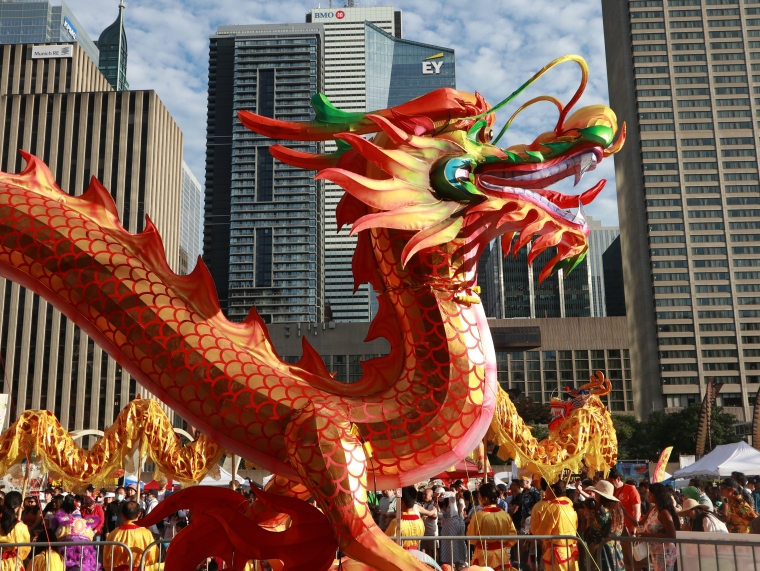
The dragon has entered the room. The architecture of what comes next will be shaped by what it chooses to do.
*Raf Manji is Principal Research Fellow at the Institute for Indo-Pacific Affairs (IIPA) and a former non-resident Senior Fellow at the Asia New Zealand Foundation. He is an experienced policy professional with a background in global markets, social enterprise, non-profits, and local and central government. This article was first published in Kwentuhan, an IIPA journal, and is used with permission.
We welcome your comments below. If you are not already registered, please register to comment
Remember we welcome robust, respectful and insightful debate. We don't welcome abusive or defamatory comments and will de-register those repeatedly making such comments. Our current comment policy is here.