
Governor Adrian Orr says the Reserve Bank plans to impose capital standards on banks that match the public’s risk tolerance.
"We have been reassessing the capital level in the banking sector that minimises the cost to society of a bank failure, while ensuring the banking system remains profitable," Orr told a Business NZ CEO Forum in Auckland on Friday.
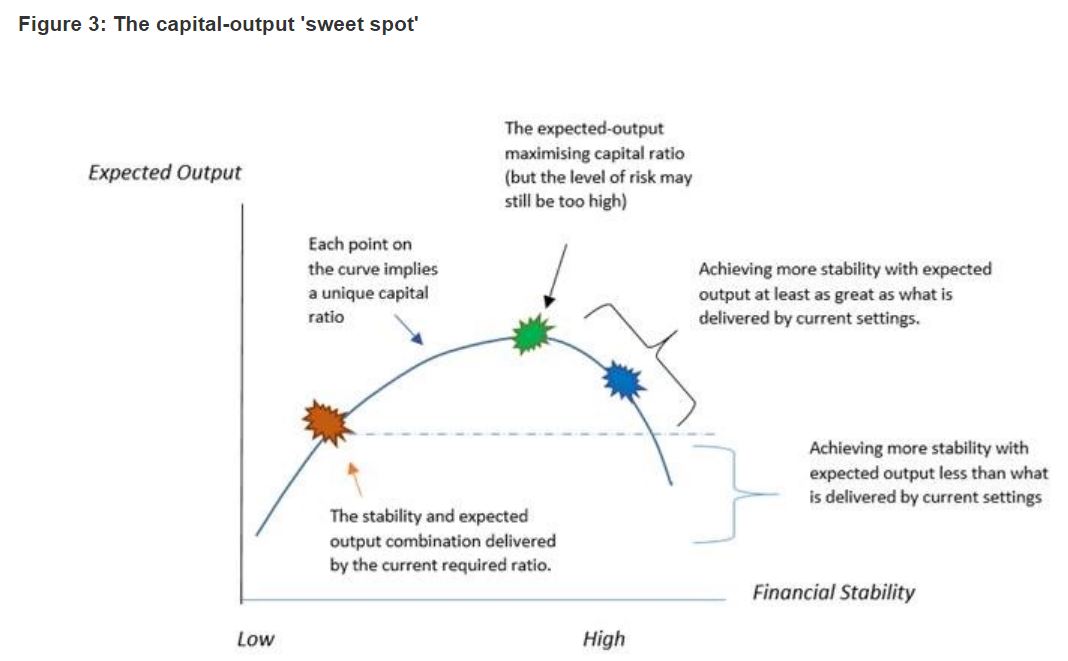
"The stylised diagram in Figure 3 [below] highlights where we have got to. Our assessment is that we can improve the soundness of the New Zealand banking system with additional capital with no trade-off to efficiency," said Orr.
"In making this assessment, our recent work makes the explicit assumption that New Zealand is not prepared to tolerate a system-wide banking crisis more than once every 200 years. We have calibrated our ‘sweet spot’ thinking about economic ‘output’ and financial stability benefits."
'We need to hear a broader perspective'
Orr went on to say that the Reserve Bank is tasked with ensuring the banking system is sound and efficient. The most important tool to do this is ensuring banks hold sufficient capital, or equity, to be able to absorb unanticipated events. The level of capital reflects the bank owners’ commitment, or skin in the game, to ensure they can operate in all business conditions, bringing public confidence, said Orr.
"Given its importance, we have been undertaking a review of the optimal level of capital for the New Zealand system. We conclude that more capital is better. We are sharing our work with the banking sector and public, and expect to hear one side of the story loud and clear, that capital costs banks. We need to hear a broader perspective than that, to best reflect New Zealand’s risk appetite."
"The Reserve Bank needs to ensure there is sufficient capital in the banking 'system' to match the public’s 'risk tolerance.' This is because it is the New Zealand public - both current and future citizens - who would bear the social brunt of a banking mess," added Orr.
"We know one thing for sure, the public’s risk tolerance will be less than bank owners’ risk tolerance. How do we know this? Surely the more capital a bank has the safer it is and the more it can lend. Why don’t banks hold as much capital as they can?"
"First, there is cost associated with holding capital, being what the capital could earn if it was invested elsewhere. Second, bank owners can earn a greater return on their investment by using less of their own money and borrowing more - leverage. And, the most a bank owner can lose is their capital. The wider public loses a lot more."
"Hence, we need to impose capital standards on banks that matches the public’s risk tolerance," said Orr.
'Bank failures happen more often and can be more devastating than bank owners & credit ratings agencies tend to remember'
Orr went on to say existing capital levels are based on international standards, and thus aren't optimal for any one country.
"The standards are also a minimum. There is a clear expectation that individual countries tailor the standards to their financial system’s needs. Banks also hold more capital than their regulatory minimums, to achieve a credit rating to do business. The ratings agencies are fallible however, given they operate with as much ‘art’ as ‘science’," said Orr.
"Bank failures also happen more often and can be more devastating than bank owners – and credit ratings agencies – tend to remember. The costs are spread across the public and through time."
"Many large banks are foreign owned – especially in New Zealand. Their ‘parents’ are subject to capital requirements in their home and host country. This creates continuous tension as to who gets the lion’s share of capital and failure management support. It would be naïve to expect a foreign taxpayer to bail out a domestic banking crisis," Orr added.
"Hence, New Zealand needs to assess its own risk tolerance, and decide who pays to clean up any mess and the scale of that mess."
"A word of caution. Output or GDP are glib proxies for economic wellbeing – the end goal of our economic policy purpose. When confronted with widespread unemployment, falling wages, collapsing house prices, and many other manifestations of a banking crisis, wellbeing is threatened. Much recent literature suggests a loss of confidence is one cause of societal ills such as poor mental and physical health, and a loss of social cohesion. If we believe we can tolerate bank system failures more frequently than once-every-200 years, then this must be an explicit decision made with full understanding of the consequences," said Orr.
Widest ranging review of bank capital requirements
His speech follows the release of the Reserve Bank's latest Financial Stability Report on Wednesday, where Orr said bank capital is the number one safety valve for the citizens of a country.
The Reserve Bank will release a consultation paper on minimum bank capital ratios in December. This is the final part of the widest ranging review of bank capital requirements the Reserve Bank has ever undertaken, which began early last year. (There's more information here).
In an "in principle" decision announced in July, the Reserve Bank said the big four banks will now have to calculate capital under both the internal model and standardised approaches, and publish both sets of results, rather than just use the internal models approach that allows them to set their own models for measuring risk exposure which they must then get approved by the Reserve Bank. All other banks use the standardised approach for measuring credit risk, through which their credit risk weights are prescribed by the Reserve Bank and are higher than those of the big four banks.
The big four banks - ANZ, ASB, BNZ and Westpac, using the internal models, or internal ratings based, approach means credit risk weights calculated using it account for about 86% of NZ bank lending.
Another in principle decision the Reserve Bank has made during the capital review is to ban contingent debt from qualifying as regulatory capital.
The chart below covers key NZ retail banks at September 30
| Bank | Total capital | Gross loans |
| ANZ | $11.858 billion | $127.058 billion |
| ASB | $7.882 billion | $83.983 billion |
| BNZ | $8.763 billion | $83.682 billion |
| Co-operative Bank | $216 million | $2.386 billion |
| Heartland Bank | $570 million | $4.148 billion |
| Kiwibank | $1.680 billion | $18.789 billion |
| Rabobank | $1.545 billion | $10.387 billion |
| SBS Bank | $341 million | $3.876 billion |
| TSB Bank | $626 million | $5.558 billion |
| Westpac | $8.925 billion | $80.515 billion |
The chart below comes from Wednesday's Financial Stability Report

Note, CET1 is common equity tier one capital. Tier 2 is tier two capital, tier 1 is tier one capital, and AT1 is additional tier one capital.
The video below comes from the RBNZ
We welcome your comments below. If you are not already registered, please register to comment
Remember we welcome robust, respectful and insightful debate. We don't welcome abusive or defamatory comments and will de-register those repeatedly making such comments. Our current comment policy is here.