
By Jenée Tibshraeny
The Reserve Bank (RBNZ) has been making the case it’s still getting bang for its buck cutting the Official Cash Rate (OCR) further into record-low territory.
Now, it's released a brief summary of some of the modelling done to support this position.
Its analysis found the impact of OCR changes on both inflation and GDP growth have been “relatively stable” over the last 12 years.
So from the global financial crisis and through the recovery, inflation and economic growth haven’t really responded differently to interest rate changes.
The RBNZ is of the view that the same will be the case looking to the future, even though it's in unchartered territory with the OCR now at just 1%.
The RBNZ drew its conclusion by using three models that try to isolate the effects of an OCR cut from the other moving parts in the economy. This is what it found (the three lines represent the three models):
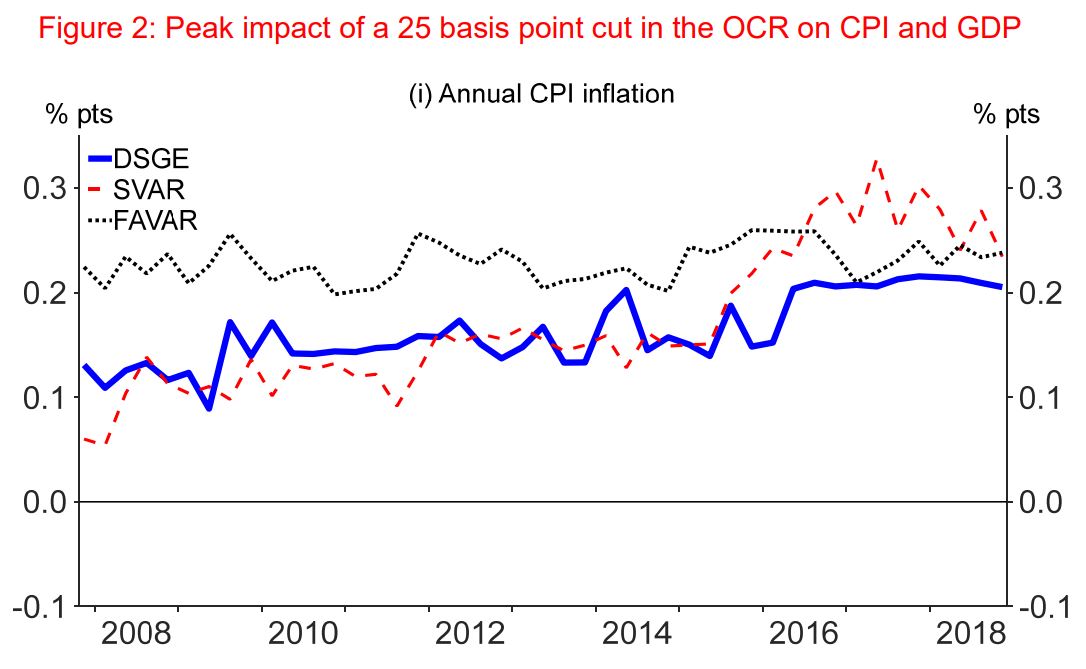
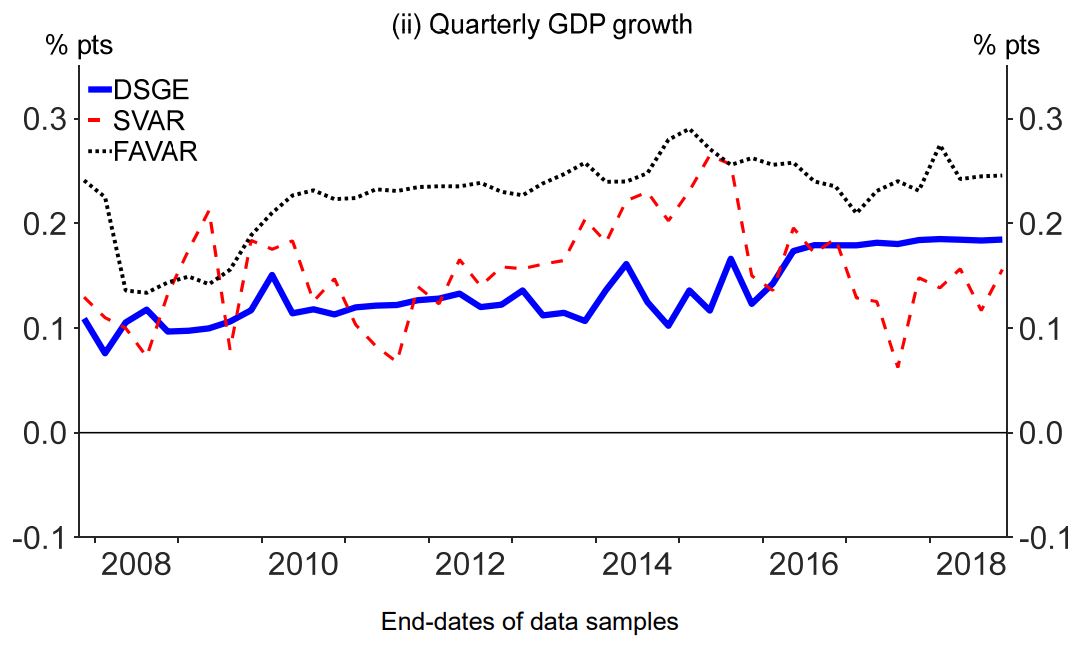
Averaging its results, the RBNZ found a 25-basis point OCR cut had a “peak impact” on annual CPI inflation of 0.19 percentage points, on average.
In other words, cutting the OCR by 25 basis points boosted annual inflation by an average of 0.19 percentage points across the time period examined.
A 25-basis point OCR cut had a peak impact on quarterly GDP growth of 0.17 percentage points on average.
With results being relatively stable across time and methodologies, the RBNZ concluded that “the transmission of monetary policy shocks has not changed significantly in New Zealand over the last 12 years. There is no sign that OCR moves have become less effective in recent years…
“This means it is business as usual for the Bank - further cuts in the OCR should boost the economy and inflation, and OCR increases should constrain demand and inflation.
“The significant knowledge and experience we have built up during the inflation targeting era can still be used to guide our monetary policy strategy and achieve our goals of price stability and supporting maximum sustainable employment.”
The quality of the data the RBNZ had access to made it difficult for it to extend its analysis over a longer timeframe, including a wider range of economic conditions.
In more technical terms, the RBNZ explained its approach: “We use an ‘expanding window’ estimation method in order to verify if the transmission of monetary policy shocks to inflation and economic activity has changed through time.
“We first estimate each model on data spanning the first quarter of 1993 to the last quarter of 2007, just before the GFC. At this point, we assess what the model implies about the effect of a 25-basis point cut in the OCR on inflation and output.
“We then repeat this process, adding an additional quarter of information up until the end of 2018.”
For more on the RBNZ’s thinking behind cutting the OCR to 1% on August 7, see this interview interest.co.nz did with its chief economist, and this piece and this one written following the announcement.
*This article was first published in our email for paying subscribers. See here for more details and how to subscribe.

We welcome your comments below. If you are not already registered, please register to comment
Remember we welcome robust, respectful and insightful debate. We don't welcome abusive or defamatory comments and will de-register those repeatedly making such comments. Our current comment policy is here.