
Summary
Fed hikes 50 basis points, QT (quantitative tightening) to start 1 June, Powell suggests 50bps hikes over the next couple of meetings
• Market reacts to Fed Chairman Jerome Powell ruling out 75bps hike increments; US 2-year rate down significantly, curve steepens
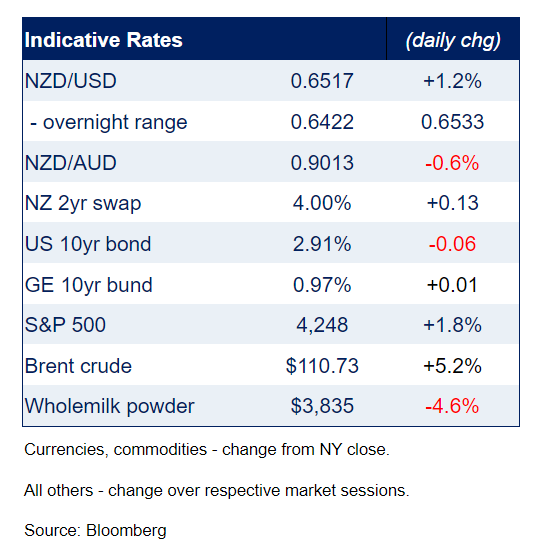
• Broad based fall in USD; NZD up through 0.65 but underperforms AUD; cross near 0.90
• Oil prices up 5% on increased chance of EU banning Russian oil
• NZ rates up to fresh highs, driven up by higher Australian yields
Good Morning
There was no surprise in the Fed’s 50bps hike, plans for further hikes, or plans for quantitative tightening but the market has reacted to Chair Powell’s comment that seemed to rule out hike steps of 75bps. The US yield curve has steepened on that, with a large fall in the 2-year rate, while the 10-year rate is down 6bps to 2.91%. The USD has broadly weakened, seeing the NZD back up through 0.65. AUD outperformance has seen NZD/AUD almost break below 0.90.
As widely expected, the FOMC raised it policy rate by 50bps taking the target range for the Fed Funds rate to 0.75% to 1% and repeated the line that ongoing increases in the target range will be appropriate. The news was the timing of the beginning of quantitative tightening, with 1 June chosen as the date for reducing the size of the balance sheet. For Treasuries, the cap would be set at $30b per month, rising to $60b per month after three months. For agency debt and MBSs, the cap would begin at $17.5b per month, before lifting to $35b. The aggregate $95b per month cap metric was in line with previous guidance.
The statement acknowledged the fall in GDP in Q1 but noted household spending and business investment remained strong. The war in Ukraine was seen as creating additional upward pressure on inflation and likely to weigh on economic activity. It also noted that the COVID-related lockdowns in China were likely to exacerbate supply chain disruptions. In a hawkish comment, the statement said “the committee is highly attentive to inflation risks”.
Chair Powell’s press conference opened with some hawkish comments. He said that inflation is much too high, underlying momentum in the economy remains strong and labour demand is very strong. He said that the FOMC sees 50bps hikes on the table for the next couple of meetings.
The messaging reinforced market expectations that the Fed would front-load the tightening cycle with 50bps hikes. The market has priced a series of 50bps hikes over coming meetings. The market has entertained some chance of an even larger 75bps move, but Powell said that 75bps isn’t something the FOMC is actively considering. Rates fell significantly after that comment. As we go to print, the 2-year rate is down 12bps for the day and the 10-year rate is down 6bps to 2.91%.
US equity markets were choppy leading up to the FOMC announcement, moving in and out of positive territory and remained choppy after the announcement. The S&P500 shows gains of over 1½% as we go to print.
Powell’s ruling out of 75bps hikes has seen the USD weaken across the board, with the BBDXY index showing a chunky fall of 0.8% for the day. The NZD has broken up through the 0.65 mark, the AUD is up through 0.72 and EUR is up through 1.06. The AUD has outperformed in the afterglow of Tuesday’s hawkish RBA policy update which has since seen the 3-year bond rate rise by some 22bps as the market prices in a more aggressive, front-loaded tightening cycle. On AUD outperformance, NZD/AUD has traded as low as 0.9002.
In other news, the EU plans to ban Russian crude oil over the next six months, refined fuels by the end of the year and bar European ships from transporting Russian petroleum products. Sources suggest that Hungary and Slovakia, who are more reliant on Russian oil, will be granted a longer timeframe, through to the end of next year. All 27 EU members will need to agree for the plan to progress. If agreed, the question then becomes what will Russia’s response be, and a cut in the EU gas supply would be highly problematic for the region next winter. Oil prices are up about 5%, as the market digested the increasing chance of the EU oil ban.
In key data overnight, the US services ISM index fell 1.2pts to 57.1 in April against expectations for a small lift. Like the manufacturing version released earlier this week, supply chain issues and inflationary pressures remained intense. The employment index fell 4.5pts to 49.5, as much a reflection of the difficulty in finding staff than weaker labour demand. Separately, the change in ADP private payrolls for Apr was weaker than expected at 247k, but that shouldn’t change expectations for nonfarm payrolls at the end of the week, given its recent patchy track record of predicting that figure.
NZ labour market were not surprising, continuing to highlight a very tight labour market, with the unemployment rate steady at 3.2% and annual wage inflation continuing to push higher, at 5.3% y/y for QES private sector average hourly earnings and 3.1% y/y for the private sector labour cost index – the latter too high for comfort for a central bank that would rather see it closer to 2%. The data reinforced expectations for a rapid move higher in the OCR, with the next hike in three weeks likely to be another 50bps increment.
The domestic rates market saw a strong lift in yields, given the force of much higher Australian rates that followed the hawkish RBA policy update. At the risk of sounding like a broken record, rates lifted to fresh multi-year highs. The 10-year NZGB rose 10bps to 3.81%, outperforming the swaps market, which saw a 15bps lift in the 10-year rate to 4.13%. Short end rates were also affected, with the 2-year swap rate up 13bps to 4.0%. The terminal OCR priced has risen to about 4.25%, which we think embodies a significant risk premium in a heavy one-sided market than representing market expectations of where the OCR will ultimately settle.
The key event in the day ahead is the Bank of England’s policy update, with almost economists picking a 25bps hike in Bank Rate to 1.0%. More interest will lie in the policy guidance, given that previous guidance was softened to further hikes “might” be needed, even though headline inflation is on the verge of breaking 9 or 10% on a surge in household energy costs. Some on MPS worry that the cost of living crisis could drive the economy into recession, and the case for further rate hikes need to be judged in that context.
Events Round-Up
NZ: Unemployment rate (%), Q1: 3.2 vs. 3.2 exp.
NZ: Employment change (q/q%), Q1: 0.1 vs. 0.1 exp.
NZ: QES avg hrly earnings (q/q%), Q1: 1.9 vs. 1.2 exp.
NZ: LCI pvt wages ex o-time (q/q%), Q1: 0.7 vs. 0.7 exp.
AU: Retail sales (m/m%), Mar: 1.6 vs. 0.5 exp.
AU: Home loans value (m/m%), Mar: 1.6 vs. -1.9 exp.
US: ADP employment change, Apr: 247 vs. 385 exp.
US: Trade balance ($b), Mar: 109.8 vs. -107.1 exp.
US: ISM services index, Apr: 57.1 vs. 58.5 exp.
US: FOMC Fed Funds (upper%), May: 1.0 vs. 1.0 exp.
*Jason Wong is Senior Markets Strategist at BNZ. BNZ's full Markets Today report is here.
David Chaston is away on holiday.
We welcome your comments below. If you are not already registered, please register to comment
Remember we welcome robust, respectful and insightful debate. We don't welcome abusive or defamatory comments and will de-register those repeatedly making such comments. Our current comment policy is here.