

S&P Global Ratings says New Zealand public debt remains low but local councils have insufficient revenue to raise funding for their infrastructure responsibilities.
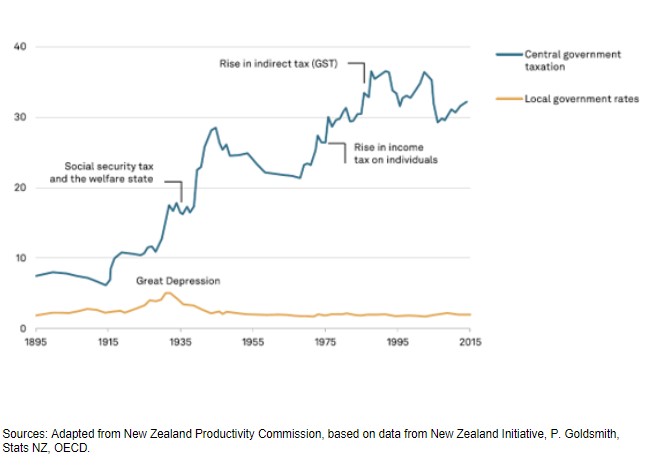
In a webinar the credit rating agency shared a chart in its presentation slides showing local government rates had not increased, as a percentage of the economy, in the past 100 years.
Meanwhile, central government taxation had risen from below 10% of gross domestic product in the early 1900s to over 30% today.
NZ councils’ debt levels are already much higher than similarly rated peers in Northern European countries—at about 180% of revenue—and more investment is needed.
Martin Foo, an analyst at S&P Ratings, said councils had been “increasingly burdened” with new central government standards such as drinking water quality and earthquake resilience.
These additional costs had not been matched by financial support or financing tools, besides a few contestable grant schemes.
“A lot of these costs are being passed down without matching funding tools or without matching revenue,” Foo said on Thursday.
“That’s leaving councilors with uncomfortable decisions to make about whether to take on more debt or whether to hike rates even higher than they already are”.
While councils theoretically have the power set rates at any level, it is politically unpopular.
Many have proposed hikes of around 10% to 25%, but there is likely to be public pushback that could result in lower increases.
That could mean councils have to let infrastructure fall further behind or take on more debt, which may mean accepting a credit downgrade.
Reformation
Both National and Labour’s proposed water reforms could help councils by shifting water-related debt off the balance sheet and creating a new revenue stream from water taxes.
Since water charges would not be levied directly by city councils, they would be less politically sensitive and more likely to match the cost of providing the service.
Foo said “almost everyone” the agency had spoken with agreed that Three Waters reform would have been financially beneficial for many councils.
He also noted it was unpopular with many voters and the Coalition Government had a mandate to get rid of it — this would please many councilors and mayors.
But it put the problem “back at square one” after half a decade of working groups, committee hearings, and community consultation.
“The negative outlooks this week indicate that credit quality could continue to deteriorate, while the government scrambles to come up with a new plan”.
Repealing the legislation was the easy part and there was still a lot more work to be done.
The Coalition Government has assembled a working group to answer some existential questions before the new water laws are introduced to Parliament sometime next year.
Will regional water Council Controlled Organisations have sufficient economies of scale?
How can the competing tension between financial independence and local council control be resolved?
And, what incentive would there be for stronger councils to join up with weaker ones?
Foo said it was possible New Zealand could be left with a handful of “orphan councils” that had high debt, poor quality water assets, weak revenues, and nobody to join with.
There were possible upsides to National’s proposed reform. Labour’s design was very complex and a revised set of laws may be able to achieve the same outcomes more simply.
Golden handshake
The wide policy gap between Labour and National left some loose ends to be tidied up when the Three Waters reform was abruptly repealed.
Two would-be chief executives of regional water entities were given $355,000 redundancy payouts, equal to six months of their annual salary, after less than a year on the job.
The pair likely walked away with about $944,000 each for their 10 months of work.
A third CEO started his new role after the coalition Cabinet had agreed to repeal the legislation and he has been transferred to a water related job in the Department of Internal Affairs.
The Taxpayers’ Union said “public sector fat cats” should not be entitled to “enormous redundancy payments”.
We welcome your comments below. If you are not already registered, please register to comment
Remember we welcome robust, respectful and insightful debate. We don't welcome abusive or defamatory comments and will de-register those repeatedly making such comments. Our current comment policy is here.