

As we head into winter, financial markets are signaling that interest rates will be rising further.
Inflation's threat from the expected long-term fallout from Donald Trump's Gulf War is driving the upward expectation.
Markets have come to accept that the monetary authorities will have little alternative than to hike rates to keep inflation in check.
That is especially true in New Zealand where the current Government removed the dual mandate that required the Reserve Bank (RBNZ) to consider the effect on the labour market. Now their sole mandate is inflation control. And RBNZ Governor Anna Breman committed to being "laser-focused on inflation" when she was appointed by the Minister of Finance.
But this rising interest rate trend isn't just related to New Zealand. It is global. Oddly however, equity markets don't seem to care. They know the world is in a rising rates cycle, but equity indexes are generally at near record highs. (However, that may only be because such indexes are now dominated by big tech.)
Historically, the rising cost of money hurt corporate profits. And it restrained households and those sectors that rely on household willingness to spend, especially on leveraged spending like house-buying.
How far will interest rates rise?
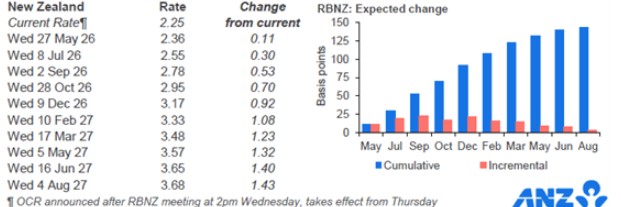
Market signals currently suggest the RBNZ's Official Cash Rate is going to rise from its current 2.25% to 3.75% over the next year. At least, that is what financial markets are pricing.
NZ Government bond yields have been rising too. From its recent low point in October 2025, the one year NZGB yield has gone from 2.45% to just under 3.1% now (+65 bps). The two year NZGB has gone from 2.5% to 3.7% (+120 bps).
Of course, the primary influence on these isn't local, rather it is the big international benchmarks. The US Treasury 10 year hasn't moved a lot even if it is now back up to year-ago levels. But the Japanese 10 year is up at an almost 30 year high. And the Australian 10 year is back to levels last seen in 2011.
Wholesale money markets are pricing in two more +25 bps hikes in Australia over the next year, three by the ECB, three by the Canadians, one by the Americans, and three by the Bank of England.
So the six +25 hikes priced in for New Zealand looks excessive on the face of it, but we are starting eight such hikes behind Australia, six behind England, and five behind the Americans. Our Consumers Price Index levels are not so different to explain those discrepancies. So, we have some catching up to do, and that will involve pain that has so far been deferred.
Adding another +1.5% to our OCR will not help our property market. But much of our borrowing is on fixed rates. Those fixed rates will be more influenced by the international cost of money. It seems unlikely this will be less than the signaled OCR hikes.
The average home loan (RBNZ C31) is currently $321,000 for current owner-occupiers, and remember half will be borrowing less than this, half more. It is $588,000 for first home buyers (FHBs). The average two year fixed home loan rate is currently 5.29%, and most borrowers will be on lower earlier fixed rates. These two data points make the current reference 30 year mortgage payment $1065 per week.
If the priced +150 bps rise does flow through over the next year, that weekly mortgage payment will rise to $1115 and a +5% addition to household budgets for this item. (Let's not talk about rates or insurance.) For FHBs the payments go from $1951/week to $2048/week.
For the average owner-occupier, that eats into their income by -$2727 of take-home pay over a year, for FHBs by -$5033 over a year. While bank lending criteria will show that almost all households could absorb these increases, they will have an outsized impact on retail sales and other discretionary spending.
And that is only part of it. Low migration and still-strong house building suggests we will arrive at an over-built situation soon. Some urban areas are already at that point (Auckland? Wellington?) with others (Christchurch?) are rapidly approaching it. Excess housing supply drives down house prices and rents. As good as that may sound, it also undermines the "wealth effect", something that encourages homeowners to spend.
In a year, most of us will look back on current interest rates as 'low'.
We welcome your comments below. If you are not already registered, please register to comment
Remember we welcome robust, respectful and insightful debate. We don't welcome abusive or defamatory comments and will de-register those repeatedly making such comments. Our current comment policy is here.