
By Roger J Kerr

A respected company director, active as a commercial/industrial property consultant and advisor, told me a story last week as we both sat at a breakfast function waiting for Governor Wheeler to deliver has standard post MPS presentation.
A property investment client of his has just received Auckland Council resource/building consent for an upmarket apartment development in a central city suburb. The development has been sold off the plans and was all set to start, however it will not happen anytime soon as there is a 12 month wait time for the vertical concrete slabs that are fundamental to the building construction.
What does such a chronic supply shortage in the building industry tell you about the direction of prices in that sector?
Demand is clearly so strong that building material suppliers are totally stretched on their forward order books and are giving 12 month delivery time.
A large residential property development in South Auckland went bust recently as the land/house packages sold off the plans were set at a sale price two years’ ago and house construction costs have subsequently increased so much the venture was just not viable. Someone else may pick the development up and build inferior quality houses a lot closer together!
The upward momentum in construction costs are no longer driven by the demand for resources coming from the Christchurch re-build, instead they are driven by population increases in Auckland and low mortgage interest rates.
It appears that the RBNZ put more faith in their beloved “surveys of inflationary expectations” than alarming anecdotal evidence of supply/demand mis-matches described above.
However, sharply rising prices in one sector do not automatically lead to increases in general inflation. If there are sufficient price decreases in other parts of the economy, the inflationary increases are offset and disguised. A problem arises when those other price falls are no longer occurring.
Substantial falls in oil and commodity prices up until a few weeks ago have disguised other material price increases in the economy.
The sudden 50% recovery in crude oil prices from the lows of US$25/barrel (WTI) to the current US$39/barrel is now being witnessed at our service station pumps. A significant risk to the RBNZ’s “lower for longer” inflation and interest rate view and policy setting is that commodity prices continue to increase at the rate they have lifted over recent weeks. Fiscal stimulus measures from the Chinese government for their house building industry is one of the reasons behind the sharply higher iron ore prices.
Excessive liquidity sloshing around the world looking for some kind of yield return is the main reason why US and NZ government bonds yields have reached new lows. Investors frightened into buying safe haven bonds at the time of the January sharemarket turmoil should be now be reconsidering their strategy with the rebound in equities and commodities over the last six weeks showing that the world is not such a scary place after all.
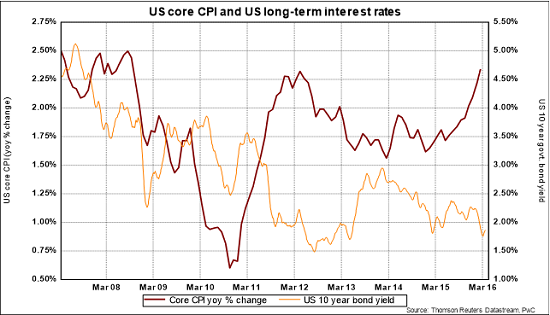
The disconnect between US core inflation trends (higher) and US bond yields (lower) is now very pronounced and does not appear sustainable, no matter what the Fed may be saying right now (refer chart below).
To subscribe to our daily Currency Rate Sheet email, enter your email address here.
Daily swap rates
Select chart tabs
Roger J Kerr is a partner at PwC. He specialises in fixed interest securities and is a commentator on economics and markets. More commentary and useful information on fixed interest investing can be found at rogeradvice.com
We welcome your comments below. If you are not already registered, please register to comment
Remember we welcome robust, respectful and insightful debate. We don't welcome abusive or defamatory comments and will de-register those repeatedly making such comments. Our current comment policy is here.