

Reserve Bank (RBNZ) Governor Adrian Orr says Wednesday’s 25 basis points Official Cash Rate (OCR) rise will cost the average mortgage holder an extra $825 a year, or $16 a week.
Orr mentioned the figures when he appeared before Parliament’s Finance and Expenditure Committee on Thursday to talk about the Bank’s latest Monetary Policy Statement.
“Many things are hidden among the average,” he noted.
“There will be people who have significant equity in their homes, because they’ve been there for a very long time, so their wealth has gone up considerably. There will be people who are very recent buyers and will have a very high level of debt relative to their income and they will find that additional cost harder. So there are unders and overs.”
The other point worth noting is that the OCR has already gone up 75 points since the RBNZ started tightening monetary policy, and is expected to continue on a steady path up.
Financial markets have also priced in hikes ahead of the RBNZ lifting the OCR.
Someone with a $200,000 mortgage, paying the average two-year fixed rate a year ago (2.53%), would’ve had monthly repayments of $793. Meanwhile someone paying the average two-year fixed rate today (4.20%), will be paying $978 a month. That’s $2,200 more a year.
Meanwhile someone with a $600,000 mortgage would’ve had monthly repayments of $2,380 a year ago, versus $2,934 today. That’s $6,648 more a year.
The RBNZ, in its Monetary Policy Statement, further discussed the impact rising interest rates are having on mortgage holders.
“Relatively small upward movements in mortgage rates since November 2021 suggest most of the pass-through of higher wholesale rates happened before the November Statement,” it said.
“The two-year interest rate swap rate increased nearly 100 basis points between the October Review and the November Statement, and this move was reflected in mortgage rates before the November announcement.
“Increases in the OCR will be passed through to the economy further as more fixed-term mortgages come due to reprice, and will do so at higher rates.
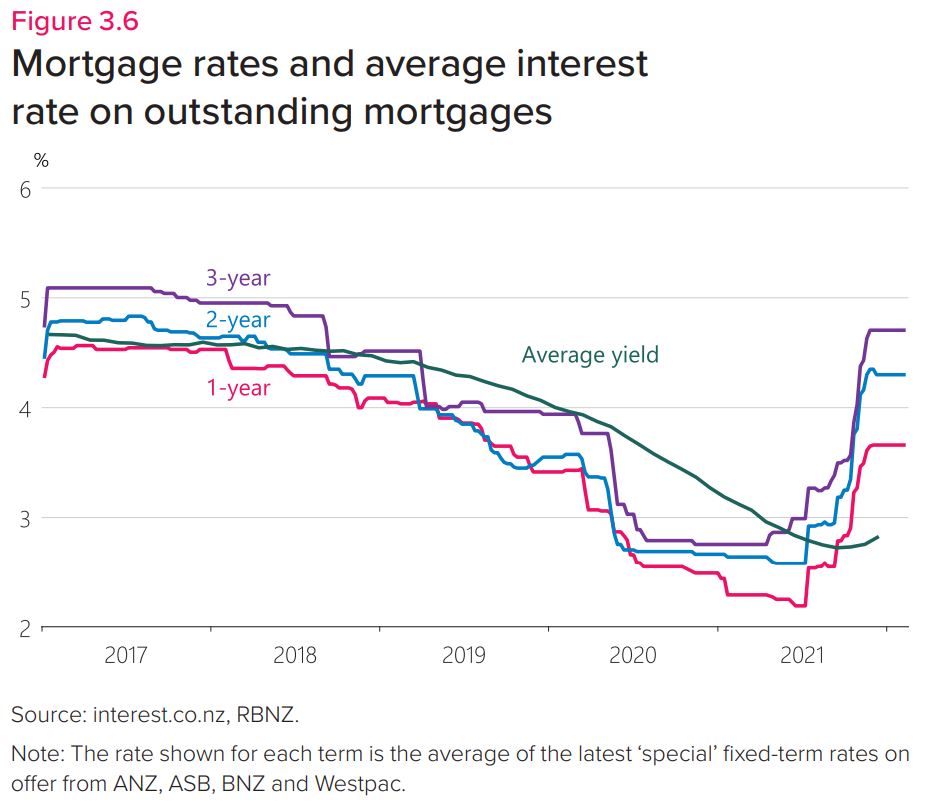
“Over half of total mortgage debt is due for repricing during 2022.
“Additionally, in the past few months more borrowers have been fixing at terms longer than one year. This means they will face even higher interest rates than if they re-fixed at the same term, as the two-year and three-year rates have increased by around 20-30 basis points more than other shorter-term rates since October 2021.
“Although mortgage rates are rising, they are still low relative to their longer-term history.”
Mortgage holders had a good run…
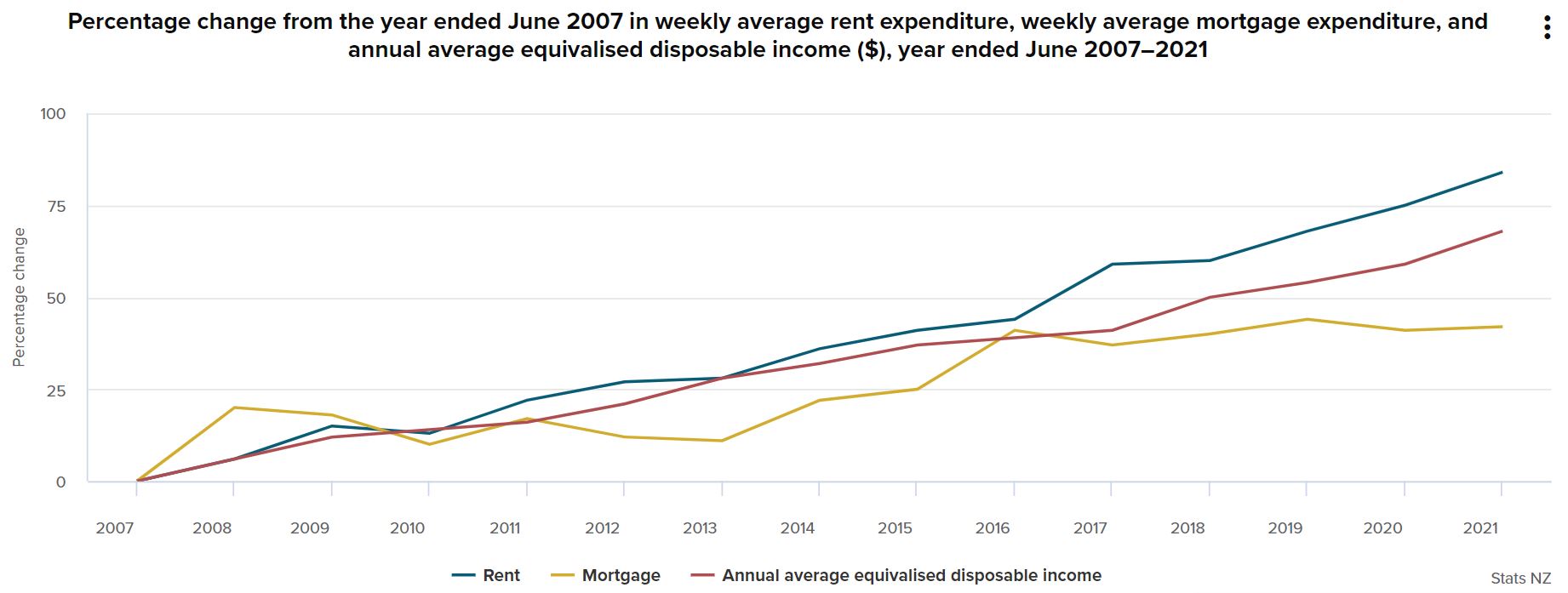
Figures released by Statistics New Zealand on Thursday illustrate how low rates mean mortgage holders have been in a much better position than renters (on aggregate) in recent years.
It noted that between June 2007 and June 2021, the average weekly rental cost rose 84%.
This increased faster than household disposable income, which increased 68% over the same period.
Stats NZ said households that had mortgages during the same period would have experienced, on average, a 43% increase.
"Mortgage payments have been relatively unchanged since year ended June 2016 (up 0.9%)," it said.
"This is due to lowering interest rates and principal expenditure increasing, through the purchase of additional mortgages or borrowing more due to rising house prices. Lowering interest rate payments offset increasing principal payments, resulting in a flat trend."
Stats NZ also said that in the year ended June 2021, 17% of New Zealand households spent more than 40% of their disposable income (not equivalised) on housing costs.
Renters were over-represented in these figures, with over one in four renters compared to one in nine homeowners spending more than 40% of their disposable income on housing costs.
We welcome your comments below. If you are not already registered, please register to comment
Remember we welcome robust, respectful and insightful debate. We don't welcome abusive or defamatory comments and will de-register those repeatedly making such comments. Our current comment policy is here.