

The Reserve Bank should not hold back on making further interest rate cuts in case there's a global crisis, economists at the country's largest bank say.
"We don’t think that the RBNZ should 'save its bullets' for a global crisis or plummeting commodity prices," the ANZ economists say in their Weekly Focus publication.
"The last thing the RBNZ would want is for the economy to take a blow around the ears with growth already weak and inflation expectations falling.
"If cuts are needed, best to stimulate the economy now and get the economy in a position to weather the next storm."
The ANZ economists went against the prevailing thinking among fellow major bank economists late last year when they changed their call on interest rates and said they expected to see the Official Cash Rate cut three times to 1% by early 2020.
In the event, the first rate cut has taken place much earlier than even they forecasted late last year, and they now say there will be another cut this year before a final cut early next year will bring down the OCR to the 1% level they are still predicting.
The economists say that ANZ’s Financial Conditions Index (FCI) for New Zealand shows that financial conditions are currently a "tailwind" to growth. (The index includes indicators of lending rates, NZD movements that cannot be explained by terms of trade moves, equity market moves, housing market conditions, and credit conditions. The FCI tends to lead GDP growth by about 12 months.)
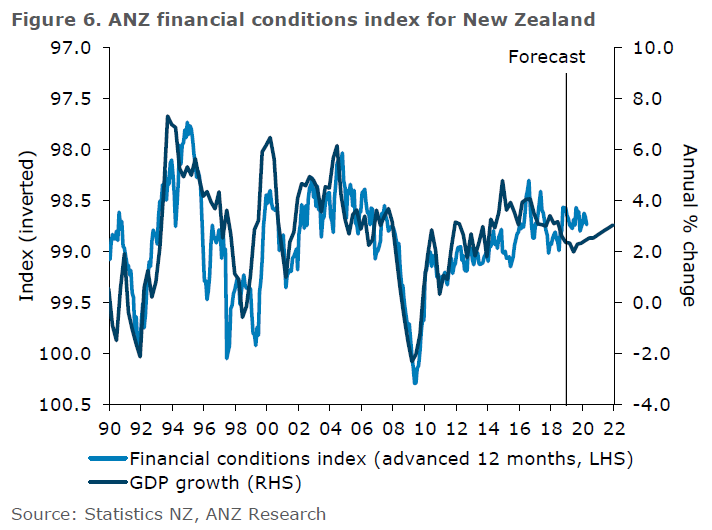
Despite this, however, they say there are "numerous other headwinds present" that they expect to limit the acceleration of economic growth.
Among these headwinds, they point to gloomy business surveys generally, a "precarious" outlook in residential construction - with construction intentions at their lowest since 2009 - and the weakening global growth picture.
They also say there is a possibility that financial conditions could tighten sharply, removing a key support to growth.
The three key risks they cite on this are: potential deterioration in global growth, a large increase in bank capital requirements [as the RBNZ is currently proposing] and the possible removal by the RBNZ of an "easing bias" for interest rates and therefore the OCR remaining on hold at the current 1.5%.
"Part of the reason that financial conditions are currently easy in New Zealand is that market participants expect further cuts in the OCR. A terminal rate of about 1.10% is currently priced into the New Zealand interest rate curve. If the RBNZ does not deliver this in a timely fashion, then financial conditions will tighten from here.
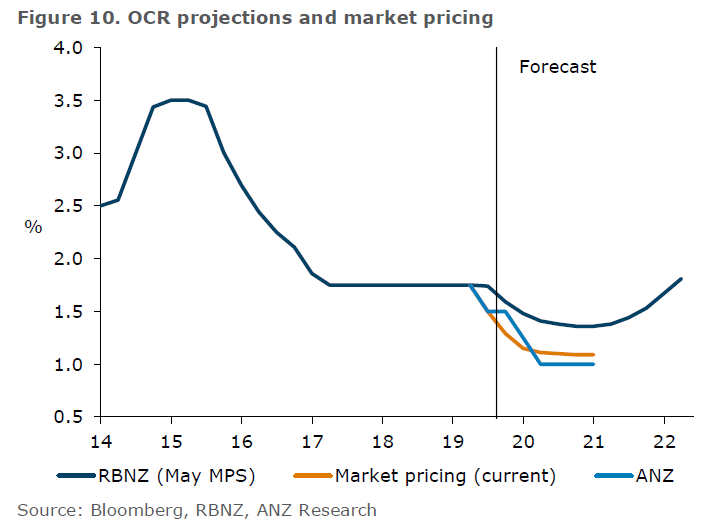
"As OCR cuts are priced out of the curve, lending rates and the NZD would move higher. That said, if the RBNZ isn’t cutting later this year then it’s because the economy is doing better than we expect. We’d take that as a positive."
The economists believe, however, that it will becomes clear later this year that economic growth is unlikely to accelerate sharply and they therefore expect additional rate cuts in November and February to take the OCR to 1%.
However, they say the risks are that cuts come earlier, based on the newly revealed pre-emptive characteristics of the RBNZ's decision-making committee, highly asymmetric global risks, and the cuts now expected from both the Reserve Bank of Australia and the US Federal Reserve before November.
And in urging the RBNZ to not "save its bullets", the economists stress that OCR cuts don’t need to stop at zero.
"As we have seen from international experience, the OCR could go negative (in theory as low as -0.75%) and there are other options such as the purchase of assets (i.e. quantitative easing) that the RBNZ has been exploring. These measures would help lower longer-term borrowing rates and free up lending in a crisis.
"Nonetheless, the options rapidly become pretty limited as the OCR moves lower, meaning fiscal policy will need to be prepared to step up. And in a crisis, the freely floating exchange rate is the economy’s safety valve – depreciation will provide some support to the export sector and inflation."
We welcome your comments below. If you are not already registered, please register to comment
Remember we welcome robust, respectful and insightful debate. We don't welcome abusive or defamatory comments and will de-register those repeatedly making such comments. Our current comment policy is here.