

Vodafone’s announcement it will switch on a fifth generation (5G) mobile internet network in December is putting even more pressure on the Government to defy its Five Eyes partners and give Spark the green light to launch its 5G network enabled by Huawei.
Vodafone made the announcement on Thursday to coincide with the completion of the sale of its New Zealand business to Brookfield and Infratil.
It said Nokia would provide it with the equipment needed to roll out 5G starting in Auckland, Wellington, Christchurch and Queenstown.
Meanwhile Spark on Thursday confirmed it was still in discussions with the Government Communications Security Bureau (GCSB) further to the agency in November declining its application to use Huawei’s 5G equipment, citing a “significant network security risk”.
Spark said it hadn’t decided whether or when it would submit a revised proposal.
While it avoided mentioning the hurdle posed by the Chinese company, its technology director Mark Beder made Spark’s desire to advance its 5G plans quite clear.
He tweeted: "At Spark we've been making the case for some time about the importance of 5G to the future of New Zealand. Vodafone's announcement is a good reminder to government to keep moving with the spectrum allocation for 5G."
A Treaty of Waitangi claim has held up the allocation of this spectrum necessary for a major 5G rollout.
At @SparkNZ we’ve been making the case for some time about the importance of 5G to the future of New Zealand. @VodafoneNZ’s announcement is a good reminder to government to keep moving with the spectrum allocation for 5G. https://t.co/k2KIgGwNne
— Mark Beder (@beder_mark) August 1, 2019
In China’s eyes, the GCSB’s decision to stop Huawei providing Spark with 5G equipment is one of the most significant sticking points when it comes to its relationship with New Zealand.
The health of this relationship is particularly crucial, as negotiations to upgrade the New Zealand-China Free Trade Agreement are underway.
If Huawei gave up on the New Zealand market, China would be admitting defeat to the United States, as the two powers battle it out globally for control over crucial 5G infrastructure.
Huawei has been putting pressure on the New Zealand Government through aggressive advertising campaigns.
Its New Zealand deputy chief executive, Andrew Bowater, in an impassioned speech delivered at the New Zealand China Business Summit in May, told the country’s business and political leaders that Huawei had been “blind-sided” by the GCSB.
Accusing geopolitics of getting in the way of business, he said things got very hot, very fast.
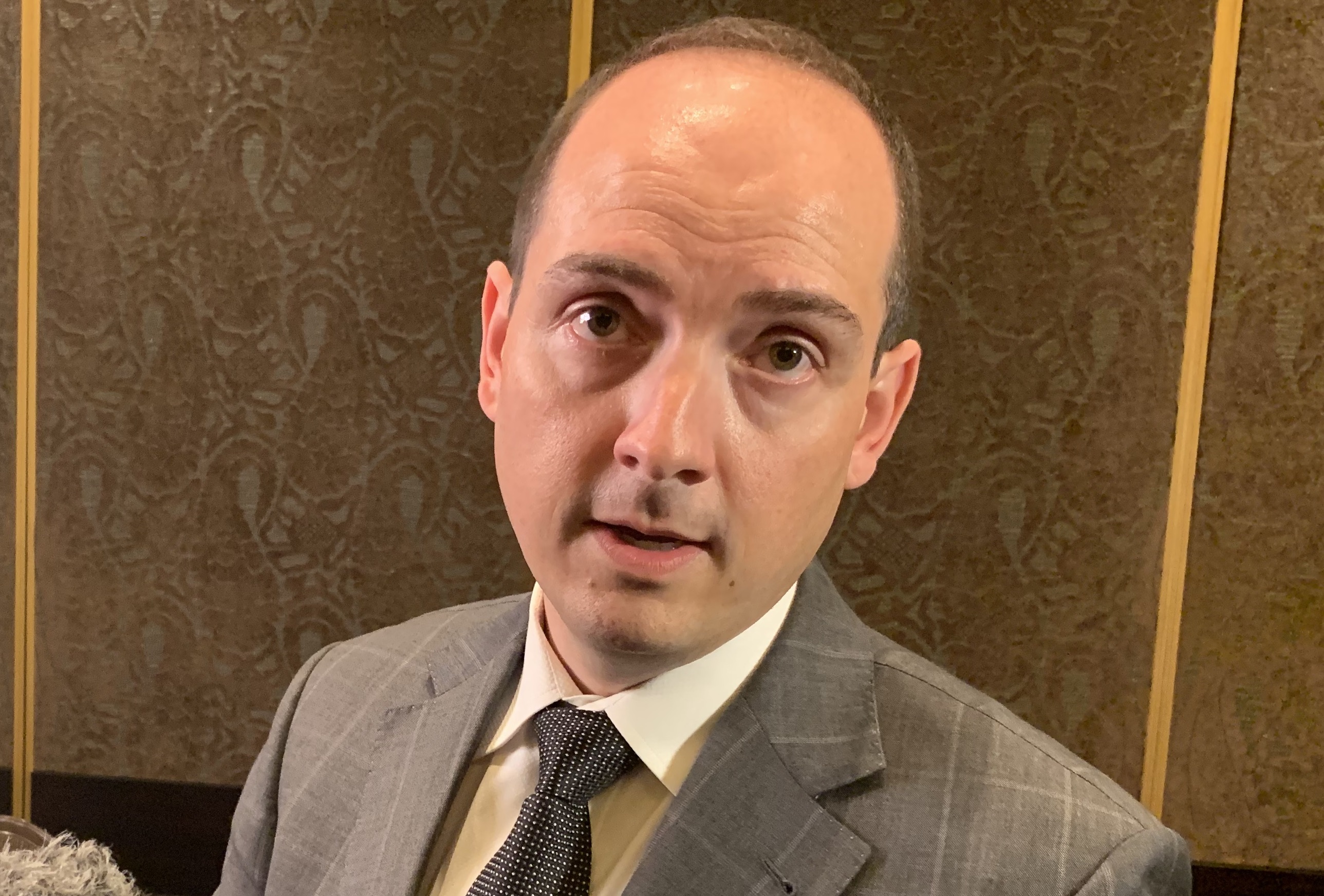
Andrew Bowater speaking to media at the New Zealand China Business Summit
While Government ministers have swatted away questions on Huawei, pawning the responsibility off to the GCSB and underlining New Zealand’s “independent foreign policy”, having Vodafone grabbing headlines will further motivate Spark to apply more pressure.
Tech commentator and public relations consultant Paul Brislen said Spark will be banging on the Government’s door saying, “‘Come on, everyone knows the only reason the Americans are upset about security is because they don’t want Huawei building the world’s networks. You’ve crippled us… Vodafone will steal the march on the industry and it’s all your fault for “protecting us from the evils of the Chinese spy network”.’
“In addition to that, you’ve got Huawei lobbying the Government hard, saying ‘Look, we won’t even build the core of the network. We’ll only build around the edges’.”
Brislen said that while it might be possible for Vodafone and Spark to share a network provided by Nokia, giving it this monopoly status wouldn’t be ideal.
“Spark would also have to go cap-in-hand to Vodafone and say, ‘Can we borrow your network?’” Brislen said.
“I suspect Vodafone would firstly take this to the Commerce Commission and secondly say, ‘Here’s our price, it will be $3 trillion per minute’.”
We welcome your comments below. If you are not already registered, please register to comment
Remember we welcome robust, respectful and insightful debate. We don't welcome abusive or defamatory comments and will de-register those repeatedly making such comments. Our current comment policy is here.