

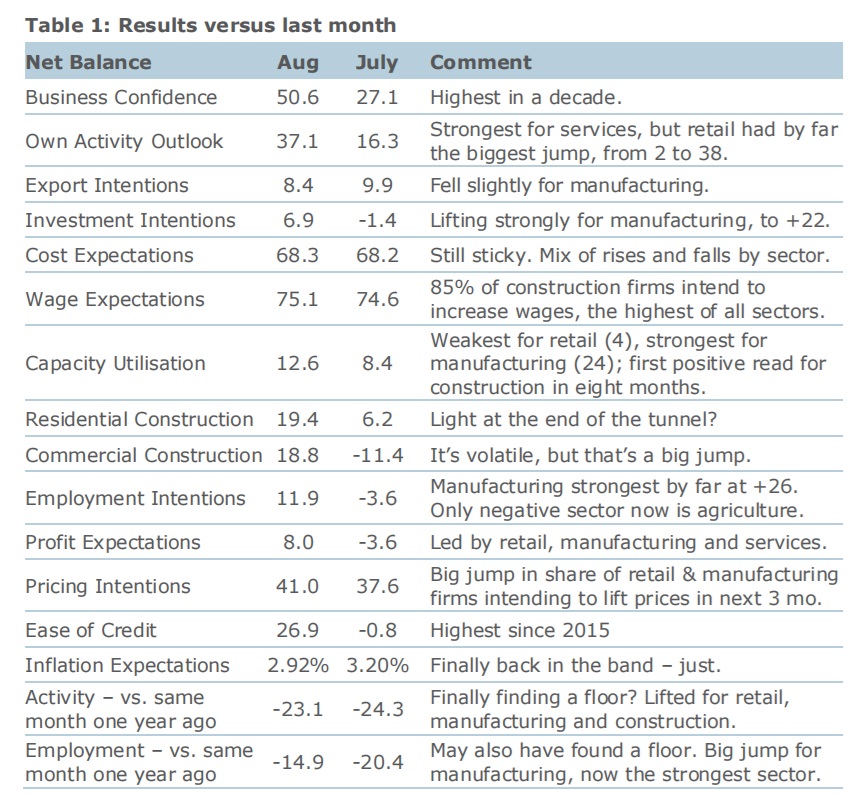
Business confidence as measured by the ANZ Business Outlook Survey has soared to its highest level in a decade in a month in which the Reserve Bank cut interest rates.
The headline 'confidence' measure in the survey jumped 23 points to a decade-high +51 in August, while the 'expected own activity' measure put on 21 points to +37, a seven-year high.
The August survey was conducted on either side of the RBNZ's Official Cash Rate decision on August 14, so, therefore the soaring confidence was not simply a result of the 25 basis point cut to 5.25% in the OCR. However, wholesale interest rates and indeed bank retail interest rates had been falling meaningfully ahead of the OCR decision. And business confidence had risen in July too.
Finance Minister Nicola Willis issued a media statement in response to the survey, which was headlined: "Business confidence rises under new economic management," and in which she said the survey showed businesses "are feeling a whole lot better about the future".
Difficult conditions are starting to ease, she said, and we are already seeing "the green shoots of recovery" with inflation forecast to be under 3% this quarter.
"It’s early days and there is still more work to do, but our careful and deliberate plan is working. Like businesses, we are optimistic and confident that brighter days are ahead," Willis said.
ANZ chief economist Sharon Zollner said the latest survey "showed a flurry of optimism".
"Forward-looking activity indicators lifted strongly, and this was evident already in the responses that came in at the very beginning of the month," Zollner said, while the "roughly one-third" of responses that came in after the OCR cut "didn’t change the results a great deal".
Zollner said, while she didn't want to be "a killjoy", it remains the case that the hurdle for expecting better times ahead is "very low".
"Reported past activity, which has a good correlation to GDP over its short history, barely lifted, and at -23 remains very weak."
New Zealand has experienced contraction in its GDP in four of the last six quarters - and the RBNZ's picked negative GDP growth both for the June quarter, the results of which have not been reported yet, and the September quarter we are currently in.
Commenting on the survey results, Westpac senior economist Michael Gordon said the Westpac economists wouldn’t suggest that a single OCR cut "could make this degree of difference to the economic outlook".
"Rather, we think this shows how downbeat firms had become earlier in the year. We had noticed a distinct souring in the mood amongst businesses at the prospect that interest rate cuts might be another year or so away, as the RBNZ had been signalling in its February and May forecasts. With the economy having already been effectively flat for the last year and a half, the prospect of having to “survive until ‘25” would have been daunting for many," he said.
"The RBNZ emphasised the recent weakness of high-frequency activity indicators in its decision to cut the OCR in August. And indeed there was a marked deterioration across a range of measures for the June month. However, the updates for July and beyond have generally improved since then. We don’t think this will derail further OCR cuts in the months ahead, but the lift in business confidence along with other measures should see the market scale back the odds of larger 50bp [basis-point] moves," Gordon said.
Zollner said the variation in reported activity between sectors is "stark", with construction the weakest "by quite some margin", followed by retail. Agriculture is the only sector reporting higher activity than a year ago.
The RBNZ will as ever be interested in the responses to questions about inflation, costs and pricing intentions. The RBNZ targets getting inflation between 1% and 3% and its now widely expected that annual inflation, which was 3.3% as of the June quarter, will fall back under 3% in the September quarter.
Inflation expectations in the survey dipped from 3.2% in the last survey to 2.9%, which Zollner said was the first sub-3% reading since July 2021.
She said pricing intentions rose 3 points to a net 41% of firms intending to raise their prices in the next three months, with the average expected increase lifting from 1.4% to 1.6%.
"By sector, retail and manufacturing rose – the latter from 1.8% to 2.7%, the highest read since June 2023. Average expected price changes for the services sector were flat at 1.3%, and agriculture and construction fell, with the latter just 0.5%," she said.
"The net proportion of firms expecting higher costs over the next three months was steady at 68%, with the magnitude of expected average cost increases also unchanged at 2.5%.
"In some good news for firms’ profitability, implied margin squeeze is easing, insofar as the gap between firms’ own expected price and cost changes continues to narrow.
"Reported wage increases versus a year earlier fell from 3.8% to 3.3%, and expectations for firms’ own wage increases over the next 12 months were unchanged."
Things therefore are looking up, albeit from a pretty dark place for many firms, Zollner said.
“So is this burst of (relative) euphoria justified, will it be sustained, and will it actually impact business decisions?
"We will be closely watching indicators such as housing auction clearance rates, job ads, PMI and PSI new orders, and card transactions. And the RBNZ will be too. Just as the pace of monetary tightening varied considerably, the speed with which interest rates come down will also be data dependent," Zollner said.
We welcome your comments below. If you are not already registered, please register to comment
Remember we welcome robust, respectful and insightful debate. We don't welcome abusive or defamatory comments and will de-register those repeatedly making such comments. Our current comment policy is here.