
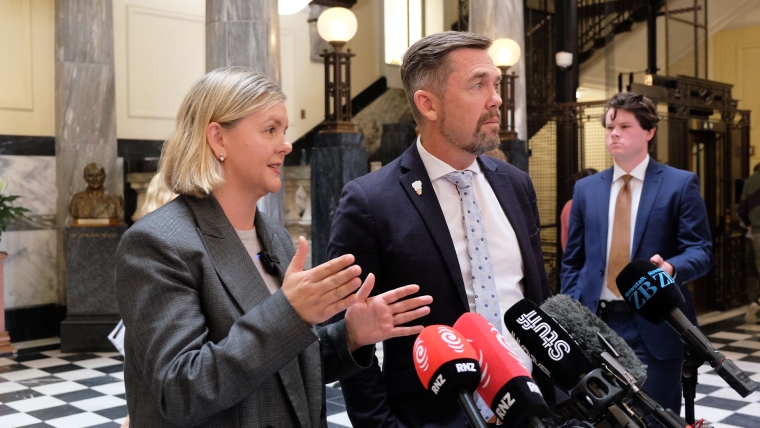
National and Labour have teamed up with a Members’ Bill that aims to address modern slavery in Aotearoa.
Labour MP Camilla Belich and National MP Greg Fleming have joined forces and plan to have the Bill introduced in the House on the next sitting day (this would be February 10).
Modern slavery includes human trafficking, slavery, forced marriage, forced labour and debt bondage. It is described by the Ministry of Business, Innovation and Employment (MBIE) as; “severe exploitation that a person cannot leave due to threats, violence or deception.”
A 2022 World Vision report looking into supply chain risk found New Zealand had imported $7.9 billion worth of risky goods connected with child and forced labour. World Vision's report also found 10% of the country’s total imports were linked to child and forced labour, and each week, a New Zealand household spent about $77 on risky products potentially linked to forced labour.
The Bill will be able to be introduced in the House because 61 MPs from National and Labour (who are not ministers or undersecretaries) have agreed to support it, meaning it can bypass the biscuit tin.
This is known as Standing Order 288 and this is the first time it has been used in New Zealand's Parliament, according to Labour and National.
Both Belich and Fleming have previously placed two private members’ bills on modern slavery.
“The Bill will require large businesses to report on how they identify and address modern slavery in their supply chains, create a public register of these reports and strengthen support for victims in New Zealand," Belich said.
“It would also give the Human Rights Commission a formal role and allows for future reviews, including the potential establishment of an Anti-Slavery Commissioner."
“I’m proud that both sides of the House have come together to stand against exploitation, and grateful to the advocates, organisations and businesses who have pushed for this change," Belich said.
Fleming said the issue is close to his heart.
"I’ve been working on this legislation since I came to Parliament. Camilla Belich and I have agreed to co-sponsor the Modern Slavery Bill, meaning that it will bypass the biscuit tin," said Fleming.
He said the Bill would require large organisations to publicly report on modern slavery risks and incidents in their operations and supply chains.
“It introduces fines of up to $200,000 for companies that refuse to report or publish false or misleading statements, including civil penalties of up to $600,000, public naming, and potential liability for directors and senior managers.”
“The Bill also strengthens reporting to Parliament on investigations, prosecutions and victim support, and prevents public funds being paid to entities that breach the Act," Fleming said.
Not about blacklisting companies
Asked about potentially blocking imported products where there was well-known exploitation of workers, Belich told reporters on Thursday: "I think the objective of this law is really to identify those instances and prevent it from happening."
"So it's actually about improving the supply chain, not stopping the supply. And that's, I think, a more sustainable way of making sure that slavery doesn't exist at all. And that's common as I understand it, in other modern slavery regimes that have been implemented worldwide."
Belich said: "And anyone in that area will tell you that is the objective. It's to identify instances and improve them. It's not actually about blacklisting companies."
Getting it through
Work has been done in the past to look into modern slavery legislation with the Labour-led government in 2023 planning to make businesses publicly report on modern slavery risks. There was also a Modern Slavery Leadership Advisory Group which ended up being disbanded.
In September 2024, Workplace Relations Minister Brooke van Velden told 1News that while she thought modern slavery was important, she didn't think there needed to be a new law to fix it.
Slavery, human trafficking and migrant exploitation were already crimes, she said.
In order to get the Bill though, Fleming said: "For the legislation to get through Cabinet, it obviously needed the full support of Cabinet and ACT weren't supportive of it, which is why Camilla and I worked through this [Standing Order 288] route."
When asked why ACT wasn't supportive of it, Fleming told reporters they would need to ask them about that.
"There's different views on it. I understand their critique of it. I don't agree with it. I'm in full support of this legislation," he said.
Belich said: "We've seen from the ACT Party a complete disregard for workers' rights ... from Labour's perspective, it's not surprising to see that, once again, they've failed to stand up for workers - not only in New Zealand, but that are being exploited worldwide."
In a statement on Thursday, van Velden said: “At the start of my term as Minister for Workplace Relations and Safety, I made it clear what my priorities are, and I’ve worked for the past two years to progress those."
"They are reforms to the Holidays Act, health and safety, and an Employment Relations Amendment Bill. All three will progress through the House this year."
She said she would consider the Bill that has been put forward by other parliamentarians "as a caucus member of the ACT Party".
Next steps
Belich said the legislation will bring New Zealand into line with the United Kingdom and European Union.
“When we signed free trade agreements with these partners, we said we would act on modern slavery, and through this joint Bill we are keeping that promise," said Belich.
As for next steps, Fleming told reporters they would be writing to the Business Committee asking them to place this Bill at the top of the Members' Order Paper.
If that was granted, then the Bill would be able to have its first reading not too long after.
Their hope was to get their Bill through before the election, he said.
Business support
In September, a group of institutional investors and New Zealand businesses publicly called for legislation to address modern slavery in New Zealand. They also urged for political parties to work together on this issue.
The group calling for action in a joint statement was made up of organisations including ANZ New Zealand Investments Ltd, Westpac, Pathfinder, Kernel Wealth, AMP Wealth Management New Zealand and Responsible Investment Association Australasia (RIAA).
Modern slavery legislation was a big gap in the country’s corporate regulatory landscape, they said.
“We stand at a tipping point to introduce legislation aimed at driving transparent and ethical supply chains."
“This is critical to protect vulnerable workers but also to maintain competitiveness and trust in our exports and brand," they said.
“Clear legislation also enables investors to assess and manage risk more effectively, strengthening business credibility and access to capital.
“Appropriate legislation provides the clarity and consistency needed to support this work, creating a level playing field to ensure all businesses are required to meet these standards.”
RIAA, which led the joint statement, welcomed the announcement on Thursday.
RIAA co-chief executive Dean Hegarty said "we cannot continue to risk New Zealand becoming a dumping ground for forced labour products as laws overseas push these goods out to us".
“There’s a persistent but false narrative that regulation is inherently bad for business,” Hegarty said.
“This is a clear example where businesses acting in the best interests of human beings also amount to acting in the best interests of the economy, as they understand that strong standards underpin economic growth.”
'Us answering the call to take action'
Belich told reporters on Thursday they had received an overwhelming number of messages of support, encouraging them to take action.
"This is not something that we thought of by ourselves at all. There's been a campaign for modern slavery that has been going on for a really long time. A number of Non-Government Organisations have been really active in the space - World Vision, Tearfund, [and] trade unions have been advocating for it, businesses," Belich said.
"We've had school children outside of Parliament delivering petitions to us, so this has really come from New Zealanders from lots of different places and that is why we have really taken this action today."
"So it's more us answering the call to take action, rather than us coming up with an idea and then consulting with them," Belich said.
'Issue of modern slavery isn't going to stagnate for another election cycle'
World Vision's head of advocacy and justice Rebekah Armstrong said the bi-partisan decision was momentous.
“After years of advocacy and widespread public support, politicians from across the aisles are finally moving to make modern slavery legislation a reality," Armstrong said.
“Kiwis don’t want to be complicit in exploitation. This new law will require companies to take responsibility and gives New Zealanders confidence that the goods they are buying are slavery-free."
Armstrong said: “It’s reassuring to see that the issue of modern slavery isn’t going to stagnate for another election cycle and that Parliament will work to address an issue of such immense importance."
Equal Employment Opportunities Commissioner Gail Pacheco said the proposed legislation would strengthen transparency and accountability - two critical tools for preventing exploitation and abuse.
“As this bill progresses, we look forward to engaging constructively with the Select Committee to help ensure the legislation is robust and effective. Today’s decision is an encouraging signal for both democracy and human rights in New Zealand.”
We welcome your comments below. If you are not already registered, please register to comment
Remember we welcome robust, respectful and insightful debate. We don't welcome abusive or defamatory comments and will de-register those repeatedly making such comments. Our current comment policy is here.