

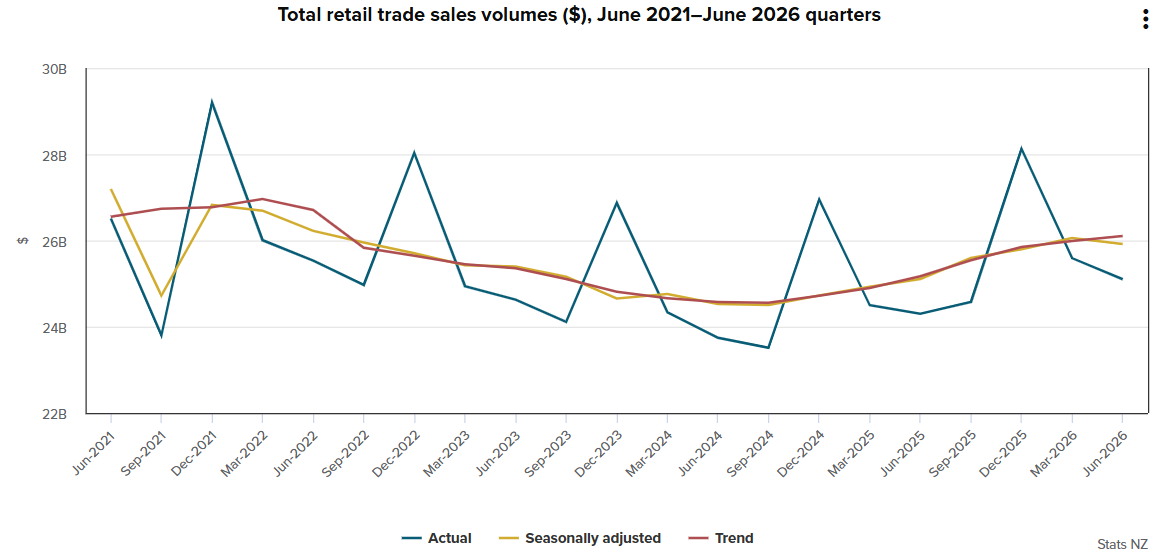
Seasonally adjusted retail sales fell 0.5% in April, May and June, breaking an almost two-year streak of increased spending across the sector.
According to Statistics New Zealand’s latest retail trade survey, the total volume of retail sales in NZ decreased by 0.5% or $138 million in the June quarter. Stats NZ adjusts sales volumes for price inflation and seasonal effects, while sales values are adjusted for seasonal effects only.
The retail trade survey measures the sales and stock of businesses that provide household and personal goods and services, like supermarkets, restaurants, cafes, hotels, petrol stations and car yards.
The June quarter headline figure mark the first downturn in seasonally adjusted retail sales volumes since the December 2024 quarter.
Stats NZ’s economic indicators spokesperson Michelle Feyen said higher fuel prices, which have been affected by the Middle East conflict, drove a “sharp increase” in fuel retailing sales values in the three months to June.
On a seasonally adjusted basis, fuel retailing fell $185.8 million in the June quarter, compared to March.
“However, once the effect of price changes is removed, fuel retailing recorded the largest fall in sales volumes of the industries measured,” Feyen said.
Electrical and electronic goods retailing had the largest increase in the June quarter, up $243.5 million on a quarterly and seasonally adjusted basis.
Stats NZ said eight of the 15 retail industries it tracks had lower sales volumes in the June quarter compared with the March quarter. In comparison, nine of the 15 industries had higher seasonally adjusted sales values in the three months to June compared to the prior quarter.
Sales volume measures the physical quantity of products sold, while sales value measures the total monetary amount generated from those sales.
Westpac NZ economists had expected a 0.2% fall in sales volumes for the three months to June. ASB economists had anticipated a 0.3% contraction in retail trade volumes, predicting that higher fuel prices would have a flow-through effect to spending on other goods.
“We also expect to see a shift toward essential items – particularly supermarkets and pharmaceuticals – given the squeeze on household budgets,” ASB senior economist Chris Tennent-Brown said before the data came out.
Fuel sales volume falls as value rises
The largest movements in retail sales volumes over the June quarter were:
- fuel retailing – down 13%
- motor vehicle and parts retailing – down 2.3%
- accommodation – down 8.0%
- food and beverage services – down 2.8%
- electrical and electronic goods retailing – up 9.2%
The largest movements in retail sales values over the June quarter were:
- fuel retailing – up 12% or $299 million
- electrical and electronic goods retailing – up 12% or $122 million
- accommodation – down 6.6% or $104 million
- motor vehicle and parts retailing – down 2.3% or $101 million
- hardware, building, and garden supplies – up 3.4% or $92 million
On a regional level, sales values in the North Island increased by 0.8% or $196 million to $24 billion during the June quarter, while sales values in the South Island increased by 1.5% or $120 million to $8.3 billion, Stats NZ said.
During the three months to June, retail sales experienced their sharpest drop in Hawke’s Bay, falling 2.1%. Marlborough reported the highest sales volumes in the June quarter, rising 3.3%.
Stats NZ said the total value of stock held at the end of June was $9.2 billion, up 4.5% or $397 million compared to a year earlier.
Retail volume sales provide an idea of where gross domestic product (GDP) activity is heading, due to consumer spending making up a large part of economic activity and growth.
The NZ economy grew 0.8% in the March quarter. Stats NZ said the measurement of gross domestic product (GDP) in the first three months of the year wasn’t heavily impacted by the Middle East conflict and late-quarter fuel price increases.
Annual growth in GDP was also up 0.8% and the size of the economy was $450 billion for the year ended March. The GDP figures for the June quarter will be released on September 17.
Annual sales volumes also lower
In a note following the survey’s release on Monday, ASB economist Yen Nguyen said retail spending momentum stalled in the second quarter, which in turn dragged down annual growth in total retail sales volumes to 3.2%, the lowest in a year.
“The Q2 increase captures most of the Middle East conflict, with fuel prices peaking during mid-April, before dropping gradually following the positive developments on a resolution for the US-Iran conflict happening during May and June,” she said.
“The decline in discretionary spending was across the board, led by accommodation, specialised food, food and beverage, and recreational goods. This partly reflects squeezed household budgets amid the cost shock, prompting a pullback in non-essential items.”
The softness in consumer spending outlook poses some downside risk to ASB’s prediction for the end-of-year Official Cash Rate (OCR), according to Nguyen.
“Even so, at this stage we continue to expect a timely removal of monetary stimulus, with the OCR ending the year at 3.25%,” she said.
We welcome your comments below. If you are not already registered, please register to comment
Remember we welcome robust, respectful and insightful debate. We don't welcome abusive or defamatory comments and will de-register those repeatedly making such comments. Our current comment policy is here.