
The Government is fast-tracking a law change that will require petrol companies to open up their books to the country’s competition watchdog.
Prime Minister Jacinda Ardern is prioritising the passing of the Commerce Amendment Bill, which compels petrol companies to give the Commerce Commission the information it needs to understand how the market functions.
Speaking at a post-Cabinet press conference on Monday afternoon, Ardern said petrol companies had refused to play ball when the previous government requested this information, so it’s now being legislated.
She said the Bill would have its second and third readings in Parliament in coming weeks. Once passed, there would be a one-month transition period before the Act becomes operative.
Ardern expected the study to report back next year.
While the Coalition Government has copped flak for exacerbating high fuel prices by increasing the petrol excise duty and introducing a regional fuel tax, Ardern pointed out New Zealand has the highest pre-tax petrol prices in the OECD. In 2008, we had one of the lowest.
“Between 2008 and 2017, the margins importers were taking for themselves more than doubled from 7% to 16%,” she said.
“Between the 27th of October 2017 and 28 September 2018, petrol prices have risen roughly 39 cents, of which 6.8 cents at that point could be attributed to taxes and levies, 22 cents roughly to importer costs, and 9.8 cents to importer margins...
“Some of that cannot be explained. I do not see that as acceptable."
Ardern went on to point out: "We also have different fuel prices between the South Island and Wellington versus the rest of the North Island. While there might be a slightly higher cost of transportation in the South Island, it is no way near equivalent to the difference in fuel prices now."
2010 a turning point...
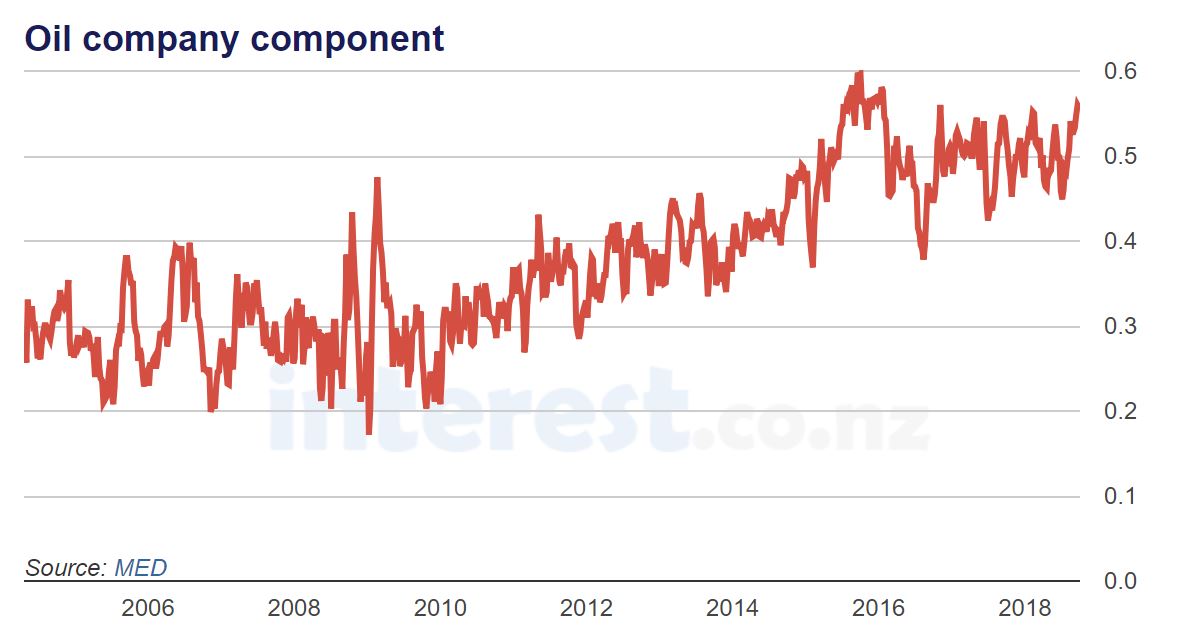
According to Ministry of Business, Innovation and Employment data collated by interest.co.nz, the 'oil company component' of the petrol price - IE what you get when you subtract taxes and the crude price from the discounted price at the pump - started tracking up from 2010.
It rose to 56 cents a litre in September 2018, from around 30 cents per litre before 2010 when Shell sold its retail stations and stake in the refinery at Marsden point to a consortium of Infratil and the Guardians of New Zealand Superannuation. These stations were then re-branded Z.
Ardern refused to comment in the press conference on whether the Commerce Commission made a mistake allowing this sale, saying "we need to look at the industry as a whole".
National: The Govt should axe tax increases
National Leader Simon Bridges has responded to Ardern's announcement saying: “While the Government passes new legislation and waits for yet another report it should provide immediate relief to motorists by putting a stop to its relentless imposition of new taxes...
“The inquiry will take months and any resulting changes could be years away. Meanwhile New Zealanders are paying record prices for petrol and the Government is collecting hundreds of millions of extra tax from them.
“Unlike petrol, talk is cheap. And the Government is a big part of the reason why petrol prices are so high."
As of September 31, New Zealanders have been paying an extra 3.5 cents per litre in petrol excise duties. These will fund $5 billion of transport infrastructure over 10 years, as set out in the government's policy statement on land transport.
And as of July 1, Aucklanders have been paying a 11.5 cent per litre regional fuel tax. Auckland Council will use the revenue generated to support transport projects that would otherwise be delayed or not funded.
Oil and Petrol
Select chart tabs
128 Comments
I don't get the obsession with fuel prices? Surely we are being ripped off more by the supermarkets?
got evidence to back that up?
Here is 2.27l of milk at Tesco UK for $2.22: https://www.tesco.com/groceries/en-GB/products/254656543
Here is 2l of milk at Countdown NZ for $3.95: https://shop.countdown.co.nz/shop/productdetails?stockcode=282748&name=…
That is twice the cost. Are you saying our fuel is that overpriced?
Yes, the supermarket is the only element in the supply chain. couldn't possibly be anybody else.
I have occassional chance to purchase products from a NZ dairy company staff shop when I visit that site. The staff price for most common items is not hugely cheaper than the supermarket price.
Well the fuel retailer isn't the only element in the supply chain either.
We have slightly higher than average fuel prices and the government has a special enquiry. We have massively higher food prices and no one cares.
Fresh milk is not a traded commodity so local prices apply
UK Dairy farmers receive massive EU subsidies
Supermarkets price bulk milk as a loss leader eg Australia $1 / litre
UK customers paid in UK Pounds - roughly twice the value of the NZ $'s
Your comparisons of UK vs NZ prices make no sense whatsoever
How about 4.55 euros for 40 g of tobacco in Germany vs $68 NZD for the same thing. With an exchange rate of 1.78 that's over 8 times the price. No wonder poor people are getting ground into dust in NZ
Yep, if the government really wanted to provide immediate discretionary spending relief to a good chunk of the lower to middle income/blue collar working classes - they would reverse out most of National's tobacco tax rises.
Massive immediate difference to these people/families lives. The stress/worry the addiction causes tobacco addicts with families is immense. I know so many good, solid hard working parents who feel such guilt having tried unsuccessfully to kick the habit. When they go back to it, they then feel inadequate, even more depressed and a sense of hopelessness.
Second most addictive substance on earth, I believe.
Exactly! My own humble observations are that tobacco price elasticity correlates with socioeconomic status, with the mentally ill occupying the extreme end of lower socioeconomic & practically zero tobacco price elasticity. Trouble is the literature seems to suggest the opposite. I downloaded a few papers saying that poor people would benefit the most from aggressive tobacco price increases. No doubt policy makers see this as a win win, raising money from tobacco excise and “helping” poor people at the same time.
If you are poor you shouldn't smoke. Smokers are already costing more in health and welfare costs than is made on the taxes placed on tobacco. The poor are also probably sucking benefits and working for family tax credits at the same time. They should be too ashamed to wrap their bludging lips around a cancer stick.
No pity here.
Point is - if you are rich you shouldn't smoke - that's a no brainer. But it is, as I said earlier, the second most addictive substance on the planet (the first being opium/opioids I think).
Hence, a whole bunch of folks got addicted when the price was affordable as the amount of excise tax was negligible. Then came the Maori Party/National coalition and the punitive tax rises. Treasury reported that the health costs were met via the excise taxes back in 2012 - and recommended any further taxes would exceed associated social costs. Similarly, the more recent Tax Working Group has recommended against any further tobacco excise taxes - for much the same reason - they are inequitable, i.e., overly punitive.
All of the struggling smokers I know are working. We have far more (I think I read somewhere a factor of 1:30) working poor here in NZ than we have non-working poor (i.e., those on social benefits).
Not interested in your "pity" - just your sense of decency and fairness.
And I'm not interested in your excuses.
If you can't afford it don't buy it. If people are wondering if they are scum for making their children go without so they can smoke. Wonder no more; the answer is YES!
As for rich people. If you want to smoke it's nobody else's business as long as you don't hurt others and pay for your vice; knock yourself out I say (literally in a life and death sense).
No sense of decency and fairness then.
Fair enough.
Just different than yours. I put kids welfare before drugs. Try it some time rather than encouraging your friends to keep sucking on fags at the expense of their children's welfare. You'll see it makes you and your friends feel better (and be better people).
A modest proposal - Jonathan Swift
Swift was talking about parents who were too poor to feed their kids. Kate is talking about parents who put drugs before their children.
You need to work on your strawmanning skills.
When was the last time you left the country?
Even Australia is noticeably cheaper than us at the supermarket.
Was in Australia for a few days last week actually. And on some things they are cheaper, on many things they are not.
And as I said to Jimbo.. the supermarkets aren't the only element in the supply chain.
I disagree. I lived in Australia for 3 years, and for a family of 4 our weekly costs for fuel, electricity and groceries were about 70% of what they are here.
Penalty: Goalpost move. Fuel and electricity were not in the field of play.
Australia also has a duopoly - with the odd Aldi keeping it slightly competitive like Gull does with fuel here.
Try going to the UK and see what real competition does to prices!
Garlic bread: 32p https://www.tesco.com/groceries/en-GB/products/300917822
20 sausages: 1.29 https://www.tesco.com/groceries/en-GB/products/299587227
1l orange juice: 55p https://www.tesco.com/groceries/en-GB/products/299914924
I have no skin in this discussion – but I’m over there a reasonable amount these days and I really don’t see a great deal of difference in prices at the supermarket – apart from the milk $1 litre thing and some local produce variations.
For the want of something to to do while shopping with my good wife I do actually carry out some informal comparisons - so am I missing something?
Back in the 80’s I was backwards and forwards a lot and recall OZ seemed considerably cheaper across the board at that time.
Nope, some thing are better prices over there, some are very similar, or worse.
Eg: Premium potato chips:
https://shop.coles.com.au/a/a-national/product/red-rock-deli-honey-soy-… Normally $4.50/165g
https://shop.countdown.co.nz/shop/productdetails?stockcode=519543&name=… $3.99/150g
Much the same really.
Housebrand potato chips:
NZ $1.50/ 150g https://shop.countdown.co.nz/shop/productdetails?stockcode=458030&name=…
Au $1.80 /175g https://shop.coles.com.au/a/a-national/product/coles-brand-potato-chips…
We track a healthy shopping list in both NZ and AU, here. Yes, there is currently a difference of about $12 between the two, more in NZ. But it isn't always like that.
If the information is readily to hand.. what are the GST exclusive prices? Just wondering how much of the difference is the GST free food items in Australia.
But the difference would be much higher than that for a family of 4 over one week.
Just don't buy milk products - I used to drink a pint a day but now we only buy mozzarella for pizza and Greek yogurt for cereal.
here in Warkworth, we pay far more for diesel than in other parts of Auckland, and prices at the five local stations are usually the same. Hmm... Bit rich though for Ardern to complain in light of the oil ban and regional fuel tax. Inquiry just buying time, I think. Quite cynical. Up here we are something of a captive audience and our supermarkets are far inferior to the ones in much of the Auckland region. Rural NZ is particularly sensitive to the price of fuel, and we are getting quite cross.
Countdowns net profit last year was around 5%
If there was ever an example of a Prime Minister that is clueless about business and the economy, then this is it. To use 2008/2009 as a starting reference for fuel margins is just complete deception at best. In the space of 4 months or so around GFC, we went from NZD/USD 0.80+ to 0.50+. This decimated importer margins right throughout the country, so to use a margin calculation from that period tells me she is either extremely dishonest or downright ignorant. Either way, we are being led by the blind...
ludwig... I agree.. Hiring PR people in new york shows me she knows how to "play" the public in a political sense..
I'd say she /labour have done this knowingly... if what u say is correct,,
I don't think she is a dishonest person, well as far as politicians go, but naive certainly, ignorant very probably, and totally out of her depth as she will find out as time goes by.
Actually no she is quite correct taking 2008 as the bench mark, it is your political blinkers that is your issue.
ie in July 2008 oil was $148US a barrel and today its $84, the q then is why today with a barrel of oil at 60% of the worst price we have ever seen is petrol so much?
Now I agree we are being led by the [wilful] blind (but National are even worse) but really no one wants to look or hear as to really why.
Meanwhile lots of pointless finger pointing.
Otherwise I am quite surprised as a staunch libertarian you didnt complain about private companies being forced to open their books to public scrutiny I certainly object to it, it sets a very dangerous precedent.
@steven try a 53% tax take on each litre of petrol .
Government need to cut the ridiculous added tax rate they have slapped on first.
The Govt are in danger of forcing Mobil and BP out of the country and then where will prices be?!
@Penguin .......... this Government are taking us for a bunch of fools , attempting to blame the fuel Companies for a problem they have caused .
Attempts to deflect the crisis the Government has caused will not wash with anyone with half -a -brain .
Miss Ardern has just discovered something called unintended consequences and she is 100% to blame .
So you have figures to rebutt her statement that (tax excluded) fuel prices in NZ are the highest in the oecd at present?
Or is this just another Boatman hates Labour post?
@ Boat - you need to educate yourself about international affairs before wasting our time:
- Oil prices are determined by OPEC who are limiting production
- Oil prices are driven by Trump's meddling with Iran and curtailing their oil exports
- Pump prices are driven by exchange rates and the NZD is low because we refuse to increase interest rates like every other developed economy has started to do, just because the Reserve Bank is too afraid of upsetting the over-leveraged landlord class in NZ
- The US economy is perceived to be relatively stronger following the federal tax cuts so investors move their money there not to NZ
You must really think Jacinda is a powerful lady if you think she can control any of that.
@larry76 ........... nonsense........... more than half the retail price of a litre of petrol is now gabbed in TAX by this incompetent Government .
They are 100% to blame for our pain .
So if the price goes up again tomorrow that was a new government tax, and then if it goes down again the day after the government removed the tax? Right.....
Maybe we need to stimulate our own oil industry so we get lower prices at the pump?
You can't have it all ways!
Drilling more oil in NZ would have no effect on pump prices. Oil prices are set on international markets, and our oil is mostly exported anyway. So it would help the govt coffers, but not the pump price.
Hallelujah - someone here understands this.
53% of the cost of fuel is government tax - I know I am being ripped off!
That fuel tax goes directly to paying for roads. How is that a rip off?
Roads like this?
https://www.nzherald.co.nz/nz/news/article.cfm?c_id=1&objectid=11928534
We are being ripped off both sides of the equation.
@jimbojones ................. what roads pray do tell ?
New roads are a capital expense item , and in the past decade they are Tolled to recover the Capital outlay .
Fuel taxes are simply going into the general fund to be squandered on salaries , enquiries and consultants
The July 1 - September 31 2018 period, has seen the largest (two quarter ) six month increase in petrol prices ( in dollar terms) , basically equal to the two quarterly increase of October 1- March 31 of 2010, since whenever. (The latter period saw the increase in GST take effect on October 1). Tell me there is no inflation, CPI data could surprise.
OMG.... I was rather amused at the reference in the article above that used September 31... I'm rather more amused that you also use September 31. Did you mean October 1st? Reminds me of the LearFan first flight on December "32nd" 1980 (so as to capture funds that expired at the end of the year).
1) The importer margin is negligible in the overall price. The governments proposed CC changes are fiddling at the margins.
The Commerce Commission allowed Z Energy to acquire Shell & Chevron retailing reducing competition & increasing oligopoly market behavior.
The government needs to change the CC requirements to force it to put more weigh on competition. (how is it that we end up with 2 main supermarket chains?) & force Z Energy to be split into two.
2) We would be far more productive adding congestion tolling in Auckland & reducing the excise tax nationwide. (it will require the land use zoning to be freed up as well so the market can respond)
Hard to see how withdrawing exploration for oil and gas permits except Taranaki onshore is going to lower prices.
Under a low exchange rate regime we need to consider the current account implications of increased imports of hydrocarbons which may not be at prices we have become used to in recent years.
A NZ $ in the mid 50's and WTI > $ 100 would decimate our trade balance.
For the sceptics just remember we have been there before - hence Synfuels, Refinery, Motonui, Maui ...
Hard to see how withdrawing exploration for oil and gas permits except Taranaki onshore is going to lower prices.
Just as hard to see how expanding them would lower it either.
Our oil production was never used in NZ so whether Shell or any one stays, drills, or leaves is irrelevant to the imports of oil.
This is all about international production and exchange rates - blame OPEC, Trump and the RB for this.
Yes - but our gas is and critical to industry and infrastructure.
A couple of events over the last few years indirectly and directly related to government control have meant a loss of moderating influences in fuel market.
In December 2016 the New Zealand Overseas Investment Office approved Australian retailer Caltex take over of the price cutting Gull chain. It had been widely commented that where there was Gull prices tended to be lower (very noticeable not only with a region but especially within a mater of kms in a small city like Napier), and here in the HB the subsequent effect of this has been very noticeable.
NZ Super Fund purchased 50% stake (along with Infratil) Z Energy in 2010. However, this possible moderating influence in the industry was lost as in September 2016 NZSF shareholding of Z was reduced to just 1.5% (with NZ Super Fund having made 48% pa - note pa not over the whole period - according to NZ Herald 13 Sept 2016).
.
Like it or not , we Kiwis are getting screwed by everyone
The fuel Companies
The Milk Companies
The builder supply merchants
Supermarkets
The list is endless
Add:
Power
Internet
I will actually agree with you - too many cartels in a small market.
For 91 Unleaded BP,Mobil and Z Energy have a vertically integrated supply chain. From the refineries in South East Asia. Tankers to shared Marsden Point storage and distribution via NZ refining to shared pipeline to Wiri Terminal.
Yet Gull who import just for themselves to their own terminal in Tauranga, Can truck fuel from there to all of their North Island network stations and compete head to head on price and presumably make a profit. It could only be the excessive profit expectations of the big 3 that make the Gull business model possible.
I was under the impression that Gull mixed ethanol with their petrol to reduce costs E10
Only the 98 octane.. which sells for the same/better price than competitors 95 octane. Just think of Gulls 98 as 95 octane and compare prices accordingly.
For the record, I love their 98, by far the best fuel in the market.
Where do Waitomo source their fuel?
Website suggests its probably Mobil that supplies them.. so why are they cheaper? Perhaps NZers just need to learn how to shop around and reward lower priced retailers.
While I too hate paying this sort of money for fuel, I am thinking twice about where and when I drive, and how often, why I might even beat the feet a bit more. If I am not the only one, maybe it won't be all that bad. We have to look at this side by side with the latest information about climate change. We have to stop using so much fossil fuel, of that I am sure
Yes, the higher petrol price the better - get it up to $4 + then the electric option would speed up, more cycling, more walking etc. And more use of public transport.
More use of public transport plus less subsidies coming in from fuel sales. Hmmm, farebox price rises on the way.
Not if you get it up to $4 by tripling fuel tax!
Dream on, Labour aren't suicidal.
Sounds like her political advisers are telling her to blame multinational oil companies now people are feeling the pinch of tax rises at the pump. Seems like a good plan, I think a lot of Kiwis would fall for it.
Cindy has got her very concerned face on and will get those nasty fuel companies to open their books.
That press conference should be enough to keep the great unwashed quiet for now. Job done now let’s have a puff piece about Neve eating her first solids.
Let’s face it the poor will always vote Labour and the rich can afford it so who cares how high petrol prices go up.
Well they might just do something about it - previously we had Judith Collins saying she was really mad and would spank them or something, and before that Sleezy John who smiled a lot and was friends with Richie. Back in 'them days it was all rocking good fun.
She probably did, except it was most likely the kind of spanking best done behind closed doors, so as not to put you off your lunch.
Aunty Judith got so mad she crushed a few cars
I struggle to get excited about fuel prices when bottled water and coke are often more expensive per litre in the gas stations - yet sales are huge.
Anyone seriously interested in lower costs would stop buying the very expensive extras.
I buy 90% of my fuel at the unmanned fuel stops that don't have shops, and if buying at a regular petrol station use pay at pump if available for just that reason.. and it avoids the counter guy doing the whole "would you like a coffee/overpriced sugar laden promo product of the week with that" spiel.
@JB , dont be silly now , when last did you buy 70 litres of coke or 70 litres of water from a petrol station ?
Buying petrol ( in my case diesel ) is unavoidable , and its 70 litres at a time .............
Truck stop diesel is yer friend.....mind you, last night, when I looked at Caltex Zone C (South Island) it was 1.469 - now 1.529. We certainly live in fast-moving times....
I was shocked when I moved back to NZ. Food was almost double the price to what I was used to in Europe. The Coalition seem to be just waking up to the fact that inflation is about to move up sharply making everyone feel poorer.
The honeymoon is just ending. Imagine what is going to happen to our cost of living if the NZD goes 10-15% lower as quite a few people think will happen....
Today’s announcement was “knee jerk politics” in response to the Herald article yesterday...it makes Jacinda look weak.
You must be wrong, Pragmatist tells me our food is fair price. All those people who are shocked by the price of food when they come home after living outside Australasia are wrong apparently.
You must be thick. I said that supermarkets aren't the only ones in the supply chain, and that many things are in fact no cheaper in Oz, and gave examples.
And the fuel retailer isn't the only one in the supply chain either. Yet the government is having an enquiry about petrol prices (again) because it is a few cents overpriced, while they don't care about food prices which are massively overpriced. I just don't get it. Maybe I am thick.
Who cares about Oz - they pretty much have a supermarket duopoly too. Have a look at UK food prices if you want to be shocked!
My guess is that the duopoly supermarkets are an issue. Normally duopolies don't compete well. Remember our mobile phone prices before 2 degrees? Or are you 100% convinced the supermarkets are for some reason being as competitive as possible? Why would they forgo profit for market share if they don't have to?
Either way surely the comcom should be checking it out? I think they are too embarrassed too because they allowed the duopoly in the first place!
So.. since the election the NZD is down and Oil is up. The NZ Price of Oil since the election is up 52%. We are paying an extra 17% at the pump... a tad higher than that in Auckland due to the regional tax.
You want to know why prices are up... no need for a change of law or 1 year study. Its called the market.... oil prices (which NZ cant affect) are up. NZ Dollar is down like many currencies against the USD... but has underperformed due to the souring business outlook.
Putting on your frowny face isn't going to change either of these things. You want to help... lower the tax at the pump... it'll help a little. If you want to do more, go and take an economics class.. take Robertson with you.
NZ Dollar is down like many currencies against the USD... but has underperformed due to the souring business outlook.
Err...you're right it's down, but the frowns or smiles of business folk here don't hold that sort of power. The actual reasons are quite different: 1) the actions of the US, and 2) Orr wanting to keep interest rates down.
The cheek! Concerned about how much we're paying after insisting their WFF changes meant it was fine for months (Whether you got it or not). But not so concerned she is opting to wind back the additional excises imposed over the last 12 months, or the GST collected on top of those.
Remember when the pipe broke last year and we ran out of Jet Fuel in Auckland and we almost ran out of petrol and diesel. Remember all of the wailing and gnashing of teeth from our soon to be leader. So what has been done since then? So WHEN it happens again we actually have a plan on what to do.
“Unlike petrol, talk is cheap"
Beaut quote
No, it's nothing to do with the value of the currency collapsing. Not at all. Move along now. Look over there, it's a Kea!
Your mostly right RW, petrol companies in NZ order their fuel in advance and most of the lower NZ$ decrease has not yet found is way to the pumps
Since when have they ever waited for the stock to arrive to adjust pricing in the upwards direction? Downwards of course they wait, but upwards, no.
Whilst Jacinda was swanning around the US with her PR cronies she obviously missed the competition that has entered the market on her own doorstep!
https://www.stuff.co.nz/motoring/news/107588748/gull-new-zealand-plans-…
Oh, why not go the whole hog, nationalise all the fuel companies, plug in a buncha public servants to run the thing. It would certainly play to the cheap seats quite well. For a while. Maybe.... And all a them New Employees would vote for their Employers.
What could Possibly go wrong?
That’s exactly what happened in Venezuela. Perhaps the Energy Minister could go there on a fact finding mission?
We could always sell the roads that require the tax in the first place.
We should TOLL all new roads built to recover the cost , as we have done for the past 50 years starting with the Auckland Harbour Bridge
Rubbish, the only toll roads in Auckland in my lifetime have been the Harbour bridge and now the Johnson's hill tunnel on the way to Puhoi. Pretty sure we have had a lot more roads than that built in the last 40years.
And toll collection adds to the cost, last I heard it was over a third of the collected tolls went to fund the collection costs.
To be or not to be is the question ..............
Will Jacinda wind back the 2 taxes she slapped on petrol and diesel over the past 90 days ?
Wellington petrol prices used to be about the same as Auckland, before Auckland's regional fuel tax. From the news tonight Wellington now paying more per litre than Auckland, appears fuel companies are discounting in Auckland and increasing margins in other centres. Essentially transferring Auckland's regional fuel tax to regions outside Auckland.
All the more reason the books need to be opened if indeed that is the case. Not that I don't empathise with them and Aucklanders, but the government does need to know if indeed that is what is happening. They might want to re-think the instrument they use to fund all that infrastructure.
Alternative theory: Auckland buyers are acutely aware of the regional fuel tax and price rises, and are shopping around, creating competitive pricing environment,
The reason kiwis get ripped off is because most of us don't bother to shop around. I can get E98 from unmanned gull station cheaper than I can get 91 from a manned retail site like shell or bp. The gaspy app is brilliant!
This government has a clear environmental agenda to try and push towards getting NZ off fossil fuels. This is evidenced by the banning of new domestic O&G exploration (Supply Side/Political move) and fuel taxes (Demand side). The taxes are communicated as required for infrastructure when in reality it could be paid out of the general fund tax vs a specific tax which targets demand of a specific commodity. Like it or not this is what they are doing, and perhaps the inquiry forces a few cents out at the pump but in reality it’s a political move to reduce focus on their taxes/ban to keep this agenda going. Clearly the move is now under immense pressure due to rising consumer costs and although well intentioned they went too early as the technology/alternatives to petrol aren’t ready yet.
Indeed. The Good Intentions Paving Company (2017) Ltd has fired too soon, aimed squarely at the poorest in the land, and is now in pure CYA mode. Plus, as fuel costs affect everything from FMCG at yer local supermarket to ag export input costs, the pain is gonna spread far and wide. Plus, for that extra frisson, the fall in the dollar is gonna affect (duh) all imports...like cement, which unaccountably we don't make here any more....
We can't even park our own cars, so how could we be expected to be able to do something as lofty as make cement.
Wtf you on about... Can't park our own cars?
Wilsons
They only offer valet parking now?
Not one comment about how much of the tax on fuel is spent on roading infrastructure. This tax goes into the consolidated fund. Can someone tell us how much in total is collected from petrol taxes, and how much is actually spent on roading. For all the criticism of the current Government, I'd bet the last national Government were worse!
I suspect this Government and JA are being a little too cute in justifying the petrol tax rise. Just as an aside, it was noted that on the day that the AKL fuel taxes hit AVGAS went up a similar amount too. So i do think there is an element of fuel company duplicity here.
Another question, how long does a Government need to be in power, before it can be safely said to be no longer cleaning up messes left by the last one? Depends on the degree of mess i suppose.
No, it doesn't go into the consolidated fund.
Really? I have been informed that it does, on several occasions. I also understand that fuel taxes were put in place originally to pay for roading infrastructure, but have also been told that mostly it is used for other things. in other words it gets siphoned off. I would like to know the truth of these claims?
Goes into the NLTF. National land transport fund. Used to go into the slush fund until about 10 years ago I think it was.
You've probably also been told vaccines cause autism. Ignore those idiots too.
10 years ago? All of it? At over 50c a litre that's a lot! I guess that make the NZTA a well funded Govt Dept.?
My scepticism means I have trouble believing anyone.
JA is a nut. Almost half the price of fuel is tax. The price of oil is rising, and actions taken by this government are undermining investor confidence in the NZD. We have the perfect storm. NZ this is what happens when you vote in someone with no economic experience. You reap what you sow.
Crude oil prices increasing, NZD dropping, taxes increasing and finally high importer margins due to lack of effective competition in NZ. Government for obvious political reasons will try to focus on importer margins and will try to distract people as much as possible from taxes (directly controlled by government) and falling NZD (while not controlled by government, albeit influenced by its policy to some extent, average person is likely to associate NZD to USD ROE with the government economic performance).
Oil companies on the other hand, will do everything to draw attention to crude oil prices, taxes and falling NZD.
If the fuel price wasn't so high we'd probably need to increase the emissions trading scheme component of the tax to achieve the same reduction in use. We're going to have to wean ourselves of petrol one way or the other.
I support transparency. I think that private sector days of hiding economic performance and financial information from the public should be over. At least for larger organisations. Therefore I support government in their demand for access to information.
However, I also think that the COL government has not been even remotely transparent itself. JA answers every question exactly like a politician following the "how not to answer a question" manual. It is very difficult for such a government to lead any discussion on transparency with credibility.
Not trying to be an apologist for the fuel industry but I wish people would run the oil price to exchange rate ratio before opening their mouths about rising fuel prices; the prime minister included.
@Mikem ............... the exchange rate aside , the retail price of a litre of petrol is 53% in TAX .
The price of a barrel of oil or the exchange rate is outside our control
TAX is within our control , we impose it on ourselves , and we can change it
That's my point. The prime minister claims she cant work out how the price increases have come from over and above the recent tax increases. Well if the global oil price increases and our exchange rate declines it's a no brainer fuel prices are going to increase. Some people need to sit down and do the maths before they jump to conclusions.
3News last night was funny in a depressing sort of way. First there was a big bit about how we were polluting and wrecking the planet at a ridiculous and almost unstoppable rate. Then came the bit on petrol and how it was criminal that we couldn't wreck at pollute the planet at the cheapest possible price.
I do dis pare at the stupidity and short shortsightedness, myself included.
Yeah - the disconnect between what we do / how we behave and the quality of the natural wold around us.
The economy is a wholly-owned subsidiary of the environment, but of course we have to kill the environment in order to be prosperous....damn I just went cross-eyed.....
Is Jacinda being economical with the truth ............. again ?
Her emotion -filled rant yesterday about "ordinary " folk being taken for a ride by oil Companies is a ruse to make you think she actually gives -a - you-know -what
I would suggest that the real reason she wants to have a go at the fuel companies is because since the Auckland tax came into play , Auckland prices have been overtaken by Wellington .
Auckland fuel is actually now cheaper than Wellington , and she suspects that the oil companies have effectively spread the tax outside of Auckland .
Unintended consequences of her naivety or plain old stupidity in railroading this tax onto us in the first place
Jacinda's putting on her grumpy face to appease the peasants.
Not just the grumpy face ................ she is about to embark on a witch-hunt
She could not care less how the fuel taxes affect Aucklanders
She's really pissed that petrol in Welly is now more than Auckland and this is a WITCH- HUNT and she will attempt to show that fuel companies are spreading the cost of the levy around the whole country .
A witch-hunt that we fail dismally
This government is in trouble. Jacinda stands up and has the gall to say we are being fleeced by the petrol companies after she just put up the petrol tax ! Turns out HALF of what we pay at the pump is TAX ! Now we get some legislation rushed through to look at the petrol station profits, which if you were trying to run your own business here on those low margins you would go out of business.
@carlos ............ more than half Mate !!!!!
Why does Jacinda care about higher fuel prices? She should be stoked with higher fuel prices given she wants to take us to the utopia of zero carbon. It's our nuclear free moment! Or has the moment passed now the UN meeting is over?
.
Take from the private sector to feed the public sectors never ending appetite for consumption
We welcome your comments below. If you are not already registered, please register to comment
Remember we welcome robust, respectful and insightful debate. We don't welcome abusive or defamatory comments and will de-register those repeatedly making such comments. Our current comment policy is here.