

Food prices are rising again after a fall in the year to June, but the previously rapid rise in rents appears to be abating.
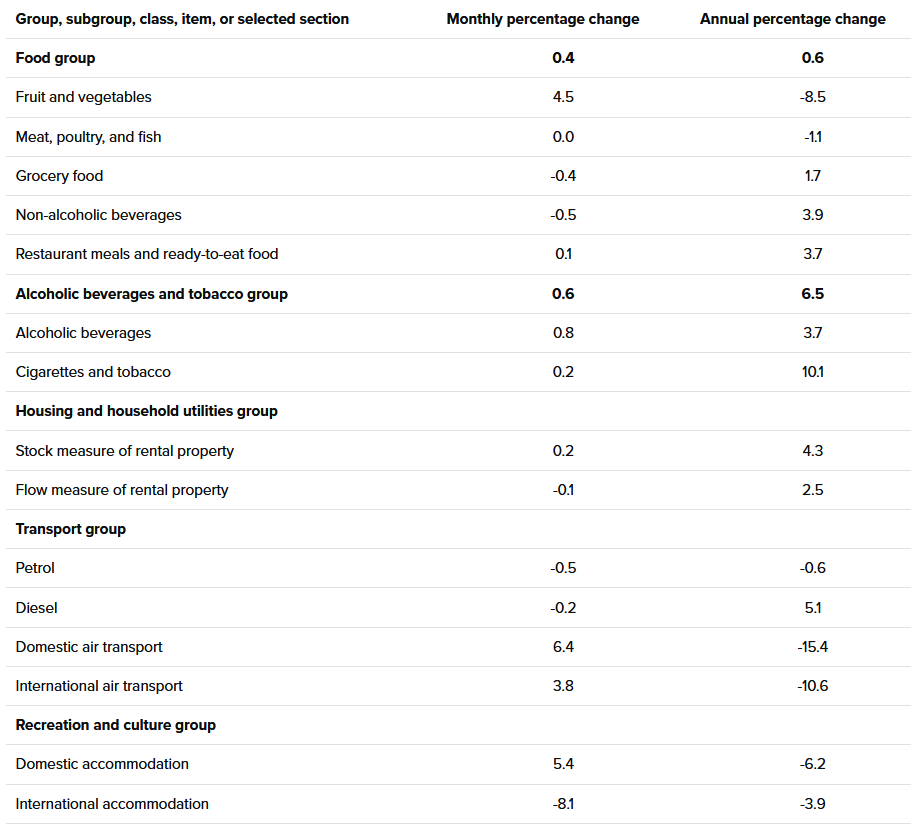
Statistics NZ says in the year to July 2024 food prices increased 0.6%, following a 0.3% decrease in the year to June.
However, separately rents increased 4.3% in the year to July and this is actually the slowest rate of increase since November 2023, showing that the recent rampant increases in rentals may finally be easing.
These figures are all part of Stats NZ's Selected Price Indexes (SPI), which features goods that make up about 44% of the quarterly Consumers Price Index, the official measure of inflation.
The SPI features some of the more volatile components in the CPI and has therefore proven a popular addition to the range of statistics being offered by Stats NZ since its introduction last year.
The latest figures come just a day after the Reserve Bank (RBNZ) cut the Official Cash Rate from 5.5% to 5.25% and forecast that annual inflation would fall to just 2.3% in the September quarter, down from 3.3% in June.
ASB senior economist Mark Smith said he had earlier thought that the RBNZ's inflation pick was "on the light side", but the latest SPI data "suggests that a sharp deceleration in headline inflation is not outside the realms of possibility, even though we believe that annual non-tradable inflation will prove to be slower to moderate".
ANZ senior economist Miles Workman said July's SPI "suggest a smidgen of downside" risk to the ANZ's own September quarter CPI forecast of 1.0% quarter-on-quarter (which would give an annual rate of 2.6%).
"However, some of the surprise came from the more volatile components, meaning there’s plenty of scope for payback next month," he said.
"Given typical volatility, we’re comfortable that today’s data are in the ballpark of our Q3 CPI forecast, and consistent with the RBNZ [Reserve Bank] delivering another 25bp cut [to the OCR] in October."
Westpac senior economist Satish Ranchhod said the SPI result "is consistent with a continued easing in inflation in the September quarter".
"That drop might be occurring a bit faster than expected but will wait to see how some of those volatile prices evolve," Ranchhod said.
He noted that the rent increases were slower than they had been and said with population growth slowing, "this could be a sign that the pressure on housing costs is at last moderating".
In terms of food prices, these were up 0.4% on a seasonally adjusted basis in July 2024, following a 1.0% increase in June 2024.
Fruit and vegetables were the largest contributor to this increase, with prices up 4.5%. After adjusting for seasonal effects, fruit and vegetable prices were up 0.8 percent.
"Price increases were seen from typical seasonal produce such as tomatoes, cucumbers, and apples,” Stats NZ's consumer prices manager James Mitchell said.
Going back to the 0.6% annual increase in food prices to July, this was partly driven by higher prices for restaurant meals and ready-to-eat food, which increased 3.7% in the 12-month period.
Despite the annual increase in overall food prices, prices decreased across the 12 months for fruit and vegetables (down 8.5%), and meat, poultry, and fish (down 1.1%).
Cheaper prices for kumara, lettuce, and potatoes drove the fall in fruit and vegetable prices.
“Kumara prices dropped to $5.72 per kilo, almost one-third of the peak price of $14.25 per kilo in January 2024,” Mitchell said.
In other SPI information, petrol prices fell 0.5% in July 2024, while diesel prices fell 0.2%. The Auckland regional fuel tax of 10 cents per litre plus GST was removed on 30 June 2024.
"Despite an overall decrease in petrol prices, Auckland was the only region to see lower prices in the month, while every other region in the country saw an increase," Mitchell said.
In terms of the rental prices, the so-called 'stock' price of existing rental agreements rose 0.2% in July, which was the lowest increase since early 2023. As stated further up, the annual increase for the 'stock' price at 4.3% was the lowest annual rate of increase since November 2023.
In other pricing information, the highly volatile air fare prices rose again in July - during the school holidays - after falling in June.
Domestic air travel fares were up 6.4% compared with a 15.4% fall in June, while international fares rose 3.8% compared with a 10.6% fall in June.
Here is the detailed SPI information as supplied by Stats NZ:
We welcome your comments below. If you are not already registered, please register to comment
Remember we welcome robust, respectful and insightful debate. We don't welcome abusive or defamatory comments and will de-register those repeatedly making such comments. Our current comment policy is here.