

The number of filled jobs in New Zealand fell for the fourth consecutive month in July, according to data from Statistics NZ.
The figures strongly point to further rises in the unemployment rate.
Stats NZ's Monthly Employment Indicators (MEI) release showed that on a seasonally adjusted basis there was a 2,975 (0.1%) drop in the total number of jobs in the country to 2.37 million.
ASB senior economist Mark Smith noted that employment was 0.5% lower than this time last year, "the weakest since the GFC [Global Financial Crisis], with the July level 1.1% below March 2024 peaks".
This is the first time since the GFC that this data series has recorded four consecutive months of falls on a seasonally adjusted basis.
The MEI figures are not directly comparable with the unemployment figures that are sourced from Stats NZ's Household Labour Force Survey (HLFS) - but they do tend to be a good forward indicator.
Unemployment as at the June quarter was 4.6%, having risen increasingly swiftly from its cyclical low of 3.2%. The Reserve Bank's forecasting that in this current quarter unemployment will rise to 5.0% and it expects it to peak at 5.5% next year.
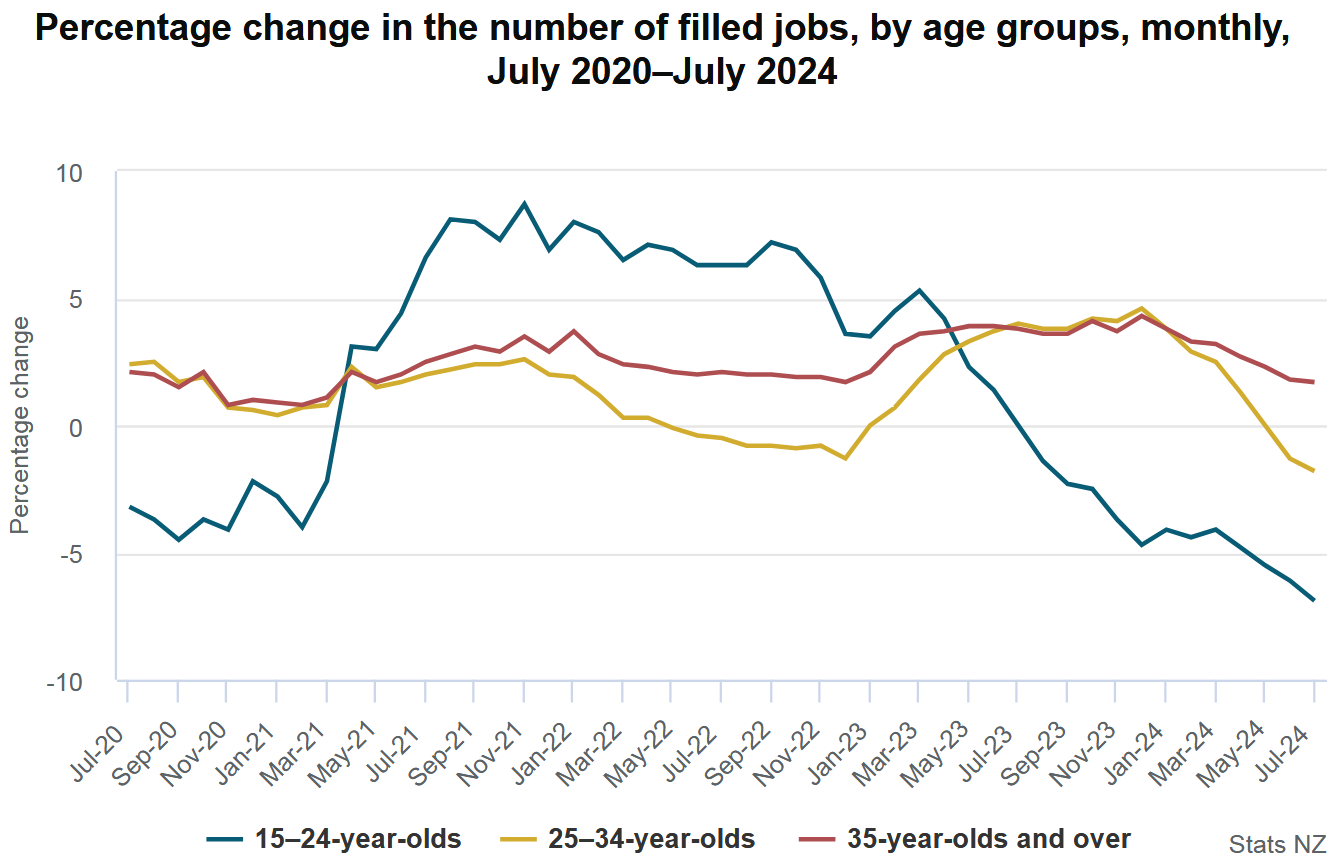
In its MEI release for July Stats NZ noted that the drop in filled jobs was across all age groups, but it made reference to the softness in employment for the young and said that in the three month period to July 2024 among the young age brackets:
- 15 to 24-year-olds, down 10,840 jobs (3.1%)
- 25 to 34-year-olds, down 10,056 jobs (1.8%)
- 35-year-olds and over, down 7,375 jobs (0.5%).
Filled jobs for 15 to 24-year-olds have been decreasing on an annual basis since August 2023, and the 25 to 34-year-olds began showing annual decreases from May 2024.
"Business demand for labour has weakened over the past year and the younger age groups can be the most affected by supply and demand shifts in the labour market," Stats NZ's business employment insights manager Sue Chapman said.
In July 2023, one-third of all 15 to 34-year-olds in filled jobs were in retail trade, accommodation and food services, or construction industries. While these industries were down over 18,000 filled jobs annually, the largest decreases across the 15 to 34-year-olds in the year to July 2024 were:
- accommodation and food services, down 6,841 jobs (6.7%)
- construction, down 6,460 jobs (7.2%)
- administrative and support services, down 5,806 jobs (12.7%).
Westpac senior economist Michael Gordon said job losses are now "becoming apparent across many industries".
"Manufacturing, construction and retail have seen extended declines over the last year, but they are increasingly being joined by a range of services sectors. Healthcare, public administration and finance are among the few remaining sources of growth," he said.
"Even if we see some flattening-off in the jobs figures in the months ahead, the soft starting point for the September quarter means that we’re likely to see some weak results overall in the HLFS. We’re currently forecasting a rise in the unemployment rate from 4.6% to 5.0% in the September quarter."
ASB's Smith said he continues to expect the labour market to "progressively loosen" heading into 2025, with the balance of power to progressively move in favour of employers.
"The primary driver is expected to be the weaker demand for labour, with anaemic economic activity over 2024. Pressures on profitability are also expected to significantly constrain future rises in employment and wages, with the labour hoarding of 2022/23 increasingly likely to give way to labour shedding.
"Our expectation is that the NZ unemployment rate will continue to head higher, moving well above 5% by the end of 2024 and likely peaking at around 5½% in mid-2025. Forward indicators – job advertising and surveyed employment intentions – point to further retrenchment in hiring."
We welcome your comments below. If you are not already registered, please register to comment
Remember we welcome robust, respectful and insightful debate. We don't welcome abusive or defamatory comments and will de-register those repeatedly making such comments. Our current comment policy is here.