

It's the last big piece of the jigsaw puzzle ahead of the Reserve Bank's final Official Cash Rate review for the year on November 27.
Statistics NZ's suite of labour market data, including the unemployment figures, is to be released on Wednesday, November 6.
The universal expectation is that the unemployment figure for the September 2024 quarter will have risen - but by how much? That's the question. And that's the important bit when we consider any potential immediate impact on interest rates.
As people speculate on what the RBNZ will decide to do in its last OCR review for 2024, it's with the thought that the only way the unemployment figures might affect the decision is if they are much worse than is commonly expected. The RBNZ would need to be surprised on the high side by the figures in order to have its collective mind changed about what to do with the OCR on November 27.
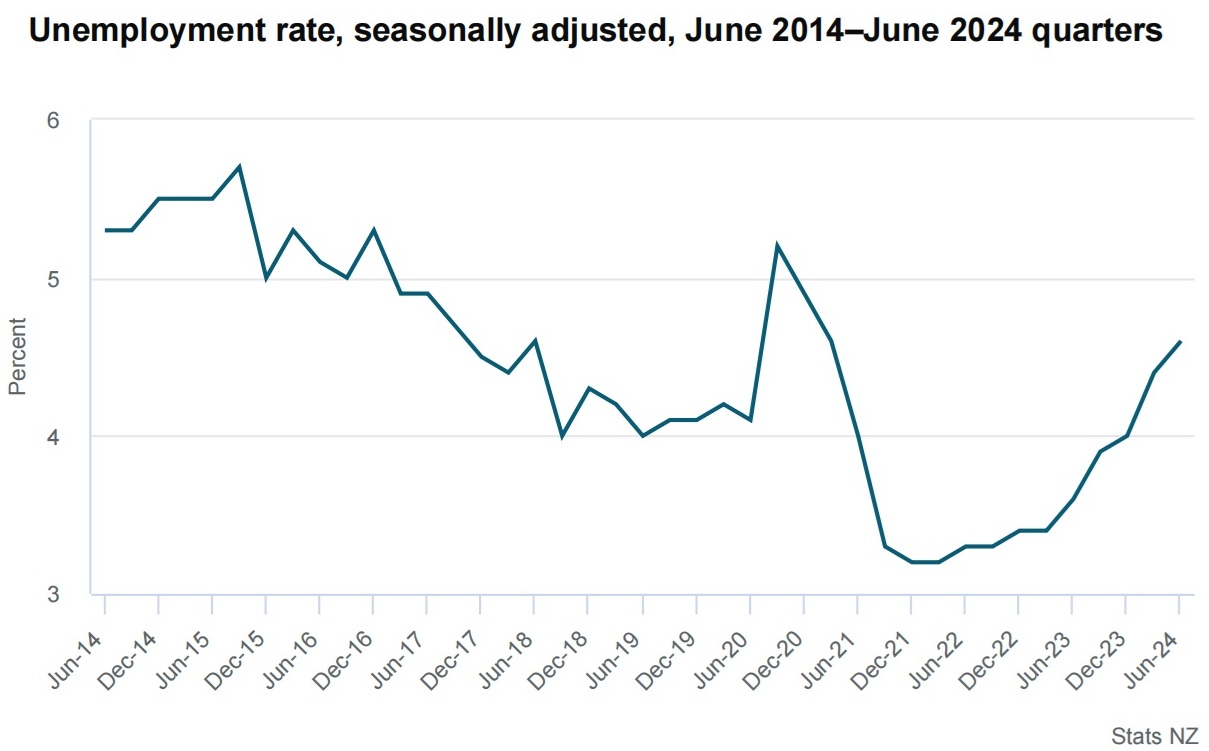
And the threshold for a 'surprise' for the RBNZ is a high one. That's because in its latest set of detailed forecasts contained in the August Monetary Policy Statement (MPS), the RBNZ forecast that the unemployment rate would rise from the 4.6% recorded in the June quarter, to 5.0%. That would be quite a rise. But the RBNZ's not alone in thinking the rise may be of that magnitude. And other already released data would appear to be supportive of that view.
Shrinking filled jobs numbers
Statistics NZ's monthly employment indicators (MEI) for September showed that in the past year the number of filled jobs has fallen by over 20,000 (0.9%). Young people have been particularly affected, while the hardest hit forms of work have included construction, administrative and support services, accommodation and food services, and manufacturing. The MEI figures are sourced from income tax figures and so are quite different to the official unemployment figures, which come from Stats NZ's Household Labour Fource Survey. But the MEI has often proven to be a good lead indicator previously. Economists reckoned those latest MEI figures roughly point to the unemployment rate having risen to 5.0%.
The last time unemployment touched the 5.0% level was in September 2020, when it hit 5.2% as part of the brief Covid lockdown-period spike. After that spike, however, unemployment fell rapidly, as demand in the economy continued at much higher levels than had been expected, while employers saw their ability to attract new workers severely hampered by the border closure.
As a result, the unemployment rate dropped all the way to just 3.2% as of December 2021 and March 2022. Extremely low as that figure was, there's actually a fairly good argument to make that the figure even understated the tightness of the labour market. It was so difficult to get workers at the time that there's reasonable anecdotal evidence to suggest that many employers simply gave up trying to fill jobs.
When a labour market becomes incredibly tight this causes the economy to overheat and inflation to emerge - or at least be accentuated. Therefore the RBNZ, while never allowing itself to be seen as actually cheerleading for higher unemployment, was nevertheless looking for 'slack' to start developing in the labour market so that the economy could start to meaningfully cool. All of this, of course, was to get inflation down from the soaring 7.3% level seen in mid-2022 and back into the RBNZ's 1% to 3% target range.
Well, we are back now, with annual inflation as at the September quarter sitting at 2.2%.
The economy certainly cooled. On a per capita basis GDP has contracted for seven consecutive quarters.
When will we recover?
Interest rates are down and will continue to come down for the moment. So, how quickly will our recessionary economy start to recover again and when will job losses abate?
In its August forecasts the RBNZ picked that after hitting 5.0% in September the unemployment rate would climb strongly again in the December quarter that we are now in, hitting 5.3% by the end of the year. The RBNZ picks a peak unemployment rate of 5.4% in the March quarter and for the rate to then start falling - but only slowly - to 5.2% by the end of next year.
Most of the big bank economists are picking the unemployment will go a little higher than the RBNZ thinks and, indeed ASB economists reckon the rate may get as high as 5.9%.
So, to go back to the point about the possibility of any impact on the next OCR decision from the upcoming unemployment figures; well, if they were to be measurably worse than the the RBNZ is picking, this could suggest the economy is in worse shape than the RBNZ has thought - and therefore more instant relief through more rapid interest rate reductions could be needed.
Financial markets are still pricing in about a one-in-four chance that the OCR, currently on 4.75%, will be slashed by 75 basis points at the November 27 review.
Measuring the cuts
RBNZ Governor Adrian Orr during public engagements in Washington DC last week appeared to offer some pushback to the aggressive financial market pricing, saying in response to a question, that the RBNZ "can be more incremental" on the way down with the pace of the OCR cuts. But he did also say, separately, that he didn't regard 50 basis point cuts as "jumbo" cuts. All of which might lead us to think that another 50 point cut could be what we see on November 27 - if the job figures don't suggest more urgent action is required. Don't hold me to that though. This is an RBNZ that can and does defy expectations on regular basis.
Is there any chance at all the unemployment figures might surprise on the downside? And what would the RBNZ's attitude be?
Well, the data we've seen so far, along with anecdotal evidence, tends to suggest it would be a very big surprise indeed if the unemployment figure didn't at least rise, even if it is to something still under 5%. Even if the figure were to stay the same as in June - 4.6%, or 143,000 people, (and, look, it won't) - then I think the RBNZ would largely discount it from its OCR considerations. After all, its all really about inflation. And now that's back in its box, the RBNZ will be looking to keep a steady path with rate reductions in order to allow the economy to recover.
As, I say, I think the chances are far greater that we get an unemployment figure that suggests job losses are happening more quickly and in greater numbers, than expected. And that would give the RBNZ something to think about. As said earlier, with the RBNZ already expecting a sharp climb in unemployment, such a scenario seems unlikely. But not impossible.
*This article was first published in our email for paying subscribers first thing Friday morning. See here for more details and how to subscribe.
We welcome your comments below. If you are not already registered, please register to comment
Remember we welcome robust, respectful and insightful debate. We don't welcome abusive or defamatory comments and will de-register those repeatedly making such comments. Our current comment policy is here.