
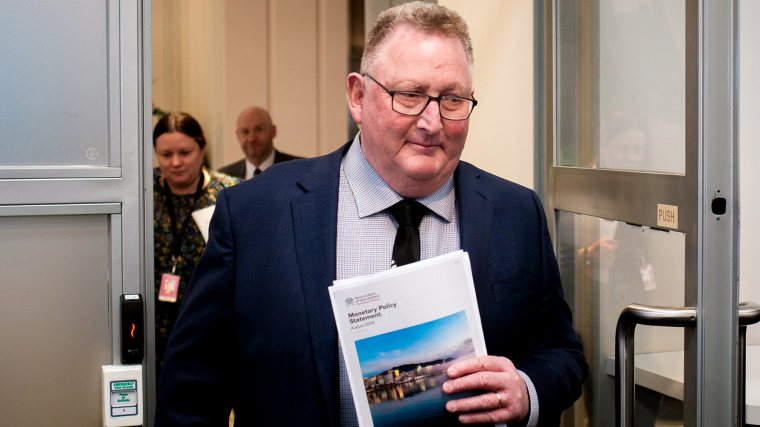
Reserve Bank (RBNZ) Governor Adrian Orr is hinting that the Official Cash Rate (OCR) might come down rather more slowly than it went up.
In question time after giving a speech in the United States on Thursday, Orr referred to the speed at which the OCR was put up by the RBNZ between 2021 and 2023 when it was hiked from just 0.25% to 5.5%.
"If we were incremental getting back to [a] neutral [interest rate] we would still be halfway there at the moment in the traditional way," he said.
"So, just quickly do it and let people get a handle on it."
Now that the OCR is on the way down, currently at 4.75%, the financial markets are expecting this might happen very quickly as well. Current market pricing is suggesting a fair chance that there will be a 75 point cut at the next OCR review next month, while a move of the OCR to 3.75% or even lower is fully priced in for early next year.
But Orr appeared to push back a little against this thinking with his comments.
"On the way down we can be more incremental now – and we have been," he said.
"We are being more incremental because we are in calmer waters but also because of that lingering inflation persistence on the domestic side. So, we are happy to be less restrictive but I said it is in sight. We are not saying that we are now in loosening space to do it.
"So, just being a bit more circumspect on the way down relative to how we got there is the general idea.
"By the way, the markets say yeah, whatever Adrian and they’ve already priced in 200-300 [bps of cuts]. But that’s all right. That’s what makes markets," he said.
Earlier Orr had said the RBNZ had needed to head off a monetary policy "mutiny" in New Zealand with inflation expectations rising and price setting behaviour changing.
In a heavily nautically-themed speech titled Navigating Monetary Policy Through the Unknown made to the Peterson Institute, Washington DC on Thursday, Orr said getting NZ inflation back into the 1% to 3% target range - as it is now - was "something to celebrate".
Orr has been attending the IMF and World Bank Annual Meetings, where policymakers are discussing monetary policy.
"Navigating monetary policy, with a one-to- two-year lag between policy action and ultimate outcome, is akin to ocean circumnavigation," Orr said.
He said that after the immediate shock of the onset of Covid in 2020, by early-2022 "the navigational signs had changed".
The risk of a deep and sustained recession had receded, and persistent inflation had begun to permeate the economy. Inflation expectations had risen significantly.
"The biggest risk to our objectives was now that of high inflation becoming entrenched, and the economic and social costs that would be required to subsequently bring it back down. We soon reversed our quantitative easing programme.
"One of our key navigational stars – the estimated neutral interest rate – was a long way north of where we sat, so we again moved swiftly to get back on course. Again, the MPC [RBNZ Monetary Policy Committee] steered policy forcefully to avoid the most serious risk – the worst-case – by tightening our policy setting to return inflation to target. This meant risking a shallow recession in the short-term to avoid the risk of deeply entrenched inflation, and a much deeper recession in the long term.
"A monetary policy ‘mutiny’ needed to be headed off, with inflation expectations rising and price setting behaviour changing. I am pleased we are now in relatively calmer waters and the crew and passengers are believing again in low and stable inflation.
"...We are in a situation where we can provide the perspective of an economy returning to low and stable inflation, interest rates becoming less restrictive, and economic activity being revitalised. But that is just the most recent navigational plot on the ocean chart," he says.
"We must also be cognisant of unanticipated risks ahead, and at times act swiftly to avoid perils. First, stay afloat. For monetary policy makers, peril includes a long and persistent downturn, with monetary policy stuck at the effective lower bound, or an inflationary spiral. Over recent years, global monetary policy navigators have had to act fast to avoid both perils.
Still restrictive
"It is now pleasing to be able to ease monetary policy in New Zealand, but it’s still at a level we think is restrictive, so as to work against any remaining inflationary tendencies that may linger.”
Having raised the Official Cash Rate as high as 5.5% by mid-2023, the RBNZ has now reduced it, with consecutive cuts in August and earlier this month to 4.75%.
Markets are expecting another cut of at least 50 basis points in the last OCR review of this year on November 27.
But Orr is still questioning how long it will take for any "lingering inflationary pressures" to dissipate.
"The sooner this happens, the sooner we will be able to claim that the inflation caused by Covid-19 – amongst other severe shocks — is behind us."
Inflation rose rapidly in New Zealand from just 1.5% as of March 2021 to a peak of 7.3% in June 2022. Now, however, it is back down to 2.2% - and expected to go still lower.
Orr said he often reflected on early 2020 and asked himself the question: "If someone offered me a peak of 7.3% inflation and unemployment around 3% in two years’ time – would I have accepted it? Yes!
"That sounded like nirvana compared to what the world was leaning into at the time. This was the eventual outcome in New Zealand – with many lessons learnt – and new shocks having been faced on the voyage, such as Russia’s invasion of Ukraine, energy price spikes, and weather-related food price shocks."
How long will inflationary pressures persist?
Orr said the answer to the question of how long inflationary pressures may linger in New Zealand depends heavily on how firms make their price-setting decisions, and how persistent that process is.
"Firms tend to set their prices based on a broad range of price signals in the domestic and global economy – the prices of competing and complementary products, wage rates and the broader costs of labour and capital, transport, exchange rates and so on.
"Because these prices and costs all move with general inflation, firms’ pricing decisions will reflect recent actual and expected inflation. The same goes for wages. These interdependent price changes can see actual inflation persist even if demand and supply in an economy are broadly balanced.
"We see this in New Zealand in persistence in domestic and services inflation, despite significant spare capacity now emerging in the economy. This isn’t surprising given the recency of high inflation."
Orr said the RBNZ was "alert" to changes in price setting processes.
"In New Zealand, firms’ inflation expectations have returned towards our 2% target midpoint, after having risen materially . Household inflation expectations have also declined. This is encouraging. However, surveyed inflation expectations alone don’t explain the persistence in inflation we’ve observed over the past year," he said.
"We’ve found that accounting for observed inflation in our models helps us to better explain inflation. This is likely to reflect – among other things – that following a period of high (or low) inflation, some prices may need to adjust by more (or less) to restore relative prices to equilibrium. Contracts and government policies that index charges to inflation also contribute to this persistence.
"Reflecting this, we often model this part of the price-setting process using a moving average of past inflation, with more weight on the recent past than on the distant past. Our approach implied that the recent bout of high inflation would be embedded in firms’ price-setting decisions for years to come.
Altered assumptions
"But is this a good assumption in all conditions?
"At the time of our recent August Monetary Policy Statement, we altered our price-setting assumptions so that they adapt more quickly to a low inflation environment," Orr said.
"This is a judgement that we have had to make with perspective, empathy and courage.
"The outcome was material to our policy decision in August, giving us more confidence to reduce our policy interest rate."
Orr said other changes in pricing behaviour are "equally challenging" to model.
"For example, it’s possible that firms’ price-setting behaviour has been ‘scarred’ by the recent period of high inflation.
"But it could also normalise more quickly."
Orr said there is evidence to suggest that people (businesses and households) pay more attention to the state of the economy when inflation is high and volatile. By contrast, when inflation is low and stable, people have less to gain from understanding the nuances of the inflation outlook as they often have better things to do. This is coined ‘rational inattention’.
Firms also adjust prices more frequently when inflation is high as it becomes more costly not to keep up.
"These dynamics give us reason to assume that price-setting behaviour may normalise quickly as we return to a low inflation environment. Rationally, attention will go elsewhere," Orr said.
We welcome your comments below. If you are not already registered, please register to comment
Remember we welcome robust, respectful and insightful debate. We don't welcome abusive or defamatory comments and will de-register those repeatedly making such comments. Our current comment policy is here.