

There's a fair chance New Zealand's unemployment rate will hit a four-year high when official labour market figures are released on Wednesday, February 5.
The labour market data is the last key economic release ahead of the Reserve Bank's first review of the Official Cash Rate for the year on February 19. And it seems unlikely there will be anything in the figures to put the central bank off its near-promise to drop the OCR another 50 basis points to 3.75%. Remember, before the RBNZ began cuts in August 2024 the OCR was sitting on a cycle peak of 5.50%.
Remember also, that the current Coalition Government removed the requirement for the RBNZ to achieve maximum sustainable employment alongside the achieving of inflation between 1% to 3%. Which is not to say the labour market isn't still a big consideration for the central bank because high wages could affect inflation, or high unemployment could have considerable economic and financial stability ramifications.
So, it still matters a lot.
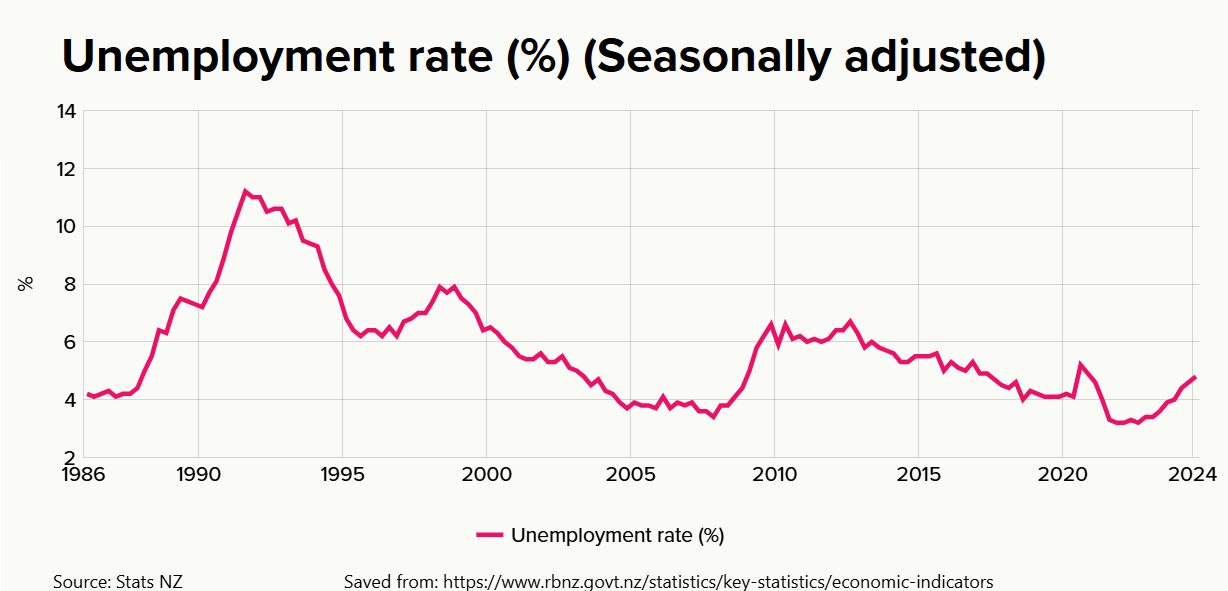
As of the September quarter 2024 our unemployment rate hit 4.8%, up from 4.6% in the June quarter. Since troughing at just 3.2% in the September 2022 quarter, our rate of unemployment has risen quite swiftly.
The RBNZ is picking the figure for the December 2024 quarter will be 5.1% and it sees unemployment peaking at 5.2% in the March 2025 quarter before slowly declining again, to hit 4.8% by the end of the year. (The RBNZ reckons unemployment will still be 4.4% going into 2027.)
At time of writing I haven't seen all the bank economists' previews of the labour market figures, but there seems to be a reasonable level of agreement that a figure of somewhere just over 5% will be what we get for the December quarter.
Highest since the pandemic spike
If so, that will be the first time our unemployment has hit 5% since a very brief spike to 5.2% in the September 2020 quarter after the onset of the pandemic early that year. Before that one-off knock, the last time we saw unemployment of 5% was as long ago as the end of 2016.
While it's never good to see people losing jobs, if the peak rate in this cycle ends up being about 5.2% then in terms of historical perspectives we won't have done too badly, particularly not when we consider that our last two quarterly GDP out-turns have been a drop of 1.1% in June 2024 and a drop of 1.0% in the September 2024 quarter.
The long recession of the early 1990s was a shocker and we saw unemployment peak at 11.2% in the 1991 September quarter and remain high for a long time after. At the end of 1998 there was another mini-peak of 7.9%.
After that the next big downtime was the aftermath of the Global Financial Crisis, which saw unemployment peak at 6.6%, but recover only slowly. In fact the rate was above 5% all the way from March 2009 till the end of 2016.
Here's a graph courtesy of the RBNZ (using Statistics NZ data), which puts the current situation into a nice historical perspective:
Unemployment's what the economists like to call a 'lagging indicator'. What that means in layperson's terms is that the unemployment rate will tend to reflect what HAS BEEN happening with the economy, not WHAT IS happening. Unemployment tends to start rising late in the economic cycle and then start dropping as the next one is already under way.
With the RBNZ now nearly six months into an interest rate easing cycle things are beginning to turn up again - at least in terms of sentiment if not necessarily yet in clear-cut visible tangible ways. It may well be that the economy stopped going backwards in the December quarter, although we won't find that out officially for a while.
A turning tide?
And there are even some early signs that the old lagging indicator of unemployment may be on the verge of turning.
Stats NZ's Monthly Employment Indicators (MEI) are taken from Inland Revenue data so are quite different in source to the official unemployment measure, which comes from Stats NZ's own Household Labour Force Survey (HLFS).
But the MEI has proven in the past to be a good indicator of future employment trends - and it's now on the improve after a dire trot during last year. There was seven consecutive months of falls in filled jobs from April to October 2024 - but the last two months have seen positive figures. Only mildly positive, but positive nevertheless.
All of which does maybe point toward a peak in the official unemployment numbers soon.
What would be the RBNZ view if the unemployment numbers do start coming down maybe sooner than it expects? Well, it's main concern would be if this fires up inflation. It will therefore be keeping a close eye on wage rises.
Private sector average hourly earnings as recorded by Stats NZ's Quarterly Employment Survey (which is part of the suite of labour market measures to be released in the coming week) saw a peak increase of 8.5% in the year to September 2022.
As of September 2024 that annual figure was down to 3.2% and the RBNZ is forecasting a further fall - to 2.8% - for the 2024 calendar year. If the figure is in around that level, there'll be no concerns from the RBNZ.
With that, I will leave you with a couple of comments from big bank economists.
What the economists say...
ASB senior economist Mark Smith, who picking 5.1% unemployment in line with the RBNZ pick, says he continues to expect more "labour market slack" to accrue over the first half of 2025.
"The primary driver is expected to be the weaker demand for labour, with economic activity expected to remain subdued until an economic recovery unfolds later this year," he said.
"Soft demand and the weak backdrop for corporate profitability is slowing business activity and hiring. Overall employment levels are expected to edge lower until a modest recovery takes place later in 2025. Our expectation is that firms will carefully manage employee headcount until then."
ANZ economist Henry Russell and senior strategist David Croy, who are picking 5.1% as well, note that a 50 basis point cut to the OCR has been well signalled by RBNZ policymakers. Economic data releases since the November MPS "haven’t challenged that guidance".
"We don’t expect the Q4 [fourth-quarter] labour market data to shift the dial either," they say.
"While typical survey volatility in the HLFS can deliver surprises on the day, we don’t see it likely that such a surprise could alter the broader economic narrative.
"Past loosening in the labour market appears to have generated sufficient spare economic capacity to return underlying inflation to the target midpoint.
"Looking forward, timely indicators, such as our Business Outlook, suggest economic activity is gradually recovering. The pace of recovery from here, and how vigorously the labour market eventually responds to that will key for the RBNZ’s policy assessment."
*This article was first published in our email for paying subscribers first thing Friday morning. See here for more details and how to subscribe.
We welcome your comments below. If you are not already registered, please register to comment
Remember we welcome robust, respectful and insightful debate. We don't welcome abusive or defamatory comments and will de-register those repeatedly making such comments. Our current comment policy is here.