
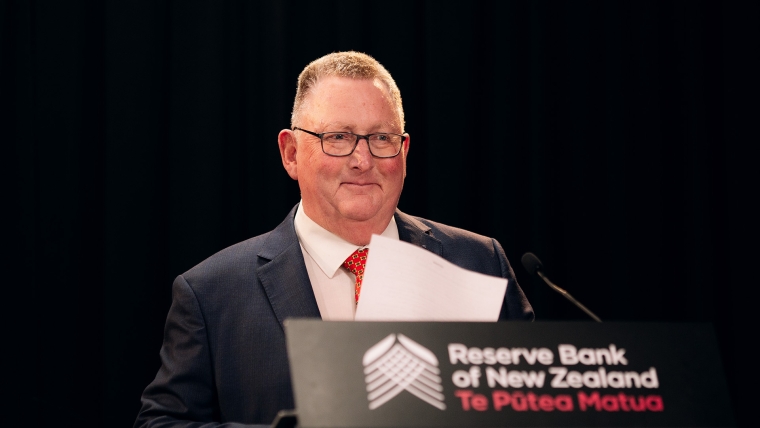
Policymakers at the Reserve Bank (RBNZ) want to get interest rates back to a neutral level before the end of the year, signalling more cuts to come in April and May.
The central bank’s Monetary Policy Committee cut the benchmark interest rate from 4.25% to 3.75% on Wednesday afternoon. This move was widely expected by market forecasters.
More newsworthy was the strong signal that the committee would continue to cut the Official Cash Rate (OCR) until it hits 3.1% by the end of the year.
Governor Adrian Orr said 25 basis point cuts were likely at the next two meetings if the economy evolved as forecast, but a final cut to 3% in late 2025 was less certain, with the RBNZ’s projections showing a roughly 60% chance.
Other forecasts show that a faster pace of cuts will weaken the NZ dollar relative to trade partners, driving up headline inflation through higher import prices. Meanwhile, economic activity and unemployment projections remain largely unchanged in the lower-rate scenario, demonstrating the need for cuts.
The output gap, a measure of economic slack, was revised from -1.5% in November to -1.7% in February, suggesting more spare capacity than previously estimated. Also, revised GDP data from Statistics NZ showed the economic slowdown began later but accelerated faster than expected at the November meeting.
Orr said the outlook changes were minor, and the lower OCR track mainly reflected the committee’s growing confidence that inflation would stay within the target band.
Risks either way
The risks to the new forecast were split. In the near term, there was a risk the economy would not pick up as quickly as expected. It was difficult to predict a turning point, he said.
But then there was also a risk growth could gather too much momentum and reignite inflation problems. This can happen if deferred investment gets released all at once, as interest rates fall.
"In the near term, it may take a little bit longer, if people want to see other people are spending before they do, and then in the medium term, it could come back quicker," Orr told reporters.
“We played the mental exercise, if we had to buy insurance today, what would we be insuring against? And that's unclear. In other words, [we’re] in a pretty good position.”
He said the New Zealand economy was entering a “benign period” for the RBNZ, with the exchange rate at its fair value, interest rates nearing neutral, and inflation on target.
One big concern for the future is how US President Donald Trump’s tariffs might play out for inflation and economic growth, but the RBNZ’s chief economist Paul Conway said it was too hard to predict what it might mean for interest rates.
“There's a lot of uncertainty about it currently, but it's clear tariffs are negative for growth, both globally and here in New Zealand, and the effect on inflation is uncertain”.
Slower growth might result in lower interest rates, but less efficient supply chains might mean higher prices and higher rates. It would be highly scenario specific, Orr said.
Good as it gets
Whatever happens, households shouldn’t expect retail interest rates to drop much further. The OCR mainly affects short-term rates, while global factors drive longer-duration rates.
RBNZ assistant governor Karen Silk said the market had been pushing rates up to account for US trade policy and higher levels of sovereign debt in many economies.
“I would say that the expectation that longer term rates will move substantially lower is probably a lot less [than with floating rates],” she said.
The average rate on existing mortgages is expected to fall to 5.8% by the end of the year, down from 6.4% in late 2024.
Most bank economists thought the RBNZ was moving rates in the right direction, and that their new outlook better aligned with market forecasts.
But Infometrics chief forecaster, Gareth Kiernan, said the central bank’s assessment of risk looked unbalanced and that it risked “overcooking the monetary policy easing”.
“We see a real chance that faster or more cuts by the Bank lead to another monetary policy overshoot, amplifying the economic cycle again, and necessitating another tightening cycle in 2026,” he said.
We welcome your comments below. If you are not already registered, please register to comment
Remember we welcome robust, respectful and insightful debate. We don't welcome abusive or defamatory comments and will de-register those repeatedly making such comments. Our current comment policy is here.