
A High Court hearing began in Wellington on Monday, as climate advocacy groups Environmental Law Initiative and Lawyers for Climate Action take on the Government over its climate change plans.
The groups allege that Climate Change Minister Simon Watts’ decisions breach the law and endanger New Zealand’s climate goals.
In a statement, Watts told interest.co.nz he was aware of the judicial review brought by Lawyers for Climate Action NZ and Environmental Law Initiative. "As the matter is before the courts, I can't comment further."
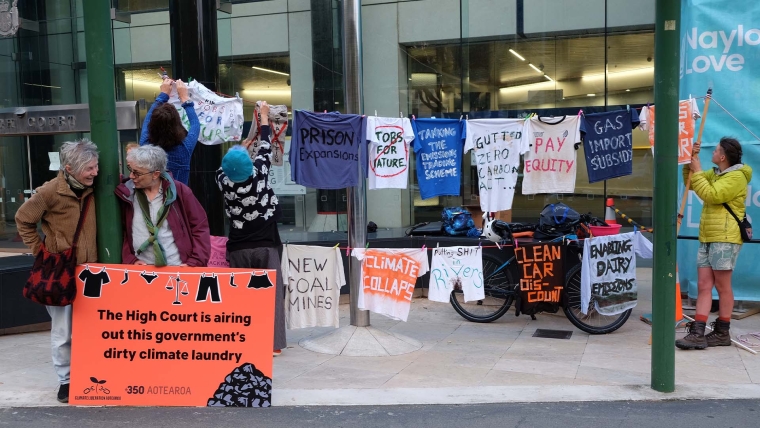
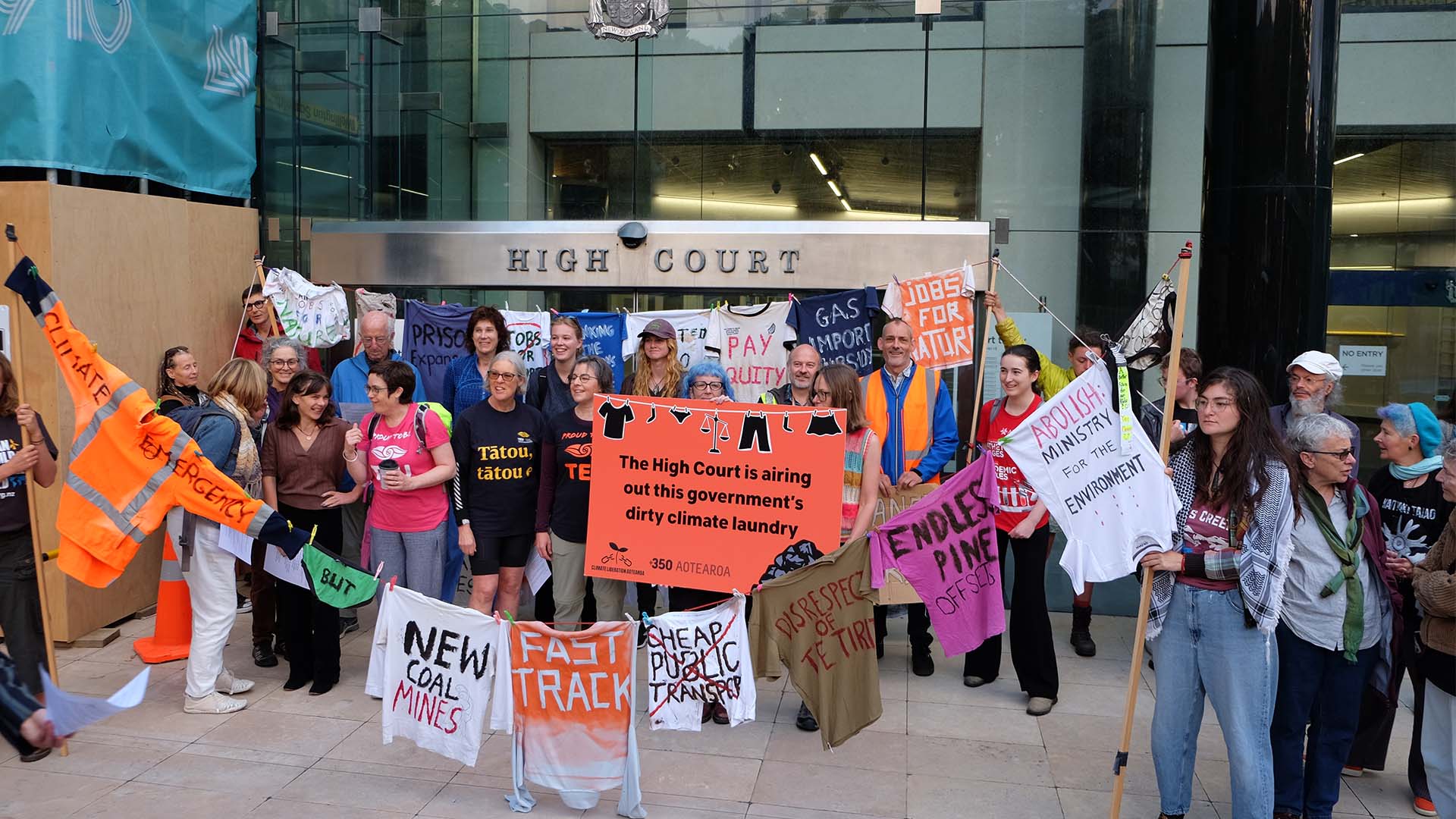
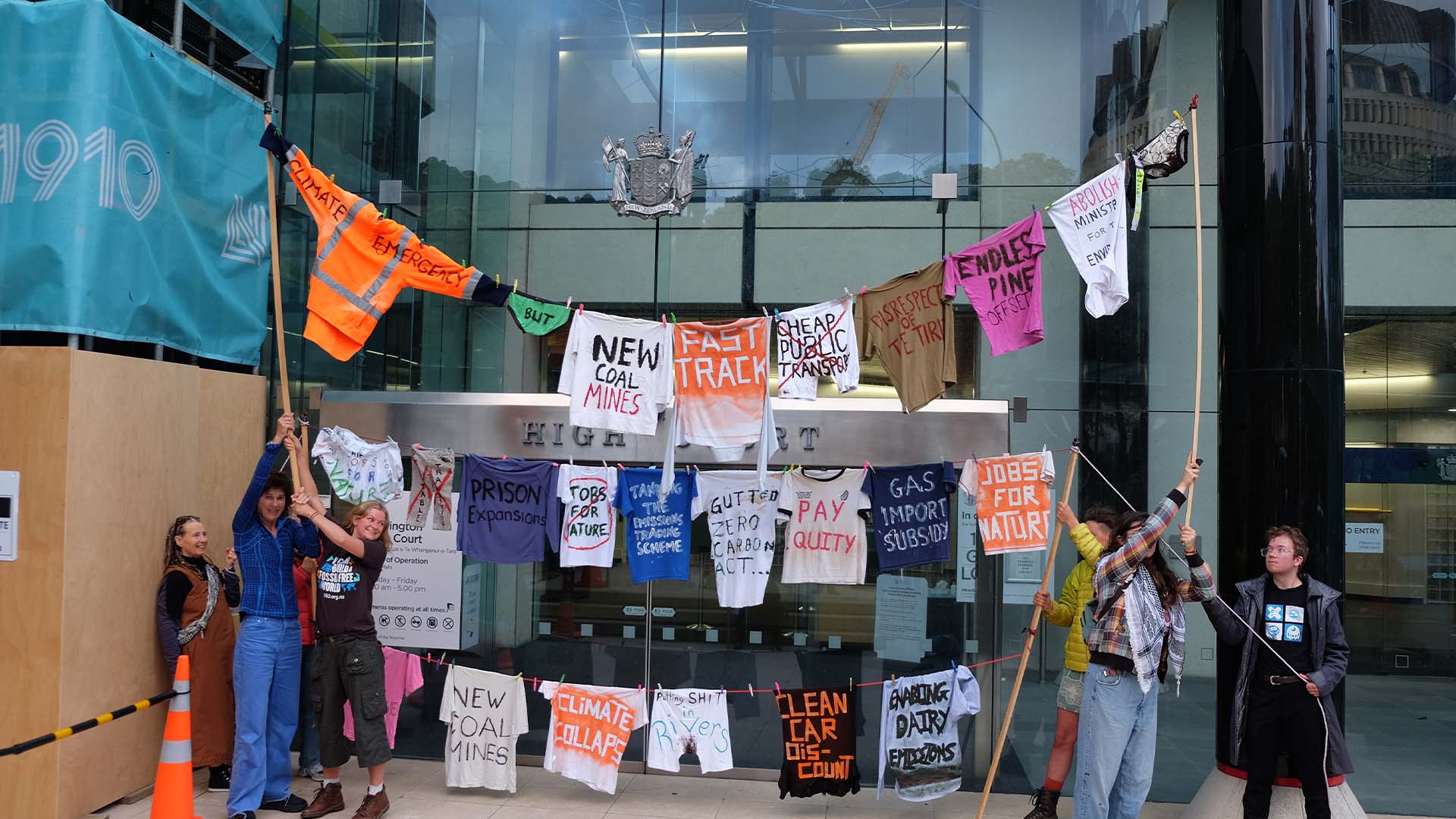
In the lead up to the hearing, there was a protest held by climate activist group 350 Aotearoa, where laundry could be seen. On the laundry, were policies that had been allegedly changed by the Government.
"The Government’s dirty laundry will be aired out in court for all to see," 350 Aotearoa campaigner Adam Currie says.
"The Ministers’ lawyers have been given an impossible job defending an undefendable climate record," Currie says.
“The Government’s climate strategy is about as credible as trying to hold up the sky with a broomstick. Pine trees get chopped, burnt, and toppled. You can’t cheat physics. It shouldn’t have to be said, but the only reliable way to lower emissions is to reduce high-emitting activities.”
Speaking to interest.co.nz before the hearing, Lawyers for Climate Action NZ executive director Jessica Palairet says Environmental Law Initiative and Lawyers for Climate Action are challenging the Government’s emissions reduction plan.
Under the Climate Change Response Act, the Government is required to have five-yearly emissions reductions plans. The Ministry for the Environment’s website says these plans; “help us navigate toward a low-emissions economy by setting out actions to meet our emissions targets. These budgets are stepping stones to our 2050 targets”.
Net zero has been a long-term target for New Zealand, where all greenhouse gases except methane emissions from waste and agriculture biological processes, are to reach net zero by 2050.
“This is the statutory plan the Government has to make under our main climate framework law and our main argument really is that plan doesn’t meet the guardrails required by the law," Palairet says.
It’s the first time this law has been tested, Palairet says, “and we are seeking some directions and orders before the court in relation to that plan”.
There are three main parts to the case.
The first is about looking back at what happened when the Government was first elected, and the projects and actions that were scrapped, she says.
“And this part of the case says the way in which you scrapped those policies without proper consultation didn’t follow the law and was unlawful,” Palairet alleges.
“We’re seeking declarations about that.”
“And then what happened is the Government replaced a lot of those policies with its new plan, which sets out how we’ll hit our 2030 emissions reduction targets.
“We have a range of issues with the new plan that the Government put in place,” Palairet says.
“It sets us off track for meeting future targets. We think it’s a really high-risk plan … the chances of it working are a little better than a coin toss. We say that’s not good enough."
The third part of the case, Palairet says, looks at the way in which the Government relies on forestry offsets.
“The Government is intending to plant hundreds of thousands of hectares of pine trees in order to reduce New Zealand emissions … We say well actually reducing emissions at source, if it’s through electrifying vehicles or reducing reliance on fossil fuels - that’s not the same thing as soaking up carbon from the atmosphere through trees.”
Palairet says Watts has assumed it’s the same thing.
“That’s the third part of the case, essentially saying we can’t plant our way out of the climate crisis but this plan proceeds on the assumption that we can.”
Climate policies
The Coalition Government has long been in the spotlight when it comes to climate change. In December it rejected all of the Climate Change Commissions’ emission targets recommendations. This adds on to changes made to the country’s climate policies.
These include restricting the Climate Change Commission to monitoring rather than advising on, emissions-reduction plans, removing the requirement for Emissions Trading Scheme settings to align with New Zealand’s Paris Agreement targets, and reducing the target for methane emissions. The New Zealand Government also reversed the offshore oil and gas exploration ban in June.
Also in December, Finance Minister Nicola Willis told the Finance and Expenditure Committee in a meeting that the Government was not prepared to send billions of dollars offshore to meet the Nationally Determined Contributions (NDC) under the Paris Agreement.
Countries can transfer carbon credits earned from reducing greenhouse gas emissions to help other countries meet their climate targets.
‘Just not good enough’
Palairet says: “It’s critically important that New Zealand reduces emissions and hits our emissions reduction targets. And this plan isn’t good enough. It’s not going to enable us to hit our 2030 methane target. It’s not going to enable us to hit future targets."
In December, Watts commented on the methane target, saying: "At the end of the day, we are a major exporting nation of primary goods."
“We need to ensure that we are balancing the reality of how we derive revenue in this country through exports in the primary sector, and not put in place policies that are going to drive that export and that food production to other countries that have a higher emissions profile.”
Watts said it was critically important that they have realistic and practical targets for farmers.
Palairet says “it’s a case that we’re bringing in the public interest because we’re really concerned”.
“We have an opportunity in New Zealand to reduce emissions, take care of our planet and do a better job. And this plan doesn’t pass muster.”
The hearing will take place over three days.
We welcome your comments below. If you are not already registered, please register to comment
Remember we welcome robust, respectful and insightful debate. We don't welcome abusive or defamatory comments and will de-register those repeatedly making such comments. Our current comment policy is here.