sign up log in
Want to go ad-free? Find out how, here.

A review of things you need to know before you sign off on Monday; Auckland new-build completions fade, business sentiment remains high, investors very concerned, large TDs popular, public service strike imminent, swap curve flattens, NZD hold, & more

Economy / news
A review of things you need to know before you sign off on Monday; Auckland new-build completions fade, business sentiment remains high, investors very concerned, large TDs popular, public service strike imminent, swap curve flattens, NZD hold, & more

Here are the key things you need to know before you leave work today (or if you work from home, before you shutdown your laptop).

MORTGAGE RATE CHANGES
No changes to report today. All current mortgage rates are here. And note, you can compare mortgage offers with our unique calculator that takes into account other costs and cashback incentives, here.

TERM DEPOSIT/SAVINGS RATE CHANGES
No changes here today either. All updated term deposit rates less than 1 year are here, for 1-5 years, they are here.

HOUSING SUPPLY TIGHTENS
New build homes being completed in Auckland were down -31% from the 2024 peak in June and back to near a four year low.

HOLDING HIGH
Business confidence fell 2 points in August to 54, while expected own activity eased 1 point to 48. Both remain at very high levels. Inflation indicators were mixed. Inflation expectations lifted from 3.14% to 3.26%, and more firms are expecting cost increases and to raise their own prices. But the size of expected cost increases is getting smaller.

NZIER’S SHADOW BOARD IN FAVOUR OF OCR HIKE
Over half of the NZIER’s Monetary Shadow Board nine members have recommended that the Reserve Bank (RBNZ) raise the Official Cash Rate (OCR) by 25 basis points on Wednesday. The Shadow Board, which is independent of the RBNZ, said raising the OCR from 2.5% to 2.75% reflects the view that the OCR needs to continue on its path of returning to neutral levels, given that inflation remains high (annual inflation came in at 4.1% in the June quarter). Across the Shadow Board member vote for the September meeting, BNZ head of research Stephen Topliss, BusinessNZ chief economist John Pask, Westpac NZ chief economist Kelly Eckhold, Victoria University emeritus professor Viv Hall and Sharesies co-CEO Brooke Roberts supported the OCR being raised to 2.75%. Kiwibank chief economist Jarrod Kerr, University of Otago associate professor Dennis Wesselbaum and Boffa Miskell CEO Kerry Gupwell thought the OCR should be held at 2.5%. Shadow Board member and former RBNZ Chairman Arthur Grimes provided no specific comment in the release from NZIER.

CANCELLED
Bowing to competitive political pressure, the Government has now formally cancelled the 12c/L fuel excise hike planned for next year. The road transport industry is not happy with what they expect will be deferred highway maintenance.

RISING AT THE INTEREST RATE
Housing debt rose +$1.4 bln in July from June, up +5.6% from a year ago. Just saying, but 5.6% is about the average interest rate on new and refixed home loans recently, and a cynic might say this is the main driver of housing debt growth. Business debt grew +4.4% and unremarkable over the past year. But rural debt rose +2.4% in July from a year ago, its second fastest expansion since September 2019. More than two thirds of the rural debt growth is by borrowers in the dairy industry.

MORE IN LARGE TDs
Household term deposits rose almost +$1.5 bln again in July from June, the fourth straight month of gains at this level or more. This month they were joined by strong company TD rises as well. (+$1.3 bln) but this only restored the unusual June dip. Transaction account balances were stable-to positive, savings account balances recorded the same minor rise. A third of all household term deposits (by value) are those between $250,000 and $1 mln. One in seven are between $1 mln and $5 mln. And a marginally smaller proportion (one in 7.4) are in the $50,000 to $100,000 range. One in eight are in the $10,000 to $50,000 band.

ELECTION PRESSURE STRIKE
Almost 10,000 public service workers will go on strike on Tuesday over bargaining for their respective collective agreements, including those working at the Department of Internal Affairs (DIA), the National Emergency Management Agency (NEMA), and the Ministry for Ethnic Communities (MEC); the Ministry of Business, Innovation and Employment (MBIE); and the Ministry of Social Development (MSD).

'VERY CONCERNED' ABOUT THE POLITICAL ENVIRONMENT
An ASB survey shows investors are keeping a close eye on domestic politics, with a record 40% saying they are 'very concerned' about how local political uncertainty will impact their investments. A further 46% said they were 'concerned', taking total concern to 86%. Global geopolitical and economic concern levels are also at a record high with 57% of investors 'very concerned'. However the same survey shows rising concern has not translated into more investment changes, with no increase in the proportion of people making or considering changes as a result.

BANK LEVERAGE
Our bank leverage summary page has been updated with the latest RBNZ Dashboard data. Of note is the slippage in bank returns to under 10% for the first time since the pandemic, and before that the GFC.

NZX50 REBOUNDS LED BY F&P HEALTHCARE
As at 3pm, the overall NZX50 index was up +0.7% today, but down -0.2% for the past 5 trading sessions. It is up +1.5% from six months ago. From a year ago it is now up +6.0%. Market heavyweight F&P Healthcare is up +1.5% so far today. Gentrack, SkyTV, Vista Group, and Kathmandu also rebound, while Vulcan Steel, Briscoes, Goodman and Tourism Holdings fall.

RISING EXPECTATIONS
In Australia, the Melbourne Institute's survey shows inflation expectations rose by 0.2 percentage points in August to 4.9%. This follows from a three-month period of moderating inflation expectations. Wage expectations also rose in August, after remaining static for a prolonged period.

BOUNCE-BACK
After the unexpected fall in June, Japanese retail sales surged back in July to be +4.4% higher than year-ago levels and restoring the strong gains they have been posting since March.

STILL CONTRACTING
In China, their factory PMIs for August improved marginally as expected but not by quite enough to avoid another contraction. Meanwhile their service sector PMIs were also expected to improve, but they didn't, staying with the same contraction they recorded officially in July. We need to note that these official surveys have been running more conservative than the private S&P Global alternatives recently. The S&P Global version is due out tomorrow for the factory sector, and on Thursday for the services sector.

SWAP RATE CURVE MOVES
Wholesale swap rates will likely be higher at the short end, lower at the long end today as rates flatten noticeably. Keep an eye on our chart below which will record the final positions closer to 5pm. The 90 day bank bill rate was up +2 bps at 3.05% on Friday. Today, the Australian 10 year bond yield is down -1 bp to 5.08% and still near 2011 levels. The China 10 year bond rate is down -1 bp at 1.69%. The Japanese 10 year bond is up +1 bp at 2.94% and a new 30 year high. The NZ Government 10 year bond rate is now at 4.76% and down -1 bp.. (The RBNZ data is now 'prior day' with the Friday rate up +1 bp at 4.74%.) And the UST 10yr yield is now at 4.71%, and down -1 bp from this morning's open.

EQUITIES MOSTLY LOWER, EXCEPT THE NZX
The NZX50 is now up +0.7% from Friday's close and that is the best of the markets we follow. The ASX200 has opened up +0.1%. Tokyo has opened down -1.6%. The KOSPI has fallen -1.0% at its open today. Hong Kong has opened down -.0.8% while Shanghai is down -0.4% at its open. Singapore is up +0.4% in early Monday trade today. Wall Street futures suggest the S&P500 will open on Wall Street tomorrow down -0.2%.

OIL PRICES RISE
American oil prices are up +US$1.50 from this morning on the Persian Gulf flare-up with the WTI benchmark is now just on US$85/bbl, while the international Brent price is now just on US$90/bbl and up +US$2.

CARBON PRICE FIRMISH
There have been quite a number of smaller traded today and the price now up +50c to $51.50/NZU. See our daily chart tracker of the NZU price for carbon, courtesy of emsTradepoint.

GOLD SOFTISH
In early Asian trade, gold is down -US$25/oz from this time yesterday, now at US$4429/oz. Silver is unchanged at US$66/oz.

NZD IN FIRMISH HOLD
The Kiwi dollar is up +10 bps from this morning, now just on 59.2 USc. Against the Aussie we are unchanged at 82.6 AUc. Against the euro we also unchanged at 51.1 euro cents. This all means the TWI-5 is now just under 62.7 and up +10 bps from this morning's open.

BITCOIN RETREATS
The bitcoin price is now at US$77,580 and down -1.8% from this morning. Volatility has been modest at just on +/- 1.6%.

HOW THE GLOBAL ECONOMIC FORCES AFFECT US
If you want to catch up on what happened last night, try our Economy Watch podcast, here.

Daily exchange rates

Select chart tabs

Source: RBNZ
Source: RBNZ
Source: RBNZ
Source: RBNZ
Source: RBNZ
Source: RBNZ
Source: RBNZ
Source: CoinDesk

Daily swap rates

Select chart tabs

Source: NZFMA
Source: NZFMA
Source: NZFMA
Source: NZFMA
Source: NZFMA
Source: NZFMA
Source: NZFMA

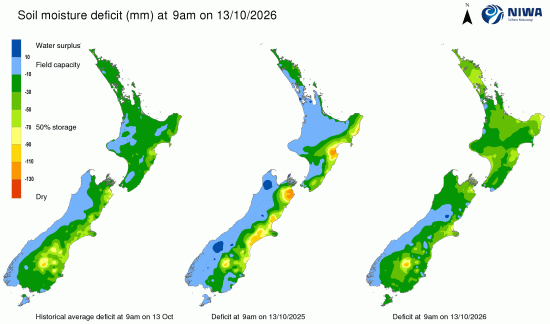
This soil moisture chart is animated here.

Keep abreast of upcoming events by following our Economic Calendar here ».

We welcome your comments below. If you are not already registered, please register to comment

Remember we welcome robust, respectful and insightful debate. We don't welcome abusive or defamatory comments and will de-register those repeatedly making such comments. Our current comment policy is here.

16 Comments

Which roading projects is the government cancelling to go with the cut in funding / cancelled fuel tax rise? It's hasn't risin in ages. With inflation and ever more efficient vehicles, the current NLTF isn't  enough to just maintain what we have, let alone build anythin new. Why do they keep the pretence going that we'll spend $12B on a third harbour crossing in auckland?

Up
2

Because their support-base is ignorant enough to swallow it. 

Conditioned by those who measure 'confidence' - which makes it easier. 

Up
2

Perhaps the unhappy road transport industry can donate some of their cash to maintenance? After all everybody else subsidises their trashing of the road network. 

Up
0

"Almost 10,000 public service workers will go on strike on Tuesday" No one will notice. Or care.

Up
4

Speaking from a structurally-restricted minority?

Who knows; maybe, just maybe, there's a bigger picture...

Up
1

PDK, "there's always a bigger picture". The problem is that many people can't see the trees for the wood.

Up
1

Almost 10,000 public service workers will go on strike on Tuesday over bargaining for their respective collective agreements, including those working at the Department of Internal Affairs (DIA), the National Emergency Management Agency (NEMA), and the Ministry for Ethnic Communities (MEC); the Ministry of Business, Innovation and Employment (MBIE); and the Ministry of Social Development (MSD).

Why don't we just get rid of these institutions and save a lot $

Up
1

Household term deposits rose almost +$1.5 bln again in July from June

These deposits are being devalued by the real inflation rate of about out 8% whilst earning 3% after tax at best.  So a 5% loss...

Up
1

This is true Dr Y. And when we need the boomers out spending their term deposits like drunken sailors. What they don't understand (if my thesis is right) is that the synergistic relationship between the Ponzi and spending is positively and causally correlated. Less spent in to the economy means less revenue and profits for business, which is also a drag on income growth. The mainstream economic thought is that this is positive for constraining inflation. While I don't disagree with this, there is little in the Aotearoa economy in the productive components to drive much at all. 

Up
1

My house makes more then me every year......    wait a minute.

Up
0

So what's the alternative Yvil? Crypto, Wall St bubbleland, Gold? It's true society can no longer afford itself by paying a return on savings, but these are not serious investments for those requiring somewhere to park their money whle earning a positive return for future needs, housing, retirement, children, etc.....

Personally, I measure the returns on deposits against property value movements which at the end of the day, is the only real investment of any intrinsic value. Measured against property the return on term deposit is well positive. I'm not worried in the least about the number of flights between Timaru and Wellington I can buy. 

Up
0

My numbers pretty much mirror yours, Yvil, maybe even slightly worse.

The Great Kiwi Cash Heist: How Your "Safe" Bank Deposits Are Getting Fleeced

For generations, the standard playbook for the average risk-averse Kiwi investor has been beautifully simple: grab your hard-earned cash, park it in a nice, boring bank term deposit or a steady bond, and sleep like a baby. It’s the financial equivalent of a reliable old Toyota Corolla - nothing flashy, but it’ll get you where you need to go with your principal fully intact.

At least, that’s the theory. In reality, a massive chasm has opened up between the sanitised economic bedtime stories we’re fed by official statistics and the financial horror show unfolding at the supermarket checkout. While the headline figures confidently assure us that inflation is settling down, anyone trying to keep a Kiwi household running knows the truth. 

Between skyrocketing council rates, insurance premiums that read like New York telephone numbers, and food prices that require a second mortgage, the actual cost of living is eating us alive. For the Main Street investor relying on fixed-interest coupons and bank deposit rates, this gap isn’t just an inconvenience, it’s a tragic wealth heist.

To see just how absurd this situation has become, you have to look at how the official numbers are cooked. The headline Consumer Price Index (CPI) is a beautifully engineered, generalised basket of goods designed to look as unthreatening as possible. It includes random discretionary items that pull the average down, neatly masking the aggressive price hikes hitting the things you actually need to survive.

Let’s be honest: the average household, especially a retiree, isn’t spending their weekly budget on cheap flat-screen TVs or fast fashion. They are buying fuel, paying the electricity bill, and watching their local council hike rates just for the privilege of existing. 

When these non-discretionary necessities balloon at multiples of the official headline figure, your personal, real-world inflation rate easily blasts past the official CPI of around 4.1% and lands somewhere north of 8.0%.

The grand irony of this entire setup is what it does to our retirees. Super-annuitants are told to play it safe, shift their money out of the "risky" stock market, and pile into fixed income to preserve their capital. 

At the exact same time, their daily expenses are dominated by the very things experiencing hyper-inflation, like medical costs and council rates. By doing exactly what the mainstream financial rulebook tells them to do, Kiwi retirees are being funneled directly into the meat grinder of purchasing power destruction.

The economic landscape has completely flipped the definition of safety on its head. 

In an era where essential living costs make a mockery of official data, the traditional "safe haven" of bank deposits and bond coupons is actually the riskiest place you can be. 

It is a guaranteed, mathematically locked-in mechanism for watching your wealth evaporate. If you want to protect your hard-earned cash from this silent heist, it’s time to realize that true safety isn’t a stable balance on a bank screen, it’s what that money can actually buy when you walk out the front door.

Up
0

Housing debt rose +$1.4 bln in July from June, up +5.6% from a year ago. Just saying, but 5.6% is about the average interest rate on new and refixed home loans recently, and a cynic might say this is the main driver of housing debt growth.

If the cynic is correct, this is not good. In principle, part of the measured increase in outstanding housing debt can be accrued or capitalised interest. I never bothered to look to see if the interest and capital are isolated accordingly - and it appears that it isn't. Would be interesting to know. And not sure if you can back in to this. You would think this. 

Up
0

Interesting that two of today's headlines are Auckland new-build completions down 31% from the 2024 peak and 86% of investors concerned about the political environment.

And you can probably see why.

Heading towards an election we've got Labour proposing a CGT on investment property, Te Pāti Māori proposing stamp duty, the Greens looking at further property tax changes and TOP proposing a 1.75% annual land tax.

You can debate the merits of each, but investors will still do the maths.

Make property investment more expensive and uncertain and some will sell, others won't buy, and importantly fewer developments may stack up.

Meanwhile Auckland is already building fewer homes.

If population keeps growing while new housing and rental supply tighten, I wouldn't be betting on cheaper rents.
 

Up
0

I wouldn't be betting on cheaper rents.

If you have higher costs of shelter with no or benign income growth, that means less money is spent in to the non-shelter economy.

More income earners per dwelling means that more income is available to spend (assuming that landlords are not charging per head). Fill a 3-bedroom house with 15+ people is a strategic choice for renters and an opportunity for the grifter. 

Up
0

AND Labour haven't Decided yet on interest deductibility.....    concerning?

Up
0