

The Reserve Bank will ultimately need to raise the Official Cash Rate by more than they assumed in their September meeting, Westpac NZ senior economist Satish Ranchhod says, as he expects “ongoing sizable increases” in administered prices like local government rates.
Even before the recent spike in oil prices, the Reserve Bank (RBNZ) has had “little headroom to absorb upside inflation surprises”, Ranchhod says, with the large cost increases to administered prices playing a role.
Administered prices are things like electricity prices, local government rates and insurance premiums.
With the expectation that many of these costs will continue to increase, Ranchhod says: "That is a key reason why we expect domestic (non-tradables) inflation will be higher than the RBNZ expects over the longer-term.”
“That ongoing firmness in domestic inflation is also a reason why we expect the RBNZ will ultimately need to raise the Official Cash Rate (OCR) by more than they assumed in their September [Monetary] Policy Statement," he says in a Westpac NZ economic bulletin, released on Thursday.
Westpac NZ economists are projecting a 25 basis-point rise at the RBNZ’s December meeting and expect the OCR will peak at 4% next year.
The Monetary Policy Committee raised the OCR to 2.75% from 2.50% at its September meeting. Although the RBNZ Governor Anna Breman has hinted at an OCR pause at the next meeting on October 28. Following the release of the latest gross domestic product (GDP) figures, some bank economists have since suggested that the OCR needs to increase at the October meeting.
Meanwhile, annual inflation, as measured by Statistics NZ’s Consumers Price Index (CPI) increased to 4.1% in the June quarter - the highest annual inflation rate NZ has seen since it hit 4.7% in December 2023. The RBNZ aims to keep inflation between 1% and 3% with a mid-point target of 2%.
Higher petrol prices were the main contributor to the June quarter CPI increase, which was no surprise as conflict in the Middle East has continued to impact fuel supply and has caused major supply disruption in the global oil market. If fuel prices had not changed, the CPI, according to Stats NZ, would have been 2.9% in the year to June.
Inflation is high for other reasons besides oil prices
Even before the spike in fuel costs, Ranchhod says inflation was running hot for an extended period, being above 3% since mid-2025, and above the RBNZ’s 2% target midpoint for five years.
“That persistent firmness in inflation is particularly notable as, based on RBNZ estimates, the New Zealand economy has had a negative output gap since September 2024, with softness in economic growth and a weak labour market. Those conditions would typically be associated with more moderate inflation than we’ve seen.”
He projects that inflation is set to remain outside of the RBNZ's target band (above 3%) until at least mid-2027.
Little headroom for RBNZ to absorb upside inflation surprises before fuel cost spikes
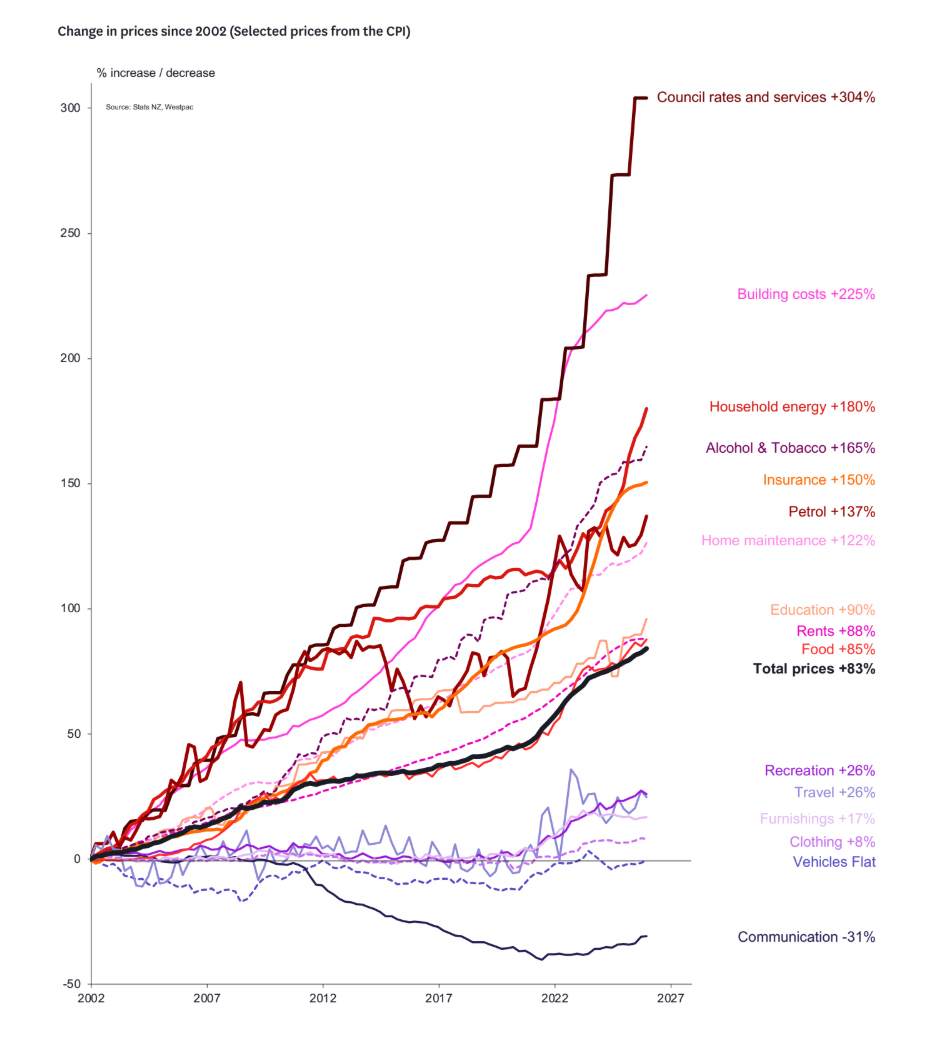
Ranchhod says looking beneath the surface, much of inflation's strength over the last year is due to administered costs, and price increases in parts of the economy with little, or no, exposure to competition.
“For instance, over the past year, local council rates rose nearly 9%, electricity prices rose by 12% and health insurance premiums rose by 19%.
“The less competitive nature of some of these sectors means they aren’t very responsive to changes in interest rates. Instead, they are most likely to behave in a ‘cost-plus’ manner. And in some cases, recent years have seen large increases in operating costs that are now being passed on to consumers.”
Ranchhod says the increases we are seeing are not one-off price rises, with large increases to administered costs happening for several years now.
“That’s been reflected in measures of core inflation, which strip out swings in volatile items like fuel and instead track the underlying trend in prices.”
Even without elevated fuel prices, inflation in the year to June was 2.9% - running close to or above 3% for five years now, Ranchhod says.
“That’s meant that the RBNZ had little headroom to absorb upside inflation surprises even before the recent spike in fuel costs.”
Ranchhod anticipates continued large increases in some administered costs. Using local council rates as an example, he says many councils will need to fund significant infrastructure spending over the coming years.
“There have been efforts to limit the extent of those increases, such as the Government’s cap on council rates. However, that doesn’t change the underlying reason for the large rates increases in recent years, such as increased spending on essential infrastructure. And if councils can’t raise the required revenue through rates, they may have to look at other approaches like user pays."
He says this could shift costs for households, rather than reducing them.
OCR will need to rise by more than the RBNZ has assumed
With the RBNZ focusing on the overall level of inflation rather than individual prices in the CPI, Ranchhod says: “In essence, it doesn’t matter why inflation is elevated - all that matters is that it is elevated and how persistent inflation will be.”
With core inflation already elevated, he says “it’s hard for the RBNZ to look through the large and continuing cost increases that we’ve seen across a range of areas that are less exposed to competition.”
“And given the risk of ongoing large increases in these costs, we expect that domestic (non-tradables) inflation will be higher than the RBNZ has assumed over the longer-term.
“That’s part of the reason why we continue to expect that the RBNZ will need to raise the Official Cash Rate by more than they had assumed in their September [Monetary] Policy Statement."
We’re forecasting a 25 basis point rate rise at the RBNZ’s December meeting and expect the OCR will peak at 4% next year. That risk is being compounded by the protracted nature of the current rise in oil prices, along with other risks such as El Niño which could boost food prices over the coming year.”
‘An uncomfortable but necessary trade-off’
Because administered costs are not responsive to changes in interest rates, Ranchhod says: “As a result, when inflation pressures are centred on such areas, the RBNZ needs to work harder to keep overall inflation in check.”
“It does this by leaning against inflation in areas of the economy that are more responsive to interest rates to bring aggregate inflation pressures down towards target in a timely manner.”
But rather than leaning against the source of inflation pressures, he says the impact of tighter policy will be to “dampen demand and price-setting in other more interest rate-sensitive parts of the economy such as the construction sector or discretionary retail spending."
“This is an uncomfortable but necessary trade-off. Tighter policy will weigh on discretionary spending, the labour market and near-term growth, and would affect prices in parts of the economy that are not the drivers of inflation," he says.
Having a higher OCR also means increases in households’ debt-servicing costs and for some households that would be very challenging, Ranchhod says.
“However, looking through or not responding to these sorts of ongoing large cost increases would still leave households dealing with significant increases in overall living costs. In the long run, that could be more damaging for households and the economy.”
While he says there’s a softness in demand that may be limiting some firms to lift prices at the current time, he also raises the risk that businesses, expecting continued high levels of inflation, may try to push through larger price rises when demand eventually firms again.
“That means inflation could remain high even when the immediate impact of temporary boosts to inflation, like an oil price spike, fades. This is a key reason why it’s important to get inflation back to 2% on a consistent basis, rather than allowing inflation to run at levels closer to the top of the RBNZ’s target band.”
Ranchhod says the RBNZ does has discretion in how aggressively it responds to inflation, “and that is where the source of inflation matters”.
“The RBNZ is likely to adjust the OCR more gradually when inflation is related to less interest rate-sensitive areas, like oil costs or government charges. And when doing so, it does account for how changes in the OCR could affect the labour market and economic activity.
“But even if the RBNZ responds more gradually to inflation, it can’t ignore ongoing large cost increases indefinitely. Eventually inflation needs to be brought back to target.”
We welcome your comments below. If you are not already registered, please register to comment
Remember we welcome robust, respectful and insightful debate. We don't welcome abusive or defamatory comments and will de-register those repeatedly making such comments. Our current comment policy is here.