
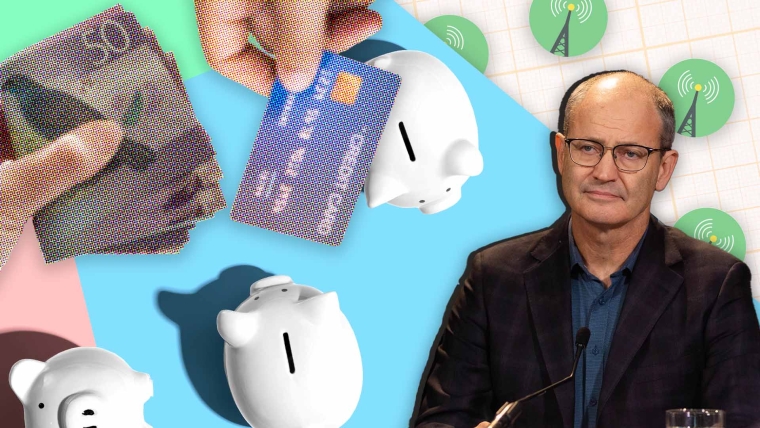
Reserve Bank Chief Economist Paul Conway says New Zealand’s economic fundamentals rather than optimism is driving the Reserve Bank's belief inflation will fall to 2%.
Speaking to interest.co.nz on Friday, Conway did acknowledge there's always risks to the inflation outlook.
The interview follows the Reserve Bank (RBNZ) leaving the Official Cash Rate (OCR) unchanged at 2.25% on Wednesday, with RBNZ Governor Anna Breman saying the central bank wouldn't be hiking the OCR until it sees more inflationary pressures and a stronger economy.
Annual inflation, as measured by Statistics NZ's consumers price index (CPI), hit 3.1% in the December quarter, a touch over the top of the RBNZ's 1% to 3% target range. It aims for a 2% midpoint.
Conway says it's about understanding why it "blipped up" to 3.1% in the December quarter after being at 2.2% at the end of 2024.
"A lot of that was coming through tradeables inflation, so inflation offshore washing up on New Zealand’s economic shores," he says.
“In the last quarter of last year, there were some big movements and volatile components of that part of the New Zealand CPI basket, and we’re expecting relatively more stability in those components this year.”
He says there's also a bit of help from the New Zealand dollar exchange rate which has appreciated and makes imports a bit cheaper.
Domestically, the reason the RBNZ thinks inflation is going to fall from here is because we have spare capacity in the economy.
“The output gap is negative 1%. It’s not an environment in which firms can easily increase their prices with demand still a bit soggy," Conway says.
Even though this was a projection of "reasonable recovery", Conway says “it’s getting a bit of momentum and broadening across the economy”.
“But the economy can grow at the moment without generating inflation pressure because of that negative output gap.”
Also when you look at the labour market and the labour cost index - a measure of wages that’s relevant to monetary policy, it’s going up around 2% which is consistent with inflation at the midpoint of the Reserve Bank’s inflation target band, he says.
And when you look at RBNZ measures of core inflation, which attempt to look through volatility by excluding the likes of food and energy, they’re all within the band.
“They’ve stopped falling," Conway says.
"They’ve been going sideways last year but they’re still below headline inflation meaning that a lot of that current spike in headline inflation is coming through from volatile components that are likely to drop out as we go forward into this year.”
"In short, New Zealand's economic fundamentals are consistent with inflation falling to that 2% target midpoint. Notwithstanding risk. There's always risk," he says.
Anchoring inflation expectations
There’s been strong inflation in products that households have to buy like food, insurance and electricity, Conway says, so households feel that.
“Everybody needs it so everybody is getting stung a little bit.”
Conway pointed out that food prices had "blipped up" in January and thought that was related to the weather.
“It hasn’t been the best summer in New Zealand so far. Often that will put an upward spike into vegetables in particular. That stuff tends to correct itself without us having to take action.”
But when it comes to perceptions of inflation, Conway says: “If households and businesses believe that inflation is going to be 2% in the long term, it makes our job easier essentially because businesses aren’t going to put prices up by more than 2%.”
“Households, in terms of wage demands - we’re all for strong increases in wages. That’s fundamental to driving wellbeing and prosperity … But it has to be driven by improvements in productivity in the economy.”
If it’s driven by the need to catch up with price increases, he says you can get into a spiral.
“A big part of our job is anchoring what we call inflation expectations to that 2% midpoint of the target. And if we can do that, then we don’t have to do as much with interest rates to get inflation back to that 2% midpoint," Conway says.
“It has a natural tendency to go there anyway.”
Can we replace the house price kicker?
The other aspect, Conway says, is that house prices are normally the “kicker” for household spending in New Zealand.
"This is called the wealth effect. The value of your house goes up if you’re in the fortunate situation of owning your house. And you feel wealthy so you’re more likely to go out for dinner, that kind of thing.”
He says house prices have been dropping at the margin so we’re not seeing the wealth effect kick in, which is quite a change for the New Zealand economy.
So where’s the growth going to come from? Conway says the RBNZ sees it coming through the labour market.
“More security for workers in their jobs, lower unemployment, more people entering the labour market.”
Conway says if we can increase our productivity then wages would go up as well.
“That’s going to provide more of an impetus for households to increase their spending than it has in the past, relative to house prices.”
But there’s a risk around all of that. “
The biggest downside to our growth forecast is that households remain cautious. [They’re] in that precautionary mode, continuing to save and don’t get out there and spend.”
Conway says that is totally reasonable, but the RBNZ does think households are going to feel more security in the labour market this year compared to last year.
“That will encourage, at the margin, a bit more spending.”
‘What’s the vibe?’
“I feel it out there in the streets at the moment, especially in Wellington. It feels like things have turned a little bit which is consistent with what we're seeing in the data.”
When Conway is cruising around Wellington on the weekends or wherever else he is, he says: “I’ve always got my antenna out. You know, what’s the vibe?”
“I actually love that. It makes the economy real. It’s not just about data and all of that. It’s about how people are living and how they’re feeling.”
Conway says: “Ultimately we do what we do to promote wellbeing in New Zealand. I think you can get a good sense of that just walking around and engaging with people.”
Administered price inflation 'will run its course'
When it comes to administered price inflation, Conway says there’s a group of prices or a bunch of components in the CPI basket that aren’t very sensitive to monetary policy.
These are things like local authority rates, electricity prices and car registration fees.
“So the inflation dynamics in that part of the economy, it’s about other factors rather than interest rates. Obviously we have a huge economic impact. We do influence prices across many markets, predominantly private markets."
"So when you’re dealing with administered prices, which is prices that are set or heavily influenced by the government," Conway says, "monetary policy will ultimately have an effect there because labour costs are a big part of the costs for government organisations that are producing the output.”
“And we’re going to affect that eventually," he says. But they're pretty insensitive at least in the short and medium run.
“All the bits of the CPI that are influenced by monetary policy are behaving themselves quite nicely, consistent with inflation at the target mid-point.”
But administered prices have been growing about 7% to 9% a year and it makes up around 8% to 9% of the CPI basket, Conway says, so it’s contributing significantly to headline CPI.
“Like 0.6% or 0.7% of the 3.1% headline inflation rate that we saw in the fourth quarter was due to inflation in administered prices. We think that’s going to not be the same this year.”
Conway says: “Prices, they don’t just keep going up forever. There is a bit of catch up there."
Administered price inflation was quite low when we were coming out of COVID and headline inflation was hitting the 5% to 7% mark, he says.
“They’re a bit slow to react to that as well but they’ve certainly been going up. As prices in the rest of the economy have been going down, administered prices have been going up.”
“We think that’ll run its course and come to an end. Although having said that, there’s clear infrastructure gaps in this economy … And they’ve got to be paid for, one way or another,” he says.
The RBNZ takes administered prices as a given.
“It’s sort of like fiscal policy, we just take it as a given. We put it through our models, through our frameworks, through our mental models and set interest rates accordingly.”
Back seat? Front seat?
Speaking in December at his last Monetary Policy Statement press conference, then-acting RBNZ Governor Christian Hawkesby told reporters: “Bring back boring. Let everything else drive the economy and we can sit in the back seat.”
When interest.co.nz spoke to RBNZ Assistant Governor Karen Silk after that December media conference, she agreed. “We would rather not be driving the cycle. We want to respond to the cycle.”
Silk said if they were sitting in the back seat and it’s boring in terms of the RBNZ, that means things are going well in the economy.
Asked about whether the RBNZ felt as though they would not be in the front seat as much, Conway told interest.co.nz: “I think a light foot on the accelerator. Monetary policy is mildly stimulatory at the moment.”
“There’s lots of uncertainty about where that kind of neutral rate of interest is. But you know, the [Monetary Policy] Committee is being slightly stimulatory at the moment. What we’re seeing or what we’re anticipating in the economy is a cyclical increase in growth.”
That’s all monetary policy can engineer, he says.
“We can influence the business cycle and we do that with the aim of keeping inflation well anchored at that 2%."
He says the real question for New Zealand is: how do we grow our long-term growth rate?
"That’s all about productivity. It’s about competition in markets. It’s all about businesses adopting technology and it’s about the government getting its policy settings right.”
RBNZ Governor says we need to look to the future
In her speech at a lunch event held by Business Canterbury on Friday, Breman told the audience to achieve the inflation target, we need to look ahead to the future while learning from the past and understanding the present.
Breman says the RBNZ is never comfortable having inflation outside of its target range.
“But we must accept what has already happened, understand it, and then look ahead. That’s what our remit asks of us.”
"Being forward focused does not imply that monetary policy is on a pre-set course. We will adjust our plans as we get new information, and always with a focus on the future," she says.
*This article was first published in our email for paying subscribers. See here for more details and how to subscribe.
We welcome your comments below. If you are not already registered, please register to comment
Remember we welcome robust, respectful and insightful debate. We don't welcome abusive or defamatory comments and will de-register those repeatedly making such comments. Our current comment policy is here.