
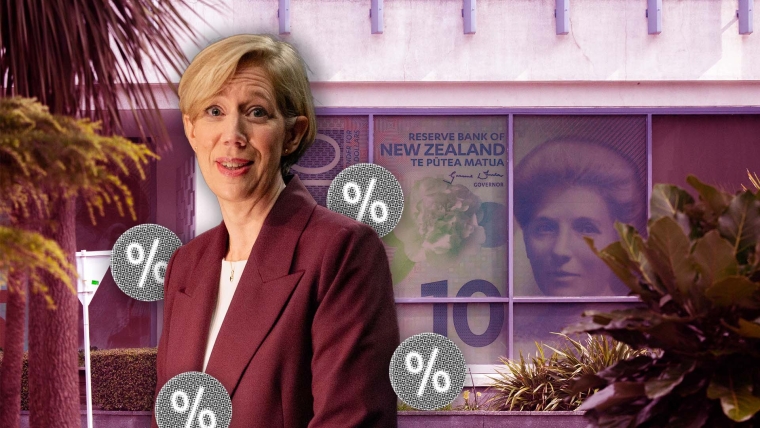
The Reserve Bank (RBNZ) has left the Official Cash Rate (OCR) unchanged at 2.25% as expected, but perhaps less expectedly has taken a 'dovish' view of the future.
In her first OCR decision, Governor Anna Breman expressed confidence inflation would return to the RBNZ's explicit target level of 2% over the next 12 months. And the feared rises in the OCR are not being forecast to happen at this stage - not by the RBNZ anyway. Nor are house price rises - the RBNZ now expects 0.0% movement in house prices in the 2026 calendar year.
The kiwi dollar and wholesale interest rates dropped slightly immediately after the OCR announcement.
And in the record of the meeting of the RBNZ Monetary Policy Committee, the committee said that if the economy evolves as expected, monetary policy "is likely to remain accommodative for some time".
"The committee will continue to assess incoming data carefully. As the recovery strengthens and inflation falls sustainably towards the target midpoint, monetary policy settings will gradually normalise."
The committee thought that monetary policy needed to remain accommodative to support a sustained recovery in economic activity.
"There is a risk that prolonged caution on the part of households could slow the recovery in consumption activity, particularly in the context of a recent tightening in financial conditions. Members also noted global risks that could slow domestic economic recovery. Significant excess capacity, modest wage growth, and core inflation within the target band provides confidence that inflation will return to the midpoint of the target band."
Breman said risks to the inflation outlook "are balanced".
"The global environment remains highly uncertain. Domestically, greater caution by households in their spending decisions could slow the pace of New Zealand’s economic recovery, risking inflation falling below the target midpoint. But with demand increasing in the economy, businesses could try to increase prices faster than expected, leaving inflation above the target midpoint."
Ahead of Wednesday's decision, financial markets were pricing in a more than two-thirds chance that the first rise in the OCR would come in September of this year.
As ever then, the new set of OCR projections contained in the February Monetary Policy Statement (MPS), also released on Wednesday, will be pored over by economists and market watchers.
In the last MPS, issued in November, the RBNZ incorporated about a 20% chance of another cut to the OCR early this year. The first rise in the OCR was not projected to happen, probably, till the second quarter of NEXT year.
'OCR to rise gradually, as necessary'
In the forecasts contained in the new February MPS (page 40) the RBNZ is suggesting there may be a rise in the OCR either late this year or in the first quarter of next year. But contrary to some expectations, there's not much forecast to follow.
The rate track contained in the forecasts suggests only three potential rate hikes in the forecast period through to 2029.
In the February MPS, the RBNZ says that "conditional on the central economic outlook", it projects that the OCR will remain around its current level in the near term, before gradually increasing from late 2026.
"We assume price‑setting behaviour will continue to adapt to a low‑inflation environment, easing inflationary pressure. We also expect that past reductions in the OCR will support an ongoing recovery in domestic activity and a reduction in spare capacity over time. As the economy recovers, the MPC expects to increase the OCR gradually as necessary to contain inflationary pressure and ensure that inflation settles sustainably near the target mid‑point."
The backdrop to the first OCR decision of 2026, is that following clear indications from the RBNZ after the last OCR decision (a 25 point cut) in November, wholesale interest rates rose, leading in short order to banks starting to increase mortgage rates again.
There's been rising concern about inflation and recent developments have not helped. The annual inflation rate as measured by the Consumers Price Index (CPI) rose in the December quarter to 3.1%, putting it outside the RBNZ's 1% to 3% target range.
Pushing back at the markets
On Tuesday, release of the January Selected Price Indexes, showed that food prices shot up 2.5% in January - the largest monthly rise in four years. Three surveys the RBNZ conducts that examine future expected inflation have all been released in the past week - and have generally shown expectations of future inflation rising, which is a warning signal because inflation expectations feed into pricing behaviour, IE they cause more inflation.
Wednesday's announcement by the RBNZ would appear to be very much a push-back at the rises in market pricing that followed the last OCR announcement in 2025.
House prices forecast to be completely flat this year
In the forecasts contained in the MPS the RBNZ is now forecasting that house prices won't move at all this year. In the MPS in November, the RBNZ forecast that there would be a 3.8% rise in the 2026 calendar year, but now the forecast is for 0.0%.
The RBNZ forecasts that house prices will rise a modest 3.0% next year and then 4.6% in 2028.
This is the statement from the Reserve Bank:
Annual consumers price inflation was slightly above the Monetary Policy Committee’s 1 to 3 percent target band at the end of 2025. Increases in food and electricity prices and local council rates were the biggest contributors to above-target inflation.
The economy is at an early stage in its recovery. With ongoing strength in commodity prices, economic activity in the agricultural sector and regional New Zealand remains strong. Although residential and business investment is increasing, households remain cautious in their spending. The labour market is stabilising, but unemployment remains elevated. House price growth remains weak, dampening household wealth and inclination to spend.
In response to previous cuts in the OCR, economic growth is broadening across sectors of the economy, such as manufacturing, construction and some retail. Economic growth is expected to increase over 2026.
Inflation is most likely returning to within the Committee’s 1 to 3 percent target band in the current quarter. The Committee is confident that inflation will fall to the 2 percent midpoint over the next 12 months due to spare capacity in the economy, modest wage growth, and core inflation within the target band.
Risks to the inflation outlook are balanced. The global environment remains highly uncertain. Domestically, greater caution by households in their spending decisions could slow the pace of New Zealand’s economic recovery, risking inflation falling below the target midpoint. But with demand increasing in the economy, businesses could try to increase prices faster than expected, leaving inflation above the target midpoint.
The Committee agreed to hold the OCR at 2.25 percent. If the economy evolves as expected, monetary policy is likely to remain accommodative for some time. The Committee will continue to assess incoming data carefully. As the recovery strengthens and inflation falls sustainably towards the target midpoint, monetary policy settings will gradually normalise.
Summary of Monetary Policy Committee meeting:
A significant easing in monetary policy since August 2024 is supporting a recovery in economic activity. Annual consumers price inflation increased to 3.1 percent in the December 2025 quarter, slightly above the Monetary Policy Committee’s 1 to 3 percent target range. The Committee is confident, however, that with significant excess capacity in the economy, inflation will fall to around the mid-point of the target range over the next 12 months.
Headline inflation is expected to fall to near the mid-point of the target band
The Committee noted that headline inflation is most likely returning to the target band in the March 2026 quarter. Recent increases in inflation have been driven by higher tradables inflation, partly due to larger increases in volatile items such as food, international airfares, and overseas accommodation. Tradables inflation is expected to fall back over the next 12 months due to relatively stable import prices and some support from the recent appreciation in the New Zealand dollar.
Inflation has also been held up by some components of non-tradables inflation that are less sensitive to monetary policy, particularly administered prices. These are prices that are set or heavily influenced by central or local government. Inflation in these components has been due to a lagged response to previous high inflation and a range of structural factors. The Committee expects there to be less inflation in some administered prices over the coming year, such as electricity lines fees, university fees and vehicle licensing fees.
Components of the non-tradables basket that are sensitive to monetary policy have declined to around historic average levels. Measures of core inflation have remained stable, albeit mostly above the target midpoint. Rates of wage inflation remain consistent with inflation trending back towards 2 percent.
The Committee emphasised the importance that higher near-term inflation not become embedded in longer-run expectations. Inflation expectations for professional forecasters and business leaders increased slightly across all tenors, but long-term expectations remain close to the target mid-point. Inflation expectations of households have continued to decline from elevated levels.
Significant spare capacity remains
The Committee noted that there is still significant spare capacity in the economy. The output gap is estimated to be -1.5 percent of potential GDP in the December 2025 quarter.
Spare capacity in the labour market is substantial but stabilising. While the unemployment rate increased to 5.4 percent, key measures of employment strengthened over the December quarter. The labour market is expected to continue to strengthen as the nascent recovery in economic activity broadens through 2026.
Continued spare capacity, subdued wage growth and measures of core inflation within the target band provide the Committee with confidence that the conditions are in place to return and sustain inflation at 2 percent over the medium term.
Economic activity is now recovering
Economic activity began recovering over the second half of last year in response to strong export prices and supportive monetary policy settings. GDP increased by 1.1 percent in the September quarter, after falling 1.0 percent in the June quarter. The Committee noted that measured GDP data has been more volatile than usual, in part due to a range of temporary factors and measurement issues.
There are signs that the recovery is broadening across the economy, although the September quarter GDP likely overstates the true level of momentum in the economy. Residential and business investment both increased from low levels, and measures of investment intentions and building consent issuance have all increased. More timely measures of economic activity such as the QSBO, PMI, and PSI suggest that growth has been maintained in 2025Q4 and 2026Q1.
The economic recovery has been uneven across sectors and regions. Stronger activity has been observed in the rural economy and in the primary sector. Consumer spending has been constrained by low growth in employment income and the negative effect of falling real house prices on household wealth.
House prices have continued to edge downwards despite lower mortgage rates and a modest pick-up in housing market activity. This possibly reflects weak population growth and elevated long-term interest rates. House price growth is expected to gradually increase over 2026 and then grow at around the rate of household income growth over the medium term.
Household consumption is projected to increase over the medium term as past reductions in the Official Cash Rate (OCR) continue to support demand. The Committee noted that labour market conditions are likely to become more important relative to house prices in influencing consumption.
Government expenditure is assumed to grow at a subdued pace over the medium term, consistent with the Half Year Economic and Fiscal Update 2025 projections.
Domestic financial conditions have tightened since November
The New Zealand dollar Trade Weighted Index has appreciated, reflecting higher domestic interest rates and a weakening US dollar. Wholesale interest rates beyond 12 months have increased due to higher global interest rates and investor expectations of future increases in the OCR. Banks have passed these increases through to fixed-term mortgage rates.
The flow of mortgage borrowing priced in the 1–2-year terms increased substantially since November. While the average mortgage rate has declined to 5.1 percent, further downward adjustments are expected to be less than assumed in November.
Global growth has been resilient but risks remain high
The Committee noted that the global economy was more resilient than expected in 2025. Tariffs have had less impact on global growth than previously expected, while strong investment in artificial intelligence technology has supported exports from our trading partners in Asia. Expansionary fiscal policy has also supported growth in a number of economies. The Committee continues to expect trade barriers to present a headwind to growth, with trading partner growth expected to weaken slightly over 2026.
On a trade weighted basis, global inflation has declined, but there has been significant divergence across countries. Tariff policies have increased inflation pressure in some economies such as the US, but these have been offset by disinflationary pressure in China and the broader Asia region.
Geopolitical developments over recent months have led to continued high economic uncertainty and financial market volatility. The US dollar has declined, while the prices of oil and precious metals have risen, along with sovereign bond term premia.
The domestic financial system remains stable
The Committee was briefed on financial system stability. Measures of domestic financial stress have eased as lower interest rates reduce debt servicing pressures. Non-performing housing loans have also declined, and banks expect further reductions in housing and commercial property impairments over 2026. The Committee agreed that there is currently no material trade-off between meeting its inflation objectives and maintaining financial system stability.
Risks to the outlook for inflation are balanced
There are upside and downside risks to the near-term outlook for inflation. The Committee noted the contribution that administered price inflation had played in recent inflation outturns and the risk that this could remain high for longer than currently assumed. Conversely, the Committee discussed the risk that volatile components of tradable inflation could fall more rapidly.
The Committee discussed the risks around firms’ price-setting behaviour. While weak demand has constrained the ability of firms to pass on higher costs, the Committee noted the risk that changing price setting behaviour could result in higher inflation. In this context the Committee also discussed the risk that the output gap could be smaller than currently estimated, accentuating the risk that firms raise prices as demand improves. This could lead to more persistence in domestically generated inflation pressure that would require tighter monetary policy than otherwise.
Members noted risks regarding the speed of the economic recovery. The Committee noted the risk that household spending could be slower to recover than currently assumed, particularly if house price growth remains subdued. This could lead to households continuing to maintain higher levels of precautionary saving. Conversely members noted a risk that higher export incomes and the return of capital to dairy farmers from the sale of Fonterra’s consumer brands business could spur higher investment and consumer spending by farmers.
The global outlook is uncertain
The Committee noted that the global economic outlook continues to be highly uncertain. In the near-term, key uncertainties relate to the direction of global trade policy, market valuations of artificial intelligence investment and geopolitical tensions. Downside risks remain to growth in China as policy makers attempt to maintain growth targets in the face of weak domestic demand. Continued excess capacity and subdued demand in China could create greater disinflationary pressure.
Over the longer term, the Committee noted risks associated with unsustainable fiscal dynamics in several countries. This could put ongoing pressure on central bank independence and create conditions for more persistent global inflation. This could lead to higher long-term global real interest rates and create risks to global financial stability.
The Committee reached consensus to hold the OCR at 2.25 percent
The Committee discussed the monetary conditions required to achieve their medium-term inflation mandate.
The Committee agreed that the economic recovery remains nascent, and a premature normalisation of monetary conditions could dampen the recovery and lead inflation to undershoot the target. The Committee also considered the risk that policy remains accommodative for too long, leading inflation to persist above the mid-point of the target range for longer.
Members agreed that the monetary policy stance would need to remain accommodative for some time to support a sustained recovery in economic activity. There is a risk that prolonged caution on the part of households could slow the recovery in consumption activity, particularly in the context of a recent tightening in financial conditions. Members also noted global risks that could slow domestic economic recovery. Significant excess capacity, modest wage growth and core inflation within the target band provides confidence that inflation will return to the midpoint of the target band.
Members noted the risk of inflation remaining more persistent, given surveys showing somewhat elevated inflation expectations and business pricing intentions. One member supported maintaining the OCR at current levels for now but noted that if economic activity recovers as expected, monetary stimulus could begin to be withdrawn somewhat earlier without compromising the economic recovery. Another member noted that responding too quickly to firms’ pricing intentions could reinforce perceptions of strong demand and encourage firms to align on further price increases.
On Wednesday 18 February the Committee reached consensus to hold the OCR at 2.25 percent. The forward OCR path reflects a somewhat stronger economic outlook and balanced risks to inflation.
If the economy evolves as expected, monetary policy is likely to remain accommodative for some time. The Committee will continue to assess incoming data carefully. As the recovery strengthens and inflation falls sustainably towards the target midpoint, monetary policy settings will gradually normalise.
32 Comments
I still think we should be at 2.00% before pausing but that would cause the market to have a hissy fit since they took it upon themselves to start hiking before anything substantial had changed.
It's a bit of a ho-hum word salad isn't it, however the take is that they do not feel it necessary to make changes, and don't like to say too much knowing it will have broader implications of impacting decisions people and businesses will make. A more restrained statement if you will, which is refreshing IMO.
I wonder if no communication would work better. “We have decided to leave the OCR at 2.25%. Nothing else, see you next time”.
Now now Jim, Anna has just taken the helm, and has to be seen to be doing something, not least for the country but at minimum for showing face and building her image in the public eye.
Market doesn't like being wrong-footed, it's expensive.
Wow... election year pressure I guess. With the current inflation and now more to come as businesses adjust to staff pressure would have seen an increase was a sure thing.
Not sure I get your logic. I'd have thought the pressure from govt would be to lower to increase borrowing and the housing market, claiming a win for the economy come election time. I'm sure Anna is well aware of the historical image of the RBNZ under Orr and will manage this accordingly.
He simply wants investors with a mortgage to burn in hell.
Of course, but given he has the opposite view from my own, the rationale was what was being queried. Still waiting on that one.
I don’t think the RBNZ are under the same political pressures as the Fed. Despite Orr’s faults, he was strong minded and would have certainly spoken out if it was the case.
correct he left over the amount of capital he felt banks should hold.....
What you want to happen and what actually happens are two different things Averageman.
On Tuesday, release of the January Selected Price Indexes, showed that food prices shot up 2.5% in January - the largest monthly rise in four years.
I've been getting a bit of pushback at the water cooler about my perception of food prices and how it's indicative of cost pressures across the supply chains. Now, forget about the arguments that monetary inflation pushes business costs up across the board for a minute. To meet sales and revenue targets, you can either
1. Cut margins and sell more vol
2. Increase shelf prices and hope to maintain sales vol - working on consumer willingness to pay
As I've said ad nauseum, it's the nice to haves and the deli foods that feel the heat first. If carrot and turnip prices are up 2.5%, most people don't notice.
Have a look at the reduction in selection...what does that tell you?
That became noticeable since 2021-2022 with shipping delays. Followed by poor performing NZD IMO at least
[ Personal insults not needed here. Please stick to the substance of the issues. Ed ]
Nice guy and intelligent. There are no expectations that he dresses like Tony Montana and has the delivery of a motivational speaker at a real estate seminar.
[ Fragment removed, related to previous comment. Ed ]
Loving it, I wonder what the OCR bulls desperate to see the OCR rise like Average man Gecko think now.
I honestly find their rate-hike hysteria entertaining :-)
Breman's "laser focus on inflation" is out the window already 😂 That really didn't take long
Time will tell. It seemed a reasonable decision to me. Everyone seems to think the OCR has to change every time, some as it would help their debt servicing costs, and others who overblow inflation risk. Give it 6-9months and we'll revisit her call.
Yes one of the many problems with Orr was his off/on the accelerator approach. Using the OCR as a blunt tool. Exacerbated by the fact that changes to the OCR take a while to feed through the economy.
Too early to judge the new Governor but a steady as she goes approach could be no bad thing after the incompetence of the Orr regime.
He lost credibility to me and any in 2020 when announcing unprecedented stimulus via FLP and LSAP, knowing full well the level of fiscal stimulus form the govt also (covid payments), and seeing the levels of private credit expanding at rates never seen before, then sitting on his hands knowing full well that there would be a surge in inflation. The correct course would clearly have been to tick up the OCR along with the stimulus to tamper an overreaction by borrowers. I will admit that the addition of the employment mandate can attest to some influence in that space, however not in any way enough to keep the decisions of the RBNZ as credible with him at the helm, and many are paying for it still.
Hindsight
This all suggests 2026 is not going to be a great year for the economy if the RBNZ is expecting inflation to cool down based on their forecast for weak demand. Inflation is now above the target upper band of 3.0% and the RBNZ has a single mandate since 2024 - that mandate is inflation. Not unemployment or business confidence - inflation.
Maintaining an accommodative stance on the OCR pre-supposes that other economic forces will bring inflation back into band.
The ship is headed in the right direction. Steady as she goes. Let her do her job, stop telling her what you think she
should not be doing. Too many cooks spoil the broth. Let NZ live a little
RBNZ says
And in the record of the meeting of the RBNZ Monetary Policy Committee, the committee said that if the economy evolves as expected, monetary policy "is likely to remain accommodative for some time".
Which really says
The economy is crap, and we think it will be for a while
To which the Government will say
We are solving the cost of living crisis, by saving $xxx per week through reduced interest rates.
In past cycles lower rates have caused higher house prices = feel good fact = increased consumer spending
this time not so much and the RBNZ are therefore a bit stumped as they want the economy to pick up a bit, noting that they think this feel good , will come this time, from labour market , lower unemployment and wage increase, hell may freeze over first.
economic recovery is a 2027 story and now luxy is worried
My pick is they are looking for a slow build and tempered increase in spending, not a sugar hit like 2021.
0.0% feels like hedging their bets, but do we think would they ever publicly forecast a decrease?
Well, I'm gobsmacked. I thought she would follow the market up.
Imo the following quotation is the key message
'Over the longer term, the Committee noted risks associated with unsustainable fiscal dynamics in several countries. This could put ongoing pressure on central bank independence and create conditions for more persistent global inflation. This could lead to higher long-term global real interest rates and create risks to global financial stability'.
Not that NZ can do much about 'unsustainable fiscal dynamics in several countries' except avoid more debt where possible, diversify, increase the range of income streams, export more, import less, become more efficient, raise productivity, increase investment in R&D, support international systems up holding the rule of law and fair trade in open markets, and broaden our cultural and trading relationships with the world.
We welcome your comments below. If you are not already registered, please register to comment
Remember we welcome robust, respectful and insightful debate. We don't welcome abusive or defamatory comments and will de-register those repeatedly making such comments. Our current comment policy is here.