
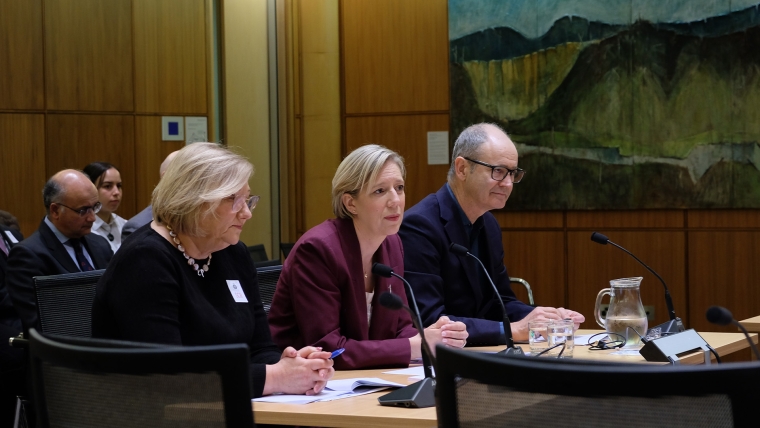
The Governor of the Reserve Bank (RBNZ) has hinted more strongly at a possible pause when the Official Cash Rate (OCR) is next reviewed in October.
"So if you look at the [RBNZ's] forward-looking OCR track, there is a probability of another rate hike, but we also said that now after having done two OCR increases, we can probably take some time to assess and see how this has affected the economy and whether we see stronger or less strong second-round effects from the high fuel prices," Governor Anna Breman told Parliament's Finance and Expenditure Select Committee (FEC) on Thursday morning.
This comes after the RBNZ released its September Monetary Policy Statement on Wednesday, with the Official Cash Rate (OCR) raised to 2.75% from 2.50%. In choosing to increase the OCR, the RBNZ's Monetary Policy Committee (MPC) decided gradually removing monetary stimulus was necessary to reduce inflation to the RBNZ’s 2% inflation target midpoint and support growth and employment.
On Thursday Breman said the OCR at 2.75% was relatively low on a historic basis.
“We assess that this is good to bring inflation down, but it’s still supporting growth and jobs."
Alongside Breman at the FEC meeting was Assistant Governor Karen Silk and RBNZ chief economist Paul Conway. External MPC members Prasanna Gai, Carl Hansen and Hayley Gourley were also present.
Conway added that in terms of medium-term inflation pressures, expectations were key and price-setting behaviour was key.
He said that indicators of medium-term inflation pressure were key, calling it a; “delicate balance that monetary policy is trying to pull off at the moment between supporting growth and preventing the price shock from becoming generalised inflation.”
Concern about 'firms taking the opportunity to hike prices'
Green Party co-leader Chlöe Swarbrick put to the RBNZ that monetary policy was a blunt instrument - one that can’t open the Strait of Hormuz, decarbonise the economy or reduce NZ’s exposure to imported fossil fuel inflation.
Conway said some things were up to the choices of elected officials. Breman said the RBNZ could deal with indirect effects.
“Monetary policy is really important in terms of containing the indirect and second-round effects of things like supply-side shocks. And it does matter a lot for inflation expectations, for how core inflation evolves, and over the medium term that turns out to be headline inflation.”
“What we’re seeing right now is that there’s a risk that unless we respond with monetary policy, those inflation expectations will get out of hand and we'll see a lot of firms taking the opportunity to hike prices in this environment,” Breman said.
“We are seeing both some bad examples but some also good examples of firms showing restraint because then we will get back to inflation at a low and stable level more quickly and that would really benefit everyone … This will not happen without us doing anything.”
External members on the spot
The MPC’s external members were put on the spot with National MP Nancy Lu directing a question to them about whether they went into the monetary policy meeting with a preference to vote for a hike.
Conway, who was happy to rotate, offered Carl Hansen his seat.
Hansen said even though this was not his full-time job, he tried to keep an eye on what was going on in the economy and globally in between meetings.
“One does tend to get an inkling and start thinking about things. But I certainly find that once we get the material from the Reserve Bank which is very comprehensive, it really updates you and at that point, we go to the first day or two and we’re getting staff presentations," Hansen said.
“We get an opportunity to clarify what we’re reading and it’s really at the end of that stage that we start putting quite a bit of thought to what we think we’re going to recommend as individuals.”
Hansen said it was interesting to find out what other MPC members were thinking.
“We talk about those things in a very structured way. We all form our own views and then we go through a structured approach of what each of us are thinking about, so that we’re keeping independence and not falling into a group think kind of way.”
Uneven recovery
Breman said they were seeing the economy recover but it was uneven.
“We are seeing some really good signs in the NZ economy right now and particularly related to exports. They’ve been considerably stronger than expected and it’s not a good environment out there, and exporters are also hit by higher fuel prices," she said.
“So clearly there is competitiveness in the agricultural sector … tourism, manufacturing. Not all, we know that, but many firms are doing rather well.”
Breman said what the RBNZ were looking for now and they’re starting to see signs from, is export-led growth is starting to spread to other parts of the economy, like business investments.
While it was uneven, Breman said the RBNZ expected it to broaden.
“We fully understand that many households are not feeling the effects of the fact that we are starting to be in a broader recovery yet.”
Breman said the RBNZ had also been talking about what extent was this the business cycle and to what extent was this more structural.
“So for example, take youth unemployment, that we know is high, we know that’s a concern... we see this in some other countries as well - is it possibly because firms are investing more in new technologies and then it gets more difficult for younger people to come into the labour market?"
“And this is a difficult question. There’s a difference between what monetary policy can do and not do in this space. But actually, we see quite a few structural changes in the economy right now, and we find them important," she said. “But monetary policy is more effective when it comes to the business cycle.”
Dual mandate
Labour has made it no secret that it wants to bring back a dual mandate that focuses RBNZ monetary policy on inflation as well as maximum sustainable employment, rather than just inflation, officially confirming this in August.
Asked by Labour MP Megan Woods if having a mandate that allowed the RBNZ to look at other things like unemployment would have altered the decision, Conway said that was a hypothetical.
Both Conway and Assistant Governor Karen Silk said the RBNZ spent a lot of time focused on the labour market.
“It’s a matter of the degree to which you want to incorporate it into decisions in terms of the mandate. I do think normally in a demand shock, the effect is the same on inflation, on the labour market," Conway said.
“It’s a little clearer for monetary policy and the breadth of the mandate doesn’t matter so much. It does become more delicate currently when we’ve got inflation going up and growth has been lacklustre because of the shock … I think the mandate would, at the margin, have an effect.”
However, Conway couldn’t say whether or not it would have altered the OCR decision on Wednesday because the MPC did not do the process with a dual mandate in mind.
‘If NZ was less dependent on fossil fuels, then inflation would be lower’
In its September Monetary Policy Statement, the RBNZ noted that commodity prices remained elevated relative to pre-conflict levels.
“High energy and other commodity prices may increase medium-term inflation pressures,” the RBNZ said.
Woods brought up how the RBNZ had pointed to rising European and Asian natural gas prices reflecting renewed disruption to gas supply chains. She put it to the RBNZ that this flows onto the Government’s proposal of establishing a liquefied natural gas (LNG) importation terminal in New Zealand.
Asked if in terms of future decisions, whether or not the RBNZ will have to take this into account if “New Zealand has tethered itself to those international rising markets of increasing and constrained supplies of LNG”, Breman said when it came to their forecasts, they took into account things that have been formally decided on.
Woods then put to the RBNZ that if a commercial contract was signed, the forecast would need to be updated to reflect differing gas prices. Conway said the RBNZ was not in a position to comment on things like that.
“What I will say is that in an era where global fossil fuel prices are high and variable, if New Zealand was less dependent on fossil fuels, then inflation would be lower," said Conway.
We welcome your comments below. If you are not already registered, please register to comment
Remember we welcome robust, respectful and insightful debate. We don't welcome abusive or defamatory comments and will de-register those repeatedly making such comments. Our current comment policy is here.