
Conversations about reintroducing maximum sustainable employment to the Reserve Bank's monetary policy mandate, alongside inflation targeting, could be back on the political table.
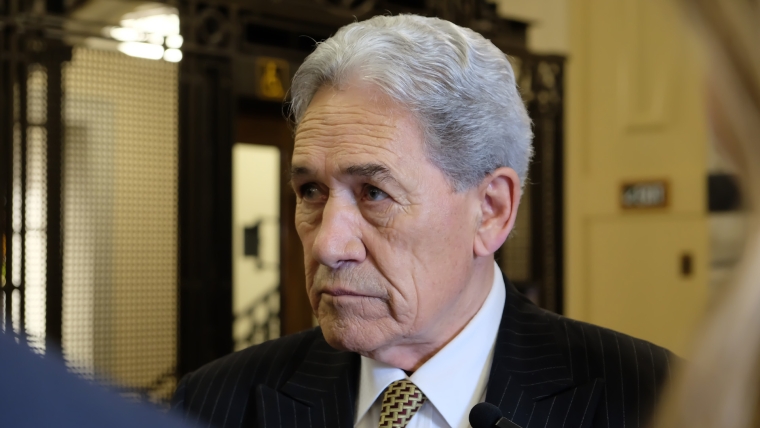
The Post reported on Tuesday that NZ First leader Winston Peters said he believed in 'full employment' as a policy.
"Successful countries have massively full employment. That's what this election is all about," Peters said.
The Post reported that Peters suggested he would look to bring up the issue in potential future coalition talks, saying: "I certainly would next time around."
Prime Minister and National Party leader Christopher Luxon, speaking on Wednesday, described Peters' comments as looking "like a soft outreach to Labour."
The Reserve Bank (RBNZ) is currently tasked with maintaining inflation between 1% and 3% and it specifically targets 2%. The latest annual inflation rate, as measured by Statistics NZ's consumers price index (CPI), hit 4.1% in the June quarter.
Peters said: “All the Reserve Bank Governor has to do … is to keep [inflation] under a certain percentage. Otherwise she loses her job. Doesn’t matter if 100,000 people lose their job, she won’t lose hers. That’s not a smart economic management model, in my view."
As of the March quarter, the unemployment rate, was at 5.3%. Stats NZ will release the labour market statistics for the June quarter next Wednesday.
'One of those dead rats you've got to swallow'
Peters said removing the employment mandate was a “dead rat” he had to swallow.
“Regrettably, we had two parties of Government that didn’t want it … It’s one of those dead rats you’ve got to swallow.”
But Luxon said NZ needed a single-minded focus on keeping inflation within the band.
"Because if you don't keep inflation within the band, you get [higher] interest rates, you get a slowdown in the economy and people lose their jobs. So the best way to tackle unemployment is to be really ruthless on keeping inflation [in that 1% to 3% band]," Luxon said.
Asked about Peters' comments, Finance Minister Nicola Willis said she thought he was wrong.
"If you look across the world, having Reserve Banks' singularly focused on a mandate of keeping inflation low and stable has been shown to be the most positive thing for economies, in terms of keeping the cost of living low but also ensuring more stability in employment and economic output over the medium term," she said.
Willis said we should stick the mandate we currently have.
ACT Party leader David Seymour said "it would be economic madness to forget about inflation just as soon as we've wrestled the inflation genie back into the bottle."
"During the Jacinda Ardern era, when we took our eye off the ball, we let inflation go up and people are still recovering from that inflationary shock last time we gave the Reserve Bank a dual mandate."
Labour 'seriously considering' bringing dual mandate back
Labour finance spokesperson Barbara Edmonds told reporters last week that her party was “seriously considering” bringing the dual mandate back.
This stance isn’t new from Labour, with Edmonds saying back in March that there were strong reasons to bring it back.
Edmonds said: “Every time I raise the fact that there was a dual mandate like other countries that we compare ourselves to such as Australia and the US, I’m then accused of saying that I want high inflation. However, you can flip that back on those other parties and say, ‘well do you want more people unemployed?’”
Role of government to look after people, Greens say
Green Party co-leader Chlöe Swarbrick told reporters last week that she had asked the former RBNZ governor about this, the interim RBNZ governor about this and the current RBNZ governor about this.
“All of which said going from the dual mandate to the single mandate hasn’t changed anything about how they would have made decisions. And [the] same goes in the opposite direction," Swarbrick said.
"The Reserve Bank has always had an eye on employment, but let's go back to the bigger picture, which is the reality that monetary policy is a blunt instrument," Swarbrick said.
"Actually, it is the role of responsible, sensible government to look after people because monetary policy can just basically decide how much money is flowing into and around the economy, whereas government gets to decide how that is distributed, what kinds of industries we're backing, and whether that money is flowing offshore or not."
'Is it really necessary to change it every time there’s a change of Minister of Finance?'
Speaking at a BusinessNZ event recently, RBNZ chief economist Paul Conway said while the RBNZ had its inflation mandate, one of their secondary considerations was to avoid unnecessary volatility in output, pointing to things like the labour market and the exchange rate.
So maximum sustainable employment was still there, he said.
Conway noted that the recent economic survey of New Zealand from the Organisation for Economic Co-operation and Development (OECD) suggested that stability in the central bank’s remit would be quite good.
“Is it really necessary to change it every time there’s a change of Minister of Finance?”
“As a Monetary Policy Committee, the job is very clear. Get inflation down to 2% in a sustainable way over the medium term. But then we do have all those secondary considerations as well," he said.
“I think a different remit would mean a different path for interest rates but I can’t be too specific on that because we haven’t done the whole process with the dual mandate front of mind,” he said.
Conway said they had a review period every five years and that was when they reviewed their remit.
Asked if Edmonds would consult with the RBNZ on the dual mandate if elected into Government, she said: “It’s not unusual for ministers to have that consultation with the Reserve Bank and to understand their particular views but ultimately the decision does lie with the minister.”
The Labour-NZ First government implemented the dual mandate in 2018, when then-Finance Minister Grant Robertson added supporting maximum sustainable employment. The current Coalition Government removed the employment mandate in 2023.
We welcome your comments below. If you are not already registered, please register to comment
Remember we welcome robust, respectful and insightful debate. We don't welcome abusive or defamatory comments and will de-register those repeatedly making such comments. Our current comment policy is here.