
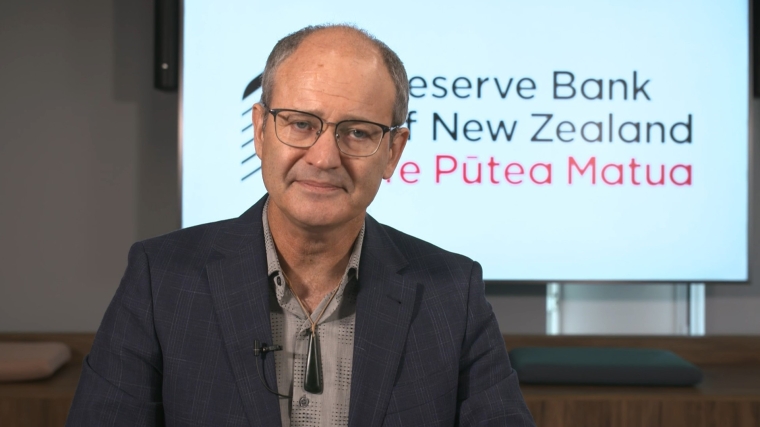
As more transparency has been brought to the Reserve Bank (RBNZ) with a change to its charter, the central bank’s chief economist Paul Conway says Monetary Policy Committee (MPC) members should be held to account for their views.
It was important the public understood what each MPC member was thinking and how they were coming to their viewpoints when making Official Cash Rate (OCR) decisions, he said at a BusinessNZ event in Wellington on Tuesday.
Conway’s comments come after the RBNZ had its new charter come into effect on April 30. As part of the charter, the MPC would make their votes publicly available when consensus was not reached over the OCR and the RBNZ would also publish instances where members have major differences of opinion in its records of meetings.
‘I don’t want it to become [a] soap opera’
Conway said the MPC was currently in a sweet spot and there were robust conversations around rates.
“There’s a good vibe in the room. It’s animated. People are arguing a position, but people move … It is very cohesive and people’s views evolve as we go through the process."
He said: “We can have those strong debates. It’s respectful and we come out of it with everybody’s mana [intact]. Everybody is feeling good and we’ll go have a beer after the decision is out.”
Conway said being transparent about the process also built trust. “And why is that useful to us? Because then people trust we’re going to get inflation to 2% over the medium term.”
“I don’t want it to become [a] soap opera. Like ‘Carl Hansen thinks this and he’s going to have a fight with Prasanna [Gai]’ … It ain’t like that and I think we have to make sure it stays not like that,” he said.
Single mandate
Currently, the RBNZ has a single mandate and that’s to maintain inflation between 1% and 3% - it specifically targets 2%.
The Labour-NZ First government implemented a dual mandate in 2018, when then-Finance Minister Grant Robertson added supporting maximum sustainable employment. The current Coalition Government removed the employment mandate in 2023.
“One of our secondary considerations is to avoid unnecessary volatility in output,” Conway said, pointing to things like the labour market and the exchange rate.
So maximum sustainable employment was still there, he said.
Conway noted that the recent economic survey of New Zealand from the Organisation for Economic Co-operation and Development (OECD) suggested that stability in the central bank’s remit would be quite good.
“Is it really necessary to change it every time there’s a change of Minister of Finance?”
Conway said they had a review period every five years and that was when they reviewed their remit.
What Conway liked about the current remit was it was clear and straightforward.
“As a Monetary Policy Committee, the job is very clear. Get inflation down to 2% in a sustainable way over the medium term. But then we do have all those secondary considerations as well.”
“I think a different remit would mean a different path for interest rates but I can’t be too specific on that because we haven’t done the whole process with the dual mandate front of mind,” he said.
In March, Labour finance spokesperson Barbara Edmonds said she was “seriously considering” reintroducing maximum sustainable employment to the RBNZ’s monetary policy mandate alongside inflation targeting.
She was swiftly criticised by National and ACT, with ACT leader David Seymour saying Edmonds “teasing the return of the dual mandate” was, in other words, taking the RBNZ’s eye off the inflation ball.
The latest annual inflation rate, as measured by Statistics NZ's consumers price index (CPI), is at 3.1% as of the March quarter. As for the unemployment rate, this was at 5.3% as of the March quarter.
We welcome your comments below. If you are not already registered, please register to comment
Remember we welcome robust, respectful and insightful debate. We don't welcome abusive or defamatory comments and will de-register those repeatedly making such comments. Our current comment policy is here.