
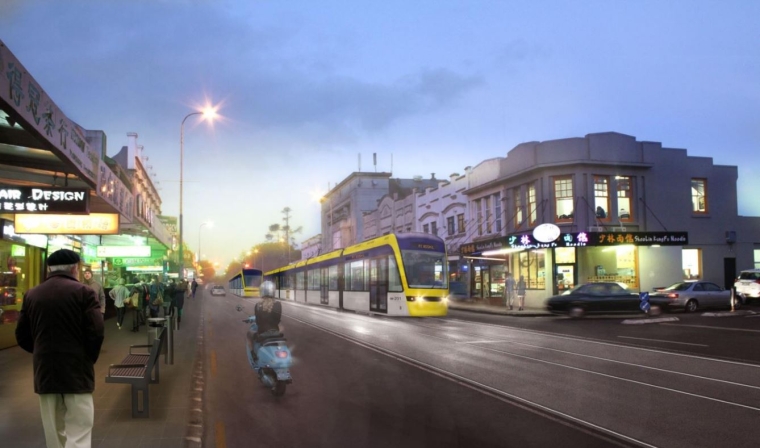
NZ Infra claims a proposal for the Auckland light rail that has been reported in the media is out of date and says it plans to present its final bid to the Government before the end of the year.
The company is a joint venture between the NZ Super Fund and Canada’s Caisse de depot et placement du Quebec (CDPQ) and wants to fund, design, build and operate an Auckland light rail network. It approached the Government with an unsolicited proposal for the project in May last year.
“It’s important to note that the information that has been put into the public arena is outdated and that we have substantially progressed our plans since then, with the benefit of further information from the Government and local and international expertise, including from leading engineering firm BECA. We continue to work on our proposal in order to present the Government with the highest quality option possible," a spokesperson for NZ Infra says.
“We have taken into account the sensitivities and constraints in terms of what is realistically achievable along the entire route and are looking at options that will minimise disruption to the greatest extent possible. While final decisions are yet to be made we’re acutely aware that a realistic solution will need to reflect community expectations and imperatives and have the ability to take Aucklanders with it.”
Twyford in the firing line
In the last week Transport Minister Phil Twyford has been in the firing line over the proposed light rail project. It follows a series of stories on Stuff which have referred to a leaked early proposal from the NZ Super Fund from December last year and a letter from the New Zealand Transport Agency’s then interim board chairman Nick Rogers criticising the fund’s proposal.
But looking at other cities around the world, from Melbourne and the Gold Coast in Australia to Edmonton and Calgary in Canada, light rail is seen as a viable option when attempting to address congestion and calls for better public transport.
NZTA announced last month that it would reallocate $313 million in funding originally earmarked for the Auckland light rail project. It followed ongoing delays with the light rail proposal and an announcement in August by Twyford that none of the construction work would now take place until 2021.
He said he had shortlisted two potential partners for the light rail project, NZ Infra and the NZTA, and he was hoping to make a decision early next year. The NZTA is going to be involved at some level, even if it’s only in a funding capacity, and has already been given the task of coming up with a business case for the project.
NZ Infra's proposal
Recent news reports on the leaked report from NZ Infra from December last year suggest it wanted fewer stops on the line to Auckland Airport. This would serve the airport's needs with a light rail shuttle service between Mangere and the CBD, but wouldn’t address the overloaded public transport between areas like Mount Roskill, Onehunga and Mangere and the CBD. It would also include an underground station at Queen Street and automated trains.
According to Stuff reports, the NZ Infra proposal would be fully automated with driverless trains or trams and would need to be "grade separated", which means the lines would either have to be below the ground, or above the road on an elevated railway. And NZ Infra will ultimately want to recoup the costs associated with its proposal, while some critics have suggested it could cost more than $10 billion.
NZ Super Fund has previously attempted to paint its project proposal as a public-public partnership (PPP) because CDPQ is a publicly owned superannuation fund in Canada. But it isn’t New Zealand owned and for that reason it's really just another public-private partnership.
PPP dilemma
And such a model still comes with costs and risks. It’s something Auckland Mayor Phil Goff is more than aware of. In August he told interest.co.nz that Public-Private Partnerships aren’t a silver bullet solution.
“PPPs keep the initial capital costs off the council’s books, or off the central Government’s books. But it’s like hire purchase, you can afford it now but you pay for it for much longer. So it’s not a magic fix.”
He said if the project isn’t funded by the NZTA and the Government it will cost more in the long run.
“The taxpayer, the ratepayer and the commuter will all be contributing to the higher costs that will be involved with a PPP. I’m just stating problems that are inherent with that model," Goff says. “I don’t think it’s a big risk for them unless they get something terribly wrong in the planning, but you know we’ve got mixed feelings about that. We want the NZ Super Fund to do well because that’ll be paying our super for us in years to come, but we don’t want them to put the price up, other than a reasonable level, for the money they invest in delivering this infrastructure.”
And while the Government and the NZ Super Fund claim they will be funding the light rail project, AT and the city’s commuters could end up paying for it in one way, or another through subsidies or fares.
Goff says under the $28 billion 2018-2028 Auckland Transport Alignment Project the Government agreed to fund the light rail project.
“As the funder, it has primary responsibility for determining which of the two proposals, NZTA and NZ Infra, is the more affordable and feasible,” Goff says. “When it has made that decision, I expect extensive consultation with Council and Aucklanders on how the project will proceed.”
During the 2017 election campaign Twyford said if elected he would deliver light rail from the CBD to West Auckland and to the Auckland International Airport within a decade at a cost of $6 billion, with longer term plans to extend the network to the North Shore.
We welcome your comments below. If you are not already registered, please register to comment
Remember we welcome robust, respectful and insightful debate. We don't welcome abusive or defamatory comments and will de-register those repeatedly making such comments. Our current comment policy is here.