

Bank economists expect to see the surprise June quarter drop in the unemployment rate to reverse back out in the September quarter.
They forecast Wednesday’s Statistics New Zealand labour market data release to show the unemployment rate rising from the 11-year low of 3.9% hit in the June quarter, to between 4.0% and 4.2%.
The unemployment rate is a lagging indicator, so all eyes will be on the extent to which the negativity in more forward-looking indicators, like business confidence, are reflected in the data.
Even though “maximum sustainable employment” is one of the Reserve Bank’s (RBNZ) two monetary policy targets (the other being inflation), and the labour market stats are the last major piece of economic data to be released before the RBNZ reviews the Official Cash Rate (OCR) on November 13, economists are divided over how much of a bearing the data will have on its decision.
ANZ economists recognise the fact the data is a lagging indicator that’s known to be volatile.
Indeed, ASB economists note the RBNZ slashed the OCR by 50 basis points in August - a day after the upbeat June quarter figures were published.
Westpac economists have a different view. They say the RBNZ already believes unemployment will worsen in the near term before improving, so it would take a substantially worse result than being forecast to prompt it to cut the OCR next week.
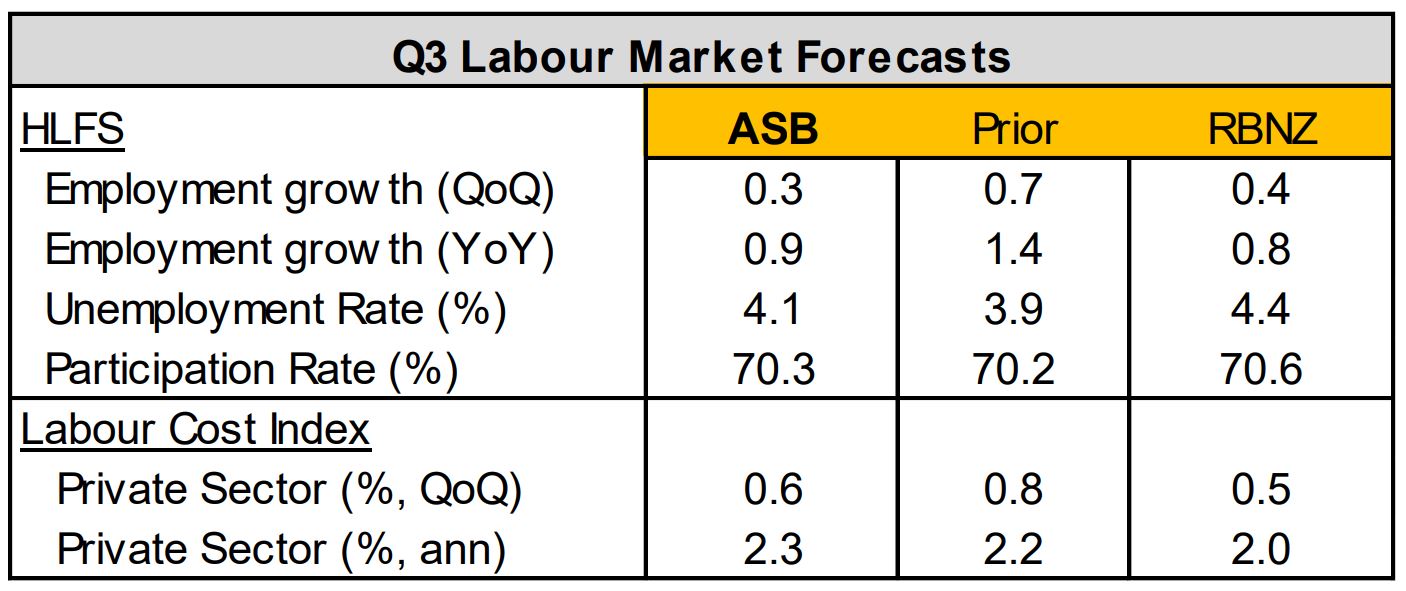
The RBNZ, in its August Monetary Policy Statement (prepared before the low June quarter unemployment rate was published), forecast a 4.4% unemployment rate for the September quarter.
Accordingly, Westpac economists believe the RBNZ will wait until February before cutting the OCR from 1.00% to 0.75%.
BNZ economists note that within the last fortnight, markets have moved from nearly fully pricing a 25-point cut in November to pricing this with 50-50 odds.
They maintain that if that RBNZ is less committed to an OCR cut, compared to in August, the labour market data may have more of a bearing on its final decision.
Coming back to the nuts and bolts of data, private sector wage inflation is expected to rise by around 0.5% in the September quarter, keeping annual wage inflation at 2.2%.
ASB economists expect various pay settlements to “remain a feature of the slow uplift in wage growth”.
“Legislated minimum wage increases contributed over a third of last quarter’s increase in the Labour Cost Index and will impact wage growth figures until 2022.”
ANZ economists conclude: “The labour market has so far been surprisingly solid in the face of slowing economic momentum, and it is possible that this theme continued over the September quarter.
“However, with the economy now running below trend pace and forward indicators suggesting that’s going to remain the case for a while yet, spare capacity in the labour market is expected to open up. It just may happen a little slower than we’re expecting.
“Looking forward, we expect the unemployment rate to lift a little further over the year ahead, peaking at 4.5% by the end of 2020 before gradually improving as economic momentum slowly recovers.
“Employment growth is expected to remain modest, with the participation rate remaining at a high level and migration coming off its peak.”
Here's a summary of the June quarter data and September quarter forecasts from the RBNZ and ASB.
We welcome your comments below. If you are not already registered, please register to comment
Remember we welcome robust, respectful and insightful debate. We don't welcome abusive or defamatory comments and will de-register those repeatedly making such comments. Our current comment policy is here.