
Well it was all looking so good. For the next three months, not quite so much.
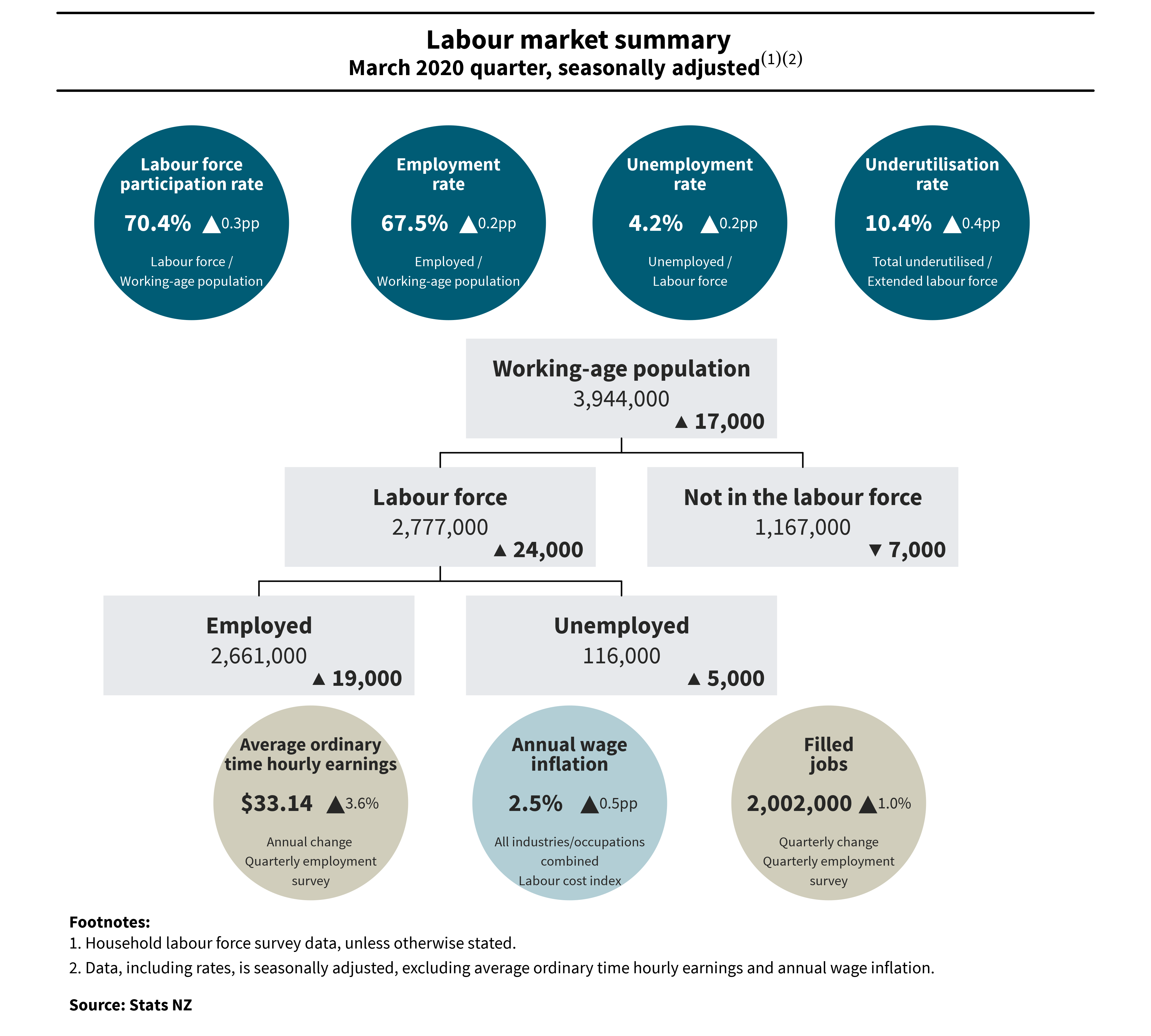
Statistics New Zealand says the seasonally adjusted unemployment rate rose to 4.2% in the March 2020 quarter, up from 4% last quarter.
In the March 2020 quarter, the number of people who were employed rose by 19,000 (0.7%) to reach 2,661,000.
The participation rate rose 0.3% to 70.4%.
The labour cost index (LCI) all salary and wage rates (including overtime) increased 2.5% in the year to the March 2020 quarter. This increase continued to reflect the impact of collective agreements signed by nurses, police, teachers, and principals in 2019.
Annually, public sector wages increased 3.2% and private sector wages increased 2.4%.
But that was then.
Capital Economics Australia and New Zealand economist Ben Udy said looking forward it’s clear that the labour market will deteriorate markedly in the second quarter.
"Admittedly, the government’s wage subsidy scheme will protect some jobs, but requirements such as the need to have suffered a 70% revenue loss or the requirement that business still pay staff at least 80% of their normal wage may mean some businesses will fall through the cracks. Business surveys and online job ads are both consistent with a more than 8% fall in employment.
"We ultimately expect the unemployment rate to rise to 15% in Q2. What’s more we expect that spare capacity in the labour market will result in annual wage growth easing further to below 1% in 2021. The considerable deterioration in the labour market is one reason we expect the RBNZ to cut rates into negative territory this year."
Back on the March quarter figures. Stats NZ's labour market and household statistics senior manager Sean Broughton said: "Our surveys captured a robust labour market in the period before New Zealand went into COVID-19 lockdown. The unemployment rate has remained stable at around 4 percent since late 2018, after trending down since late 2012.
“The impact of COVID-19 on the labour market, including unemployment, hours actually worked, and underemployment, should be clearer in the June 2020 quarter,” Broughton said.
“There was a sharp rise in the number of people receiving Jobseeker benefit support at the end of March and start of April, though this is not the same as the official measure of unemployment.”
The lowest unemployment rate since the global financial crisis of 2007–08 was 4.0%, recorded most recently in the December 2019 quarter. After the global financial crisis, unemployment reached a high of 6.7% in the September 2012 quarter. This was considerably lower than the series peak of 11.2% in the September quarter of 1991, which followed significant structural changes to the New Zealand economy. This unemployment series started in 1986.
In the March 2020 quarter, the collection of labour market statistics was impacted by measures taken to slow the spread of COVID-19, at the same time as the ability to work was affected by the lockdown.
“The household labour force survey takes place over 13 weeks each quarter, which means it measures unemployment over the whole quarter rather than a single point in time at the end of the quarter,” Broughton said.
“We are confident these statistics are reliable, though fewer interviews took place in the final weeks of the quarter, following Stats NZ’s decision to suspend face-to-face interviewing, and later, the redeployment of contact centre staff to urgent work answering public calls about the Government’s COVID-19 website.”
Finance Minister Grant Robertson put out this statement about the figures:
News that nearly 20,000 New Zealanders entered work in the first three months of the year shows the economy’s underlying strength heading into COVID-19, Finance Minister Grant Robertson says.
Stats NZ reported today that the number of employed people rose by 19,000 over the March quarter, while the number of unemployed was up by only 5,000. The employment rate rose to 67.5%, while the unemployment rate also rose slightly from 4% to 4.2%, remaining near its lowest levels in a decade.
Wages were also rising at an annual rate of 3.6%, with average ordinary time hourly earnings up to $33.14. This was well above inflation at 2.5%.
“The numbers show that this Government’s economic plan has been working, as businesses had the confidence to increase employment and invest in their workforces by raising wages,” Grant Robertson said.
“Obviously much has changed in the last six weeks in New Zealand. While these numbers reflect the position New Zealand was in before the worst of COVID-19, they show we were in a strong position. The amazing work all New Zealanders have done through Level 4 and Level 3 to stay home and break the chain of transmission now means we’re well-placed to get a head start on our economic recovery.”
The Government’s focus is on cushioning the blow of COVID-19 on the economy by supporting businesses with cashflow and helping workers maintain or find employment.
“We do know that this global 1-in-100 year health and economic crisis will contribute to unemployment rising further. The investments we’ve already put in place are designed to minimise these impacts, and support those who are out of work to find new employment.
“We went hard and early in our economic response, putting in place the wage subsidy scheme to protect jobs and incomes. The scheme has paid out more than $10.6 billion, covering the wages of more than 1.7 million workers.
“Our $3 billion tax refund scheme put into law last week will start paying out in coming days to support viable businesses with cashflow and costs like rent. This is being complemented by the Small Business Cashflow Loan scheme, the Business Finance Guarantee and a range of tax measures to encourage investment.”
We welcome your comments below. If you are not already registered, please register to comment
Remember we welcome robust, respectful and insightful debate. We don't welcome abusive or defamatory comments and will de-register those repeatedly making such comments. Our current comment policy is here.