
Greens co-leader James Shaw believes his party’s policy to introduce a ‘Guaranteed Minimum Income’ paid for by revenue generated from a wealth tax and two new top income tax brackets would “absolutely” get a look in, should Labour and the Greens form a government after the election.
However, Shaw recognised the amount of say his party would have, would depend on how many MPs it got into parliament and the extent to which Labour needed its support.
Prime Minister Jacinda Ardern on Monday created distance between herself and the Greens’ policy, saying she imagined Labour’s yet-to-be-released tax policy would “look very different”.
She said Labour and the Greens often had similar aims in terms of increasing incomes and reducing poverty, but had different views around how to achieve these outcomes.
She even went so far as to say the Green Party used “heroic” assumptions in its modelling, which concluded a wealth tax would generate $7.8 billion of revenue in its first year.
Ardern said the party didn’t consider behavioural changes that would result from such a tax being introduced, referring to people devaluing their assets or hiding them.
However, the Greens, in its policy document, said it knocked 35% off its initial figure to account for tax avoidance and evasion.
It is proposing to put a 1% tax on net wealth over $1 million and a 2% tax on net wealth over $2 million - payable every year on property, shares, bonds, business assets, expensive cars and art, assets held in trusts and assets held overseas (see more on the policy here).
So, a person with a $2 million house and a $600,000 mortgage, would pay 1% on $400,000, which is $4000.
The Green Party’s modelling suggested the tax would affect 6% of the population, or 300,000 people, meaning it expected each of these people to pay an average of $26,300.
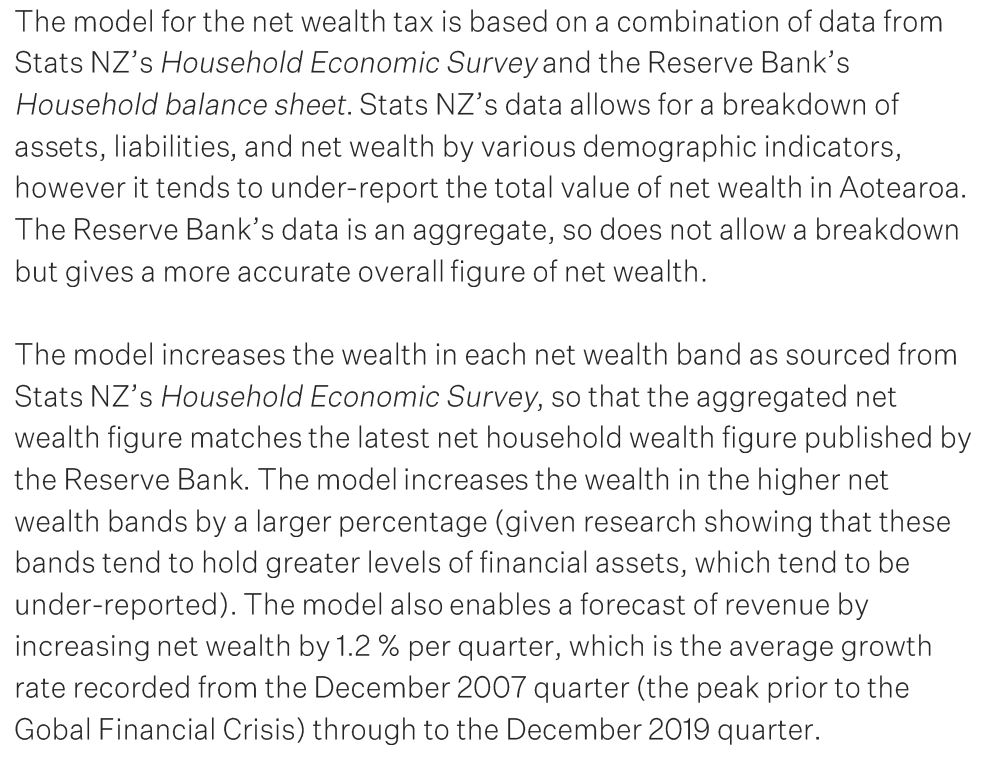
Put to him that this sounded like a lot, Shaw explained, “The numbers come from two sources - one of which is Stats NZ’s Household Economic Survey, which is obviously a long-running data set, and the other is from the Reserve Bank - and they have a different way of calculating wealth accumulation in New Zealand. We essentially took those two data sets and put them together in a model that was developed for us by the Parliamentary Library…
“That is a good a guess as you are going to get in government at the moment.”
Despite Ardern making it clear a wealth tax is a Green Party policy, National on Monday night made a Facebook post saying, “Labour-Greens plan to tax your house, your retirement fund, your business assets, and even your art. Who knows what they’ll tax next?”
Interest.co.nz emailed the party over concern this is inaccurate, as Labour's tax policy is not yet known.
The post follows National’s finance spokesperson Paul Goldsmith on Sunday sending out a press release wrongly saying, “A successful small business person, owning a $1 million house and a business worth $1 million would have to pay $40,000 a year for the 2 per cent wealth tax.”
The person in Goldsmith’s example would in fact only pay $10,000 tax - 1% on their net wealth over $1 million.
Goldsmith told RNZ’s Morning Report he made the mistake as the Green Party’s policy was unclear.
For more on the nuts and bolts of the wealth tax, see the video interview with Shaw:
- How to deal with people trying to hide wealth in trusts: 3min 35sec
- How the value of one's wealth would be calculated: 5min 34sec
- Whether the tax does anything to encourage investment in productive assets: 8min 40sec
- How asset-rich, income-poor people could defer tax payments: 12min 30sec
And here's a more fulsome explanation from the Greens' policy document on how it got to its wealth tax revenue figure:
We welcome your comments below. If you are not already registered, please register to comment
Remember we welcome robust, respectful and insightful debate. We don't welcome abusive or defamatory comments and will de-register those repeatedly making such comments. Our current comment policy is here.