

The Institute of International Finance (IIF) says given an unprecedented increase in global debt, it's not clear how the global economy can deleverage without meaningful negative implications for economic activity, and suggests a "reflationary fiscal response" over the next decade.
The IIF, which describes itself as the global association of the financial industry, makes these comments in its latest quarterly Global Debt Monitor, which tracks international indebtedness by sector.
"The pace of global debt accumulation has been unprecedented since 2016, increasing by over [US]$52 trillion. While some $15 trillion of this surge has been recorded in 2020 amid the COVID-19 pandemic, the debt build-up over the past four years has far outstripped the $6 trillion rise over the previous four years and over earlier comparable periods," the IIF says.
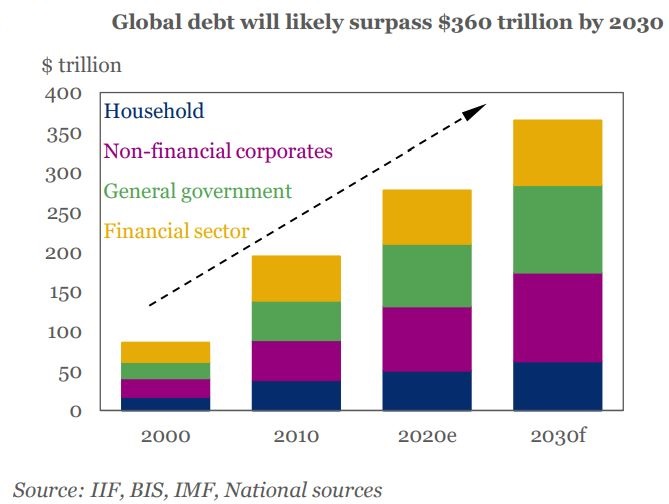
"As a result, there is significant uncertainty about how the global economy can deleverage in the future without significant adverse implications for economic activity. The next decade could bring a reflationary fiscal response, in sharp contrast to the austerity bias in the 2010s. If the global debt pile continues to grow at the average pace of the last 15 years, our back-of-the-envelope estimates suggest that global debt could exceed $360 trillion by 2030 - over $85 trillion higher than current levels."
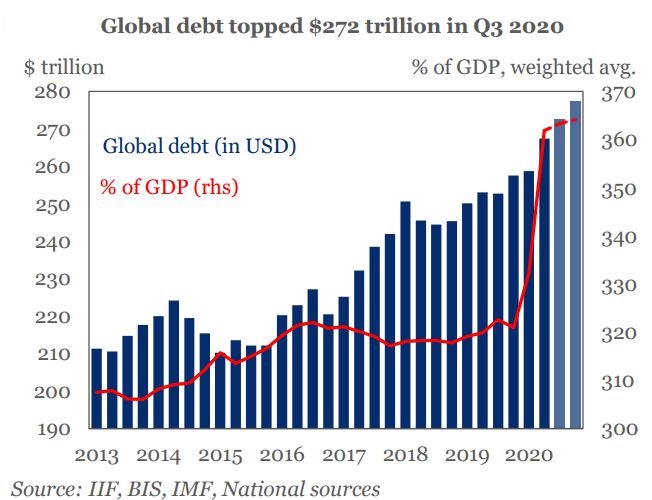
The IIF says strong rises in both government and corporate borrowing as the COVID-19 pandemic drags on saw global debt increase by US$15 trillion in the first three quarters of 2020 to more than US$272 trillion.
"With little sign of a slowdown in debt issuance, we estimate that global debt will smash through records to hit $277 trillion by the end of the year," the IIF says.
"Following a record surge in global debt-to-GDP (from 320% to around 362% in the first-half of 2020), the rise in the third quarter of 2020 was more modest, at less than two percentage points—helped by the strong global recovery. We expect that the global debt-to-GDP ratio will reach some 365% of GDP in 2020."
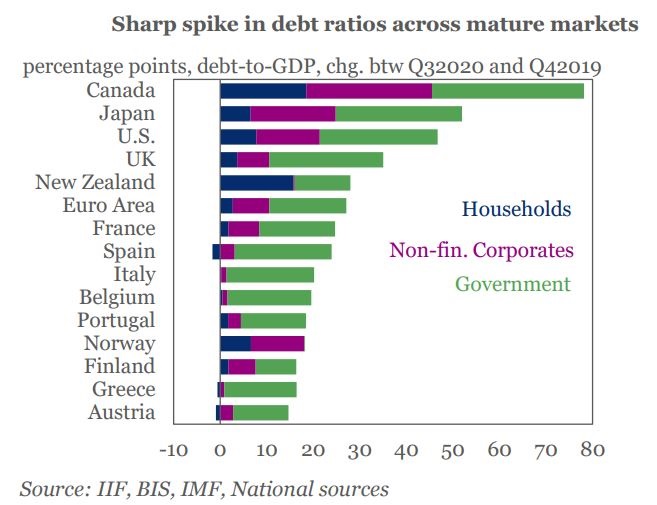
Meanwhile, the IIF says debt in so-called mature markets topped 432% of GDP in the third quarter, an increase of more than 50 percentage points from 2019. The United States accounted for nearly half the increase, with total debt on track to hit US$80 trillion in 2020, which is up from US$71 trillion last year. Most of the rise was in the general government, up US$3.7 trillion, and non-financial corporate sectors, up US$1.7 trillion.
Debt outside the financial sector reached US$206 trillion in the third quarter, up from US$194 trillion in 2019.
"Governments accounted for 60% of the $12 trillion buildup in the world’s debt pile, excluding financials. Global non-financial corporate debt rose by over $4.3 trillion to a fresh high of near $80 trillion, while household debt rose by $500 billion, to near $50 trillion," the IIF says.
The IIF chart below highlights New Zealand's high level of household debt compared to other countries, except Canada, in the chart.
*This article was first published in our email for paying subscribers. See here for more details and how to subscribe.
We welcome your comments below. If you are not already registered, please register to comment
Remember we welcome robust, respectful and insightful debate. We don't welcome abusive or defamatory comments and will de-register those repeatedly making such comments. Our current comment policy is here.