

New Zealand's amazingly resilient employment market has surpassed all expectations again.
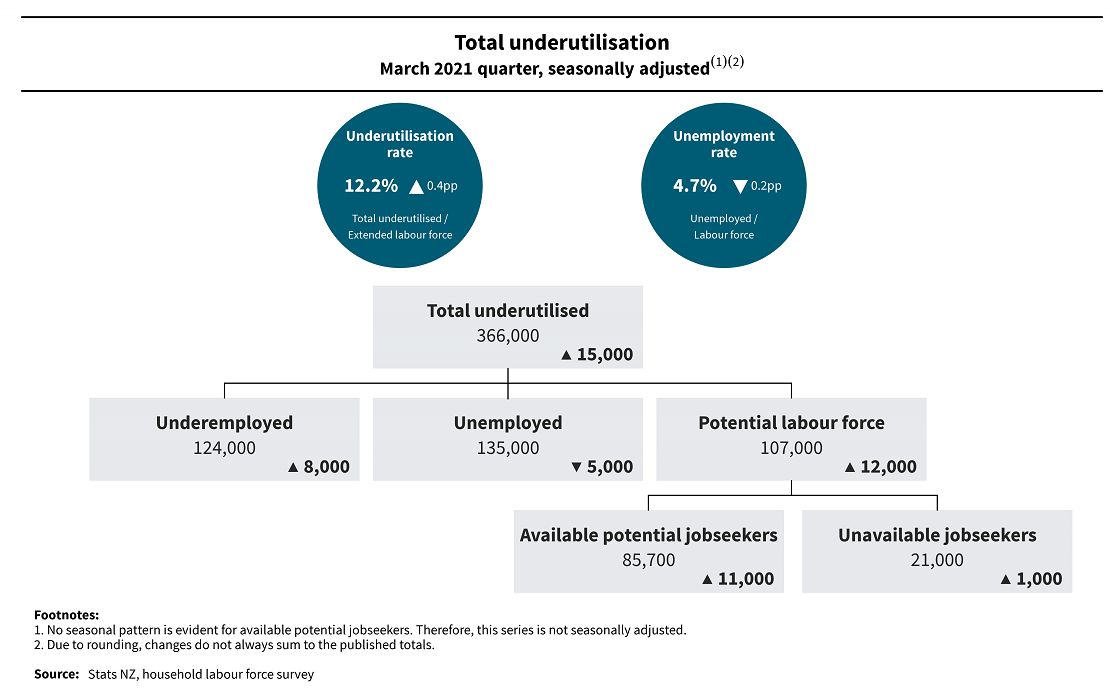
Statistics New Zealand says the unemployment rate in the March quarter fell to 4.7% from 4.9% in the December quarter.
The new figure beat the forecast of the Reserve Bank, which was for a 5% rate and also came in under many bank economists' forecasts.
Remember also that the December figures were much stronger (IE lower unemployment figure) than had been expected.
The latest unemployment figure came on the back of stronger than expected growth in employment - 0.6%
The participation rate rose to 70.4% from 70.2%.
However, the seasonally adjusted 'underutilisation rate' increased to 12.2%, up 0.4 percentage points quarterly and 1.8 percentage points annually.
Over the year, 56,000 more people were underutilised – equal numbers of whom were men and women – bringing the level up to 366,000, Stats NZ said.
The NZ employment market has continued to defy expectations earlier last year of a massive surge in unemployed numbers, helped no doubt by the massive stimulus and measures such as the wage subsidy.
It now looks at though the peak unemployment in this cycle could prove to be the 5.2% rate recorded (revised) in the September quarter.
Women were disproportionately affected by the job losses earlier last year.
But in the latest quarter Unemployment rates for men and women converged at 4.7%, as the male rate rose from 4.5% last quarter and the female rate fell from 5.3%.
"There have been some gains in labour market outcomes, especially for women, over the past two quarters. However, annual changes indicate the labour market still hasn’t returned to pre-Covid-19 levels for men or women," Stats NZ's work, wealth, and wellbeing statistics senior manager Sean Broughton said.
There was slight wage growth during the period too.
The Labour Cost Index increased 1.6% in the year to the March 2021 quarter, with wage inflation remaining steady from last quarter. This is the first quarter since the December 2019 quarter where annual wage inflation has not slowed.
"Typically, March quarters see more muted wage inflation but this quarter we saw modest wage growth as New Zealand continues to have travel restrictions and businesses aimed to retain and attract staff," Broughton said.
Westpac acting chief economist Michael Gordon said the unemployment result reinforces the sense that the New Zealand economy "is past the worst of the Covid-19 shock, and that the unemployment rate of 5.2% in the September quarter last year will prove to be the (surprisingly low) peak in this cycle".
"The result was better than our forecast of a flat outturn, and the Reserve Bank’s forecast of an increase to 5.0%. The implication is that while we’re still below what the RBNZ would consider to be ‘maximum sustainable employment’ according to its mandate, the gap is gradually narrowing."
We welcome your comments below. If you are not already registered, please register to comment
Remember we welcome robust, respectful and insightful debate. We don't welcome abusive or defamatory comments and will de-register those repeatedly making such comments. Our current comment policy is here.