
ANZ has released a major Report (.pdf 13MB) detailing the opportunities for Australia and New Zealand for agricultural commodities over the next 30 years.
Gareth Vaughan discussed the Report's finding with ANZ's Graham Turley last week.
Over the next few weeks, we will take a closer look at what the Report finds for New Zealand. This week we look at The Global Soft Commodity Opportunity.
ANZ's report finds that strong growth in global agricultural demand will coincide with increasing supply constraints over the coming decades. Prices are expected to stay higher than in recent decades, alongside increasing demand for high value products, but with continuing volatility. Global agricultural trade will play an important role in correcting the global imbalance in natural resources and productivity growth.
Australia and New Zealand stand to more than double the real value of annual agricultural exports by 2050 and more than triple exports if global demand grows faster, with a shift towards high value production.
This should result in an additional NZ$0.5-1.3 trillion in agricultural exports for New Zealand over the next four decades if we can take advantage of the opportunities.
"Strong growth in global agricultural demand will likely be met with increasing supply constraints over the coming decades. Chief among the scarce inputs will be water
and land. The shift to a supply-constrained agricultural market will create enormous commercial opportunities for resource-rich, export-oriented countries in the region" the Report says.
The growth drivers
Conventional economic theory has always predicted various forms of economic convergence – poorer countries catching up to the income levels of wealthier countries.
The 21st century is seeing this theory become reality as the balance of economic growth shifts towards the developing world, with significant changes in the distribution of global wealth.
In the five years to 2010, the developing world accounted for almost three quarters of global growth.
This is a reversal of the situation prior to 2000, where approximately two thirds of global growth came from the developed world. The world is now witnessing a surge in demand for the basic materials (minerals, energy and food) necessary to house and feed a growing global middle class.
Driver #1. Rising incomes:
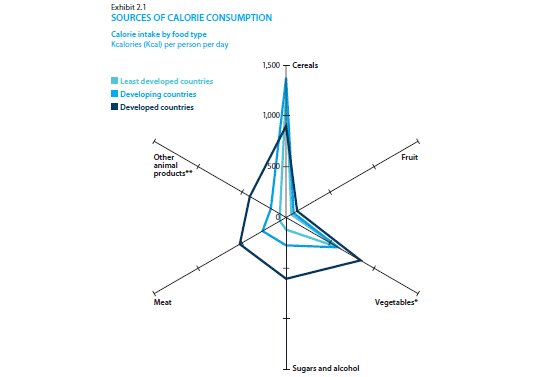
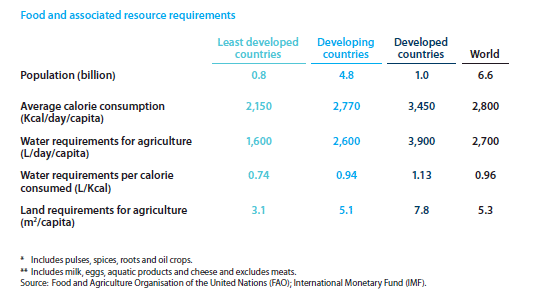
As income levels increase, demand for food increases in two ways (Exhibit 2.1). First, per capita calorie consumption rises. Second, individual diets shift from being carbohydrate based to protein based, which is far more water and land intensive per calorie.
While lower income country diets are predominantly comprised of cereals, higher income country diets are more focused on fruit and vegetables, sugars, meat, dairy and other animal products such as eggs. Moreover, developed economy diets require almost two and a half times the water (and almost three times the land) per person relative to the least developed countries, with developing countries somewhere in between.
Driver #2. Population growth:
Between now and 2050, the world’s population is expected to increase from about 7 billion people to almost 9.3 billion people, an increase of around 35%. About half of the population growth is expected to come from Sub-Saharan Africa, while Asia (largely outside China) will contribute the majority of the remaining growth.
Supply constraints to keep prices high
Despite strong growth in global production over the past decade, demand for agricultural products has already begun to outstrip supply, the Report notes.
These changes reflect growing constraints on the supply of land and water.
With limited potential for sustainable increases in these natural inputs, higher levels of agricultural output depend on improvements in agricultural productivity, but productivity growth will struggle to keep supply up with demand.
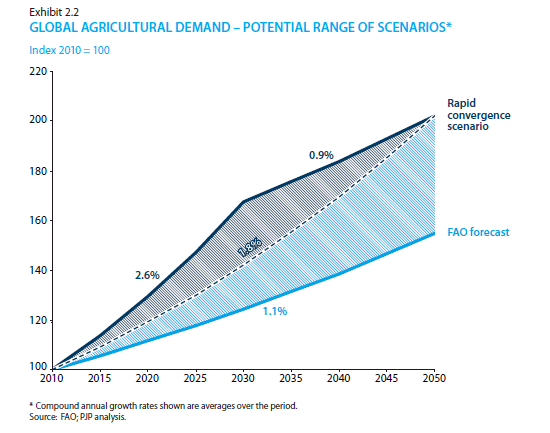
In the absence of significant improvements in productivity, global food prices are expected to remain high as land and water constraints intensify. Among others, the OECD supports this view and expects average real prices over the next decade to be 20-30% higher than the prior decade for many commodities. But prices will also become increasingly volatile as "delayed supply responses create timing misalignments with rapidly changing market opportunities. This increased volatility is expected to cause sub-optimal investment decisions, which could further impede production increases".
The important role of global gloval agricultural trade
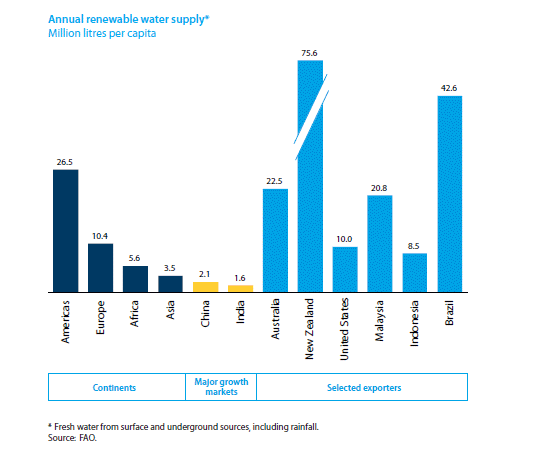
Supply deficiencies in natural resources in major growth markets, particularly in Asia, will present substantial trading opportunities for New Zealand.
Countries that are able to provide differentiated, higher quality products will be able to exploit price premium opportunities from the increasingly affluent and discerning global middle class.
At the heart of the massive trade opportunity is China and increasingly, India. The two countries are home to more than a third of the world’s population but less than a fifth of the world’s arable land and less than a tenth of the world’s renewable water supply.
China is already a major net importer of agricultural products with the average value of its agricultural imports increasing from 82% of agricultural exports in the period 1990-93 to 191% of exports during 2006-09. Major imports have been soybean to feed China’s booming pig farming operations, as well as animal and vegetable oils.
While India remains a net agricultural exporter, imports have also grown significantly in recent years. The average value of India’s agricultural imports has increased from 35% of agricultural exports during 1990-93 to 61% during 2006-09, and reached 82% in 2009.
While both countries have aggressively pursued expansion of domestic production, the momentum in agricultural import growth is unlikely to slow.
While agricultural exports from the developing world have moved quickly to take advantage of these opportunities, exporters in the developed world have been mostly slow to respond.
During 2000-09, the United States increased agricultural exports by less than 7% per annum while Australia delivered an annual growth rate of less than 4%. Australia grew beef exports at 0.4% per annum during the period, in contrast to Brazil’s beef export growth of more than 14% per annum.
Overall, New Zealand fared better, growing agricultural exports at 9% per annum during the period, predominantly supported by its dairy industry.
An enormous export opportunity
The Report says New Zealand has an enormous potential to benefit from the global soft commodity opportunity. We can significantly increase agricultural export revenues over the next four decades, by increasing volume growth and seizing higher-value market opportunities where possible. To capture these benefits, however, targeted and timely actions will need to be taken, supported by large capital investments.
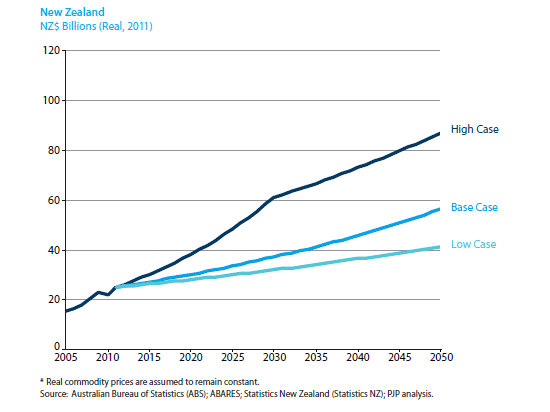
A recent Australian study suggests an export value in 2050 of NZ$57 billion for New Zealand, or a cumulative addition over 2011 levels of around NZ$550 billion. These estimates are not forecasts because they are highly dependent on the rate of global economic growth and the responses from industry and government over the coming decades. But New Zealand export revenues have the potential to grow substantially more given the right conditions and responses.
First, volumes could increase much faster from more rapid growth in global demand or gaining export market share. This has and will continue to be a major driver of overall sector growth.
Secondly, greater value in agricultural exports could be realised through a number of ways:
- Farms producing higher value products.
This includes seeking more valuable product variations, such as organics, or driving farm conversions to high returning commodities, such as shifting from beef to dairy in the South Island.
- Processors of agricultural products adding more value domestically.
Processors of commodity products could capture small price premiums from improving quality or including other features. In some cases there is scope for processors to shift to value-added manufacturing, albeit in niche areas.
- Supply chains providing higher levels of service to attract price premiums.
This includes providing more responsive, speedy or reliable supply of products to end markets.
To illustrate some potential alternatives, the Base Case has been compared with two other cases (Exhibit 2.8):
- under the Low Case, export revenues would grow in line with ABARES’ global demand forecasts of an average growth rate of 1.3% per annum (largely comparable to FAO estimates). This would lead to real 2050 export values 65% higher than in 2011, or NZ$42 billion for New Zealand in 2011 prices. The cumulative value of additional export revenue would be NZ$300 billion.
- under the High Case, export revenues would grow to respond to the Rapid Convergence Scenario and shift towards high value production. This equates to an average value growth rate of 4.8% per annum to 2030, and then at 1.8% per annum until 2050. This would lead to real 2050 export values 250% higher than in 2011, or NZ$88 billion in 2011 prices. The cumulative value of additional export revenue would be NZ$1.3 trillion for New Zealand.
It is easy to see from these estimates how significant the opportunity can be for growth in both the production and export of agricultural goods.
Moreover, improvements in the sector’s performance for both countries will provide substantial flow-on opportunities in export of agricultural and supply chain services.
However, for New Zealand to capture its share – or more – of this opportunity, will require the adoption of effective strategies not just in agriculture but in the industries that support it.
--------------------------------------------------------------------------
This story has been adapted from Part 2 of the ANZ report: Greener Pastures: The Global Soft Commodity Opportunity for Australia and New Zealand (.pdf 13MB)
Here is Gareth Vaughan's interview with ANZ's Graham Turley.
Part three will follow next week. It is about how we can build a competitive advantage in key markets.
We welcome your comments below. If you are not already registered, please register to comment
Remember we welcome robust, respectful and insightful debate. We don't welcome abusive or defamatory comments and will de-register those repeatedly making such comments. Our current comment policy is here.