

By Alex Tarrant
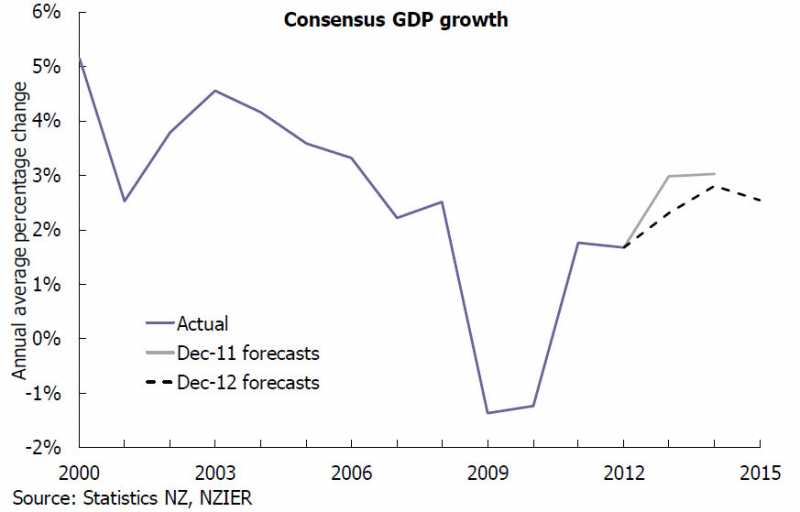
Economic growth over the next three years will be lower than previously thought, meaning unemployment stays higher for longer, inflation stays subdued, and the Official Cash Rate (OCR) will be on hold until late 2013, according to the latest set of consensus forecasts.
Exporters are being warned to expect the New Zealand dollar will be higher for longer, with the Trade Weighted Index (TWI) expected to rise each year until 2015. Lower export receipts would contribute to lower tax revenue for the government, meaning it would not hit a fiscal surplus in the 2014/15 year as planned.
The Consensus Forecasts are an average of New Zealand economic forecasts compiled by the New Zealand Institute of Economic Research (NZIER) from a survey of financial and economic agencies.
The New Zealand economy was recovering gradually, with economic growth to average 2.5% over the next three years, NZIER said.
"The Canterbury rebuild will be a key driver, though it will be more protracted than previously thought," it said.
The job market was softening. Forecasts expected slow job growth and unemployment to remain higher for longer, while real wage growth was expected to be subdued.
"The grinding recovery means inflation will remain subdued. Forecasters expect interest rates to be lower for longer, with gradual rate increases expected from late 2013," NZIER said.
"A slow economy will also reduce tax revenue. Despite borrowing costs remaining low, the consensus does not expect a return to fiscal surplus by 2015."
See NZIER's comments on the forecasts below:
Slow and low
The economic recovery remains gradual. Growth will be steady but unspectacular, thanks to a weak global economy, ongoing deleveraging at home and uncertainty about the Canterbury rebuild.
Economic growth will be a little lower in 2013 (2.3% from 2.4%) and 2014 (2.8% from 2.9%), relative to our last survey.
Economic growth is expected to be 0.2% in the September 2012 quarter.
Canterbury rebuild more protracted
The Canterbury rebuild will lift investment.
Forecasters expect the bulk of the reconstruction to occur in 2013-2014. But they also expect the rebuild to take longer. Residential investment growth will still be +11% in 2015, up 1.5% from the September survey.
Uncertainty about the timing and size of the rebuild means there is considerable divergence amongst forecasters.
Export growth will slow
The export outlook has softened. Global demand has slowed and the NZD is expected to be higher for longer. Exports will be affected, though forecasters differ on the extent.
Forecasters agree that growth will be slower. Over the next three years, export growth is forecast to average 1.7%, down from 2.1% in the September survey.
Exchange rate to weigh on exporters
The NZD will remain elevated for some time.
Forecasters have revised their expectations upwards. On a trade weighted basis, the dollar is expected to be higher every year through to 2015.
Exporters should plan for weak demand and a high exchange rate for some time. A high exchange rate will favour imports.
Inflation subdued
A slow recovery means inflation is low. Consumer price inflation will remain within the RBNZ’s 1-3% target band over the next three years.
Forecasters now expect inflation to average 2% (down from 2.3% in the previous survey) over the next three years. Inflation is expected to be 1.4% in 2013 before picking up to 2.4% by 2015.
Interest rate increases delayed
The 90 day bank bill rate is forecast to increase from an average of 2.7% in 2013 to 3.0% in 2014 and 3.7% in 2014.
Forecasters expect interest rate increases to begin in late 2013, with smaller increases than previously thought. This is due to the sluggish recovery and weaker inflation.
Labour market trending sideways
There is considerable divergence amongst forecasters about the labour market. But the consensus expects job growth to be steady.
Unemployment remains high so competition for jobs is intense, moderating real wage growth.
Fiscal deficit to remain in 2015
The government operating deficit will narrow over the next three years, but consensus does not expect a return to surplus by 2015.
Forecasters expect government borrowing costs to remain low, despite being in fiscal deficit.
We welcome your comments below. If you are not already registered, please register to comment
Remember we welcome robust, respectful and insightful debate. We don't welcome abusive or defamatory comments and will de-register those repeatedly making such comments. Our current comment policy is here.