

The mortgage market is poised to shift significantly in the first quarter of 2013.
Borrowers on a floating rate can achieve either lower payments or pay off their loans faster if they chase a better interest rate deal now.
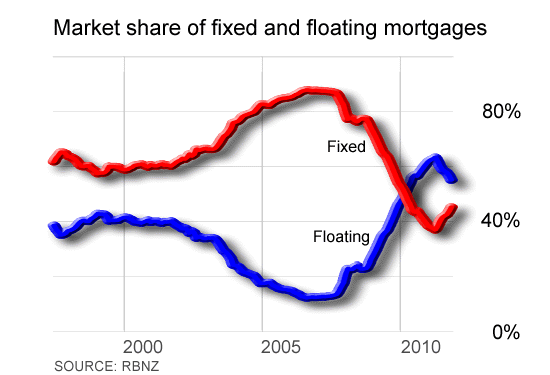
The shift could even be faster and more dramatic that the one we saw from 2009 to 2011 when borrowers switched en mass from fixed to floating.
This is because borrowers on floating rates don't need to wait until their current arrangement 'expires' - there is no 'break fee' when you go from floating to fixed.
But there are savings to be had.
By now, most borrowers know that you can get much better deals by engaging in earnest negotiations with more than one bank.
The mortgage market is only growing modestly, and banks are working hard to build their portfolio of mortgage loans to maintain their profitability. But the main way they do this is by winning business off their rivals. That makes for a very helpful negotiation environment for borrowers.
However there is a catch.
If everyone moves from floating to fixed at the same time, the wholesale markets will get flooded with transactions banks need to make to accomodate the shift. The 'payers'/'takers' balance in the swap markets become unbalanced and the wholesale swap rates will move quickly. Swap rates will rise.
Fast rising swap rates will remove the banks ability to hold their fixed rates at current levels.
When that happens, the availablility of some low fixed rates may disappear.
The best benefits will go to the early movers.
And while you have been holidaying, swap rates have been starting to trend up.
Here is a simplified table of what rates are on offer now (Monday morning). It is not a comprehensive table; you can get that here »
| as advertised | Floating | 1yr Fixed | 2yrs Fixed | 3yrs Fixed |
| % | % | % | % | |
| ANZ | 5.74 | 5.25 | 5.39 | 5.90 |
| ASB | 5.75 | 5.45 | 5.25 | 5.90 |
| BNZ | 5.74 | 5.25 | 5.40 | 5.90 |
| Cooperative Bank | 5.70 | 5.25 | 5.35 | 5.75 |
| Kiwibank | 5.65 | 5.25 | 5.25 | 5.65 |
| SBS / HBS | 5.65 | 5.25 | 5.30 | 5.65 |
| TSB | 5.79 | 5.25 | 5.30 | 5.90 |
| Westpac | 5.75 | 5.40 | 5.40 | 5.90 |
Most 'specials' disappeared over the holiday break, but there are still a few around - and the main one to notice is TSB's 4.95% for a fixed term of 15 months. And a few non-bank lenders are offering good deals too - check out AMP Home Loans, Medical Securities (if you are a member), Resimac, NZ Home Loans, and Sovereign.
At the risk of sounding repetative, the above rates are the advertised rates, and negotiation should get you bettere deals than these - although that will depend largely on your personal financial situation.
The point is, shifting from floating, to say a 2 year fixed rate could easily save you 0.4%, possibly up to 0.7%, again depending on your situation.
Assuming a saving of 0.5%, that can translate into real money.
For every $100,000 of borrowing, you could either reduce your payments by $8 per week ($400 per year), or if you leave your payments unchanged, reduce your mortgage by up to 3 year and 9 months.
These calculations assume you have a 30 year mortgage, but in the end you should work out your own savings. And the best way to do that is by using our comprehensive Mortgage Calculator here »
According to RBNZ data, there are 916,000 floating rate mortgages in New Zealand, and another 485,000 fixed rate ones.
Many borrowers have a number of loans on one property. Splitting your home loan can give you some advantages, although it does require some extra set-up cost and it also expects you to have a proper reason for the split, and to react to changes when you can benefit from them.
A comprehensive list of all mortgage rate offers is here »
Whether the mortgage market actually shifts significantly in the first quarter of 2013 will depend to a large extent on how borrowers react to the premium they are paying on floating rates.
We welcome your comments below. If you are not already registered, please register to comment
Remember we welcome robust, respectful and insightful debate. We don't welcome abusive or defamatory comments and will de-register those repeatedly making such comments. Our current comment policy is here.