

Recent commentary suggesting regional New Zealand is being plundered for the benefit of cities such as Auckland and Christchurch is simply not backed up by the facts, ANZ's economists say.
In their weekly Market Focus report the ANZ economics team, headed by chief economist Cameron Bagrie, say it pays to travel and get the full story. This, they say, is what they call knife-and-fork economics, which includes "a few dinners chatting along the way."
Their comments come after Shamubeel Eaqub, chief economist at New Zealand Institute of Economic Research, was recently quoted saying growing inequality between regions was an "elephant in the room" that was being ignored by policymakers. Economic growth was being driven mostly by Auckland and Canterbury, and many other areas were stagnating or going backwards, Eaqub was quoted saying.
In response to this Labour Party finance spokesman David Parker issued a press release saying an overheated Auckland housing market and the Reserve Bank’s response to lift interest rates were "causing massive damage" to the provinces.
Parker noted Eaqub had called the Reserve Bank's third increase to the Official Cash Rate this year, lifting it to 3.25%, a huge mistake that was punishing small town New Zealand. A Labour-led government would stop the growing inequality between Auckland and the provinces, Parker added.
'Not backed up by the stats'
The ANZ team, however, isn't having this.
"We notice some recent commentary suggesting the regions are being plundered for the benefit of the cities. Well, that is simply not backed up by the stats; our own Regional Trends proxy for regional economic activity puts Northland at the top of the annual growth stakes in the year to March 2014," the ANZ economists said.
"In the past 12 months, Northland has recorded strong annual increases in retail trade, house prices, rural real estate sales, dwelling approvals, section sales, commercial consents, online job advertising and regional traffic flows though some of this looks to be bounce out of a deep hole and unemployment is high."
"Canterbury and Auckland have led economic growth over the past few years. (But) strong rise have also been recorded by Waikato, Otago, Taranaki and Nelson-Marlborough," the ANZ economists added.
(The chart below is taken from ANZ's Market Focus report).
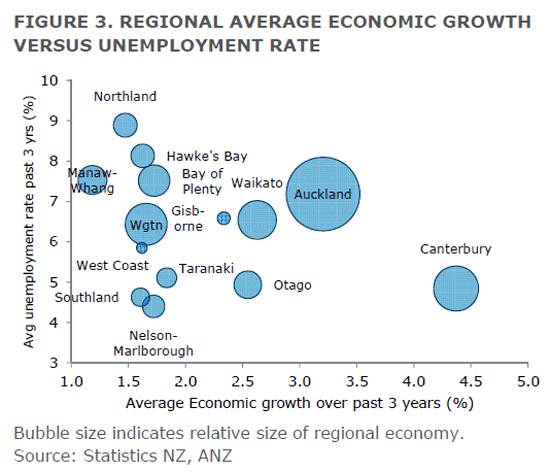
The ANZ team went on to say that over the past three years, regional unemployment rates have fallen in half of the fourteen regions they monitor.
"The largest reduction was noted in Gisborne, a region trapped with a traditionally high level of unemployment."
'It pays to travel & labour shortage not a bad problem to have'
"In this game it also pays to travel and get the full story; that’s what we call knife-and-fork economics (that’s a few dinners chatting along the way). While everyone talks about Christchurch, 100km down the road is a place called Ashburton; it’s booming. That’s irrigation for you. South Canterbury is riding the same wave. Central Otago is going very well with evening flights the icing on Queenstown’s cake," ANZ's economists said.
"Ironically in Otago, it’s the city, Dunedin, that is underperforming the region. Southland is just Southland and getting on with business and not crowing about it. Blenheim just had a bumper grape harvest; Nelson has a reasonable vibe - was there last Wednesday. Taranaki - white and black gold working in tandem. Bay of Plenty - Psa being worked through, kiwifruit land prices have rebounded, they’re seeing Aucklanders relocate, and the port is going well. Though the forestry sector is grinding to a halt, which is something we’re watching."
Even in Wellington the ANZ economists noted that although there's no government spend, there's "lots of" IT spend and investment, and Kapiti is doing well. And in the Waikato a two hour wait to get into Fieldays "told us something." And in the Manawatu things are 'trundling along solidly."
"There are weak spots, but this talk of cities surging and the regions being down in the dumps is just hubris. In many cases it’s not a lack of demand or opportunities holding regions back, it’s getting the available resources, particularly labour. That’s not a bad problem to have!" The ANZ economists said.
Westpac sees optimistic regional economic confidence
Westpac issued its second quarter regional economic confidence survey today. In it senior economist Anne Boniface said economic confidence remains in optimistic territory right around New Zealand.
"However in most regions, consumers aren’t quite as upbeat about prospects for their local economies as they were three months ago. This largely comes as no surprise. While the NZ economy as a whole is growing strongly, a number of the key drivers of recent growth have started to lose some of their lustre," said Boniface.
"International dairy prices have fallen sharply, which for dairy farmers means this season’s payout is forecast to be well down on last season’s record breaking level. In addition, housing markets in many parts of the country have slowed under the weight of LVR restrictions and rising mortgage rates. What’s more, the Reserve Bank hasn’t been shy in telling consumers that interest rates are set to rise much further from here."
Although the trend in the survey wasn’t surprising, some details left Westpac's economists scratching their heads, Boniface said.
"For example, economic confidence in New Zealand’s dairy heartland, the Waikato, was pretty resilient, while in Auckland confidence actually improved despite clear signs of a slowing housing market. Meanwhile, some long-downbeat regions have moved further into optimistic territory, in keeping with other signs of local economic life."
"We were particularly struck by a major lift in Wellingtonians’ economic confidence, to its highest level since mid-2010. One slightly surprising exception was Otago – confidence there has fallen back to very cautiously optimistic levels and is now the lowest in the country," Boniface said.
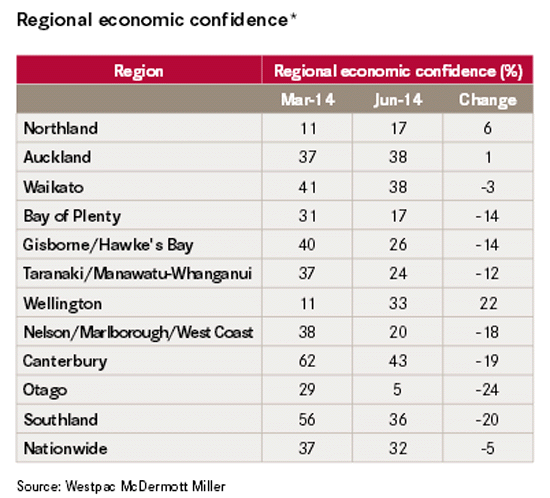
*Westpac says regional economic confidence is the balance of households expecting good, as opposed to bad, economic times in their region over the coming year, as a percentage of total number of households. Sample sizes and margins of error vary by region. The national average is weighted by the share of each region in the total population. The survey was conducted from June 1 to 10, with a total sample size of 1,565.
We welcome your comments below. If you are not already registered, please register to comment
Remember we welcome robust, respectful and insightful debate. We don't welcome abusive or defamatory comments and will de-register those repeatedly making such comments. Our current comment policy is here.