
By Bernard Hickey
The economy grew 0.4% in the June quarter from the March quarter, which was weaker than the consensus economist forecast for growth of around 0.6%.
The Reserve Bank had also forecast growth of 0.6%, which keeps the pressure on for the bank to cut the Official Cash Rate (OCR) one more time to 2.5% later this year.
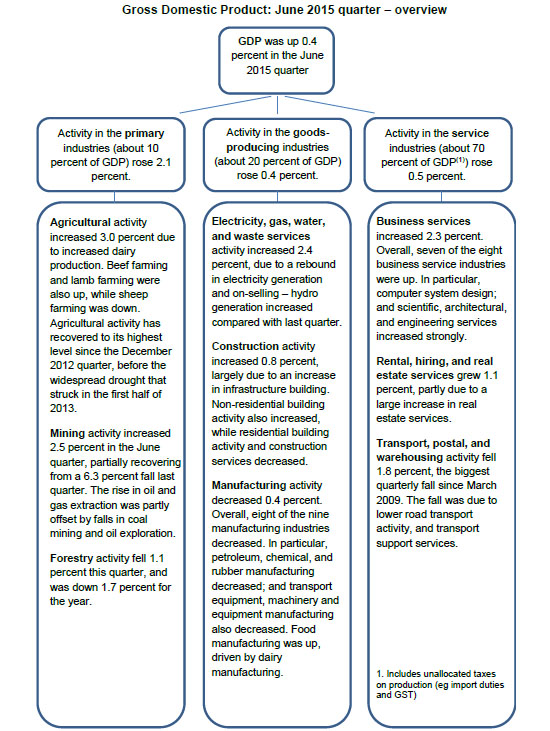
Statistics New Zealand reported GDP grew 0.4% in the June quarter from the March quarter, which was up from the 0.2% reported for the March quarter. Growth in the June quarter from the same quarter a year earlier was 2.4%.
It reported that weaker exports, stronger imports and a soft transport and warehousing sector dragged on the result. Growth in dairy production supported GDP in the June quarter.
"Collectively, the service industries were up 0.5 percent in the June 2015 quarter, but it was a mixed picture at the lower level – six industries grew and five declined. Growth was driven by business services (up 2.3 percent) and rental, hiring, and real estate services (up 1.1 percent), but these gains were partly offset by a 1.8 percent decrease in transport, postal, and warehousing – the biggest fall since March 2009," Statistics NZ reported.
Domestic demand remained strong, growing 1.3% for the quarter, with household spending up 0.9% and business investment rising 2.2%.
The weaker than expected result drove the New Zealand dollar down around 30-40 basis points to 63.5 USc.
Economist reaction
ASB senior economist Jane Turner said growth is slowing as construction and manufacturing activity plateau, with services having to pick up the pace to provide some offset.
"Within the GDP result there were signs of strong tourist spending boosting growth and robust demand for business services. However, for Q2 this was not enough to return growth to trend – with falls in wholesale trade and transport dragging on overall activity," Turner said, adding the outlook remained fragile given an expected 5% fall in dairy production.
"Although dairy prices have lifted faster than expected in recent weeks, rural confidence is expected to remain low which will continue to drag on investment and consumer demand in rural regions. Adding to the growth risks, wider confidence continues to decline and threatens broader investment and employment intentions," she said.
"We continue to expect the OCR to fall a further 25 basis points, but the timing is a close call between October, our current view, or December, the Reserve Bank indicated at the September MPS it was not necessarily in a hurry to deliver the final rate cut."
Westpac Chief Economist Dominick Stephens said the result was weaker than the market and Westpac expectations, in part because of a balancing 'technical' item.
"Primary production was up 2.1%, goods production was up 0.4%, and services production was up 0.5%. Yet total GDP was up only 0.4%!. This means it is impossible to attribute the surprise weakness to any particular sector of the economy," he said.
"For RBNZ watchers, this piece of data leans in favour of the RBNZ cutting the OCR in October. However, other data has leant against an October OCR cut. All in all, October remains a close call."
ANZ Senior Economist Mark Smith said the data confirmed the economy lost momentum in the first half of the year as the rebound from a weak first quarter was only modest.
"With the pending terms of trade hit yet to filter through the economy, the outlook is for sub-trend growth to continue over the remainder of the year," Smith said.
"This underlines the need for interest rate support, and today’s undershoot relative to expectations will keep speculation alive that the RBNZ will cut again in October," he said.
"However, we are not in that camp given our expectation that more timely indicators of activity will improve (while remaining relatively subdued) over the coming weeks and monetary policy works with a lag."
Per capita GDP growth flat
CTU Economist Bill Rosenberg said economic growth was faltering with no growth in per capita terms in the June quarter, given estimated 0.5% population growth overwhelmed GDP growth of 0.4%.
“While there was increased activity in agriculture, that was in the face of falling prices for its products which means farmers have less to spend in the rest of the economy. Manufacturing activity fell for the second successive quarter with all subsectors reducing output other than food manufacturing, which is helped by lower agricultural prices. While a falling dollar exchange rate may help to reverse this, it is not good news for many relatively well paid jobs," Rosenberg said.
“These are symptoms of an economy where the growth has been unevenly spread. There is still high unemployment in most regions of the North Island. Manufacturing has been struggling. Growth has been in areas like tourism where pay levels are low and jobs are insecure," he said.
“The Minister of Finance said earlier this week that immigration levels had kept wage rises down. So have other Government policies. Wages haven’t kept up with what the economy and employers can afford. Market sector labour productivity grew 8.5 percent between 2009 and 2014 but real average wages grew only a little more than 2 percent.”
Output per hour worked in the economy grew only 0.4 percent in the last year, indicating weak productivity growth, he said.
(Updated with reaction, market moves)
\
Economic growth
Select chart tabs
We welcome your comments below. If you are not already registered, please register to comment
Remember we welcome robust, respectful and insightful debate. We don't welcome abusive or defamatory comments and will de-register those repeatedly making such comments. Our current comment policy is here.