
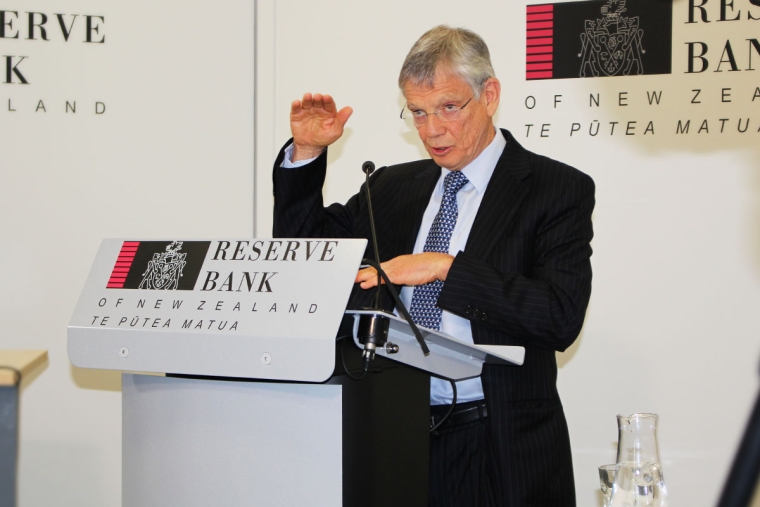
By Bernard Hickey
The Reserve Bank of New Zealand has cut the Official Cash Rate for a fourth time to 2.5% as most economists expected, but it has forecast it will hold it there until at least the end of 2018 despite also lowering its inflation forecast.
The Reserve Bank increased its forecasts for GDP growth, but saw inflation not returning to the centre of its 1-3% target band until December 2017. In its September MPS it had forecast a return to 2.1% by September 2016.
The bank took the unusual step of citing clause 4B of its Policy Targets Agreement (PTA) that specifies it should take into account financial system soundness when setting monetary policy.
"With inflation expected to increase steadily, consistent with the inflation target, a much sharper adjustment in interest rates than projected risks being inconsistent with clause 4b of the PTA, and could not change near-term inflation outcomes," the bank said in its full Monetary Policy Statement.
The statement was seen as hawkish by economists and painted the Reserve Bank Governor as a reluctant cutter, which pushed the New Zealand dollar up almost a cent to 67.4 USc. Financial markets had positioned for a cut and 13 of 15 economists had expected a cut, but the decision to leave the rate track forecast unchanged and to accept a later return to the centre of the 1-3% target band surprised some economists, who are concerned the Reserve Bank is over-estimating future likely inflation and therefore holding interest rates too high.
Governor Graeme Wheeler said global economic growth was below average and inflation was low, despite stimulatory monetary conditions.
New Zealand's growth rate had softened through 2015, but recovery in export prices, a recent lift in confidence, and increasing domestic demand from the rising population were expected to see growth strengthen over the coming year, he said.
Wheeler warned that the New Zealand dollar's rise since August was "unhelpful and further depreciation would be appropriate in order to support sustainable growth."
He noted house price inflation in Auckland remained high, "posing a financial stability risk. "
"Residential building is accelerating, and recent tax and LVR measures are expected to reduce housing pressures. There are some early signs that Auckland house price inflation may be moderating," he said.
Wheeler said CPI inflation was below the 1 to 3 percent target range, mainly due to the earlier strength in the New Zealand dollar and a 65% fall in world oil prices since mid-2014.
"The inflation rate is expected to move inside the target range from early 2016, as earlier petrol price declines will drop out of the annual calculation, and the lower New Zealand dollar will be reflected in higher tradables prices," he said.
Risks to outlook
The Reserve Bank cited a number of uncertainties and risks to this outlook, including the risk of low dairy prices for longer and an El Nino drought.
"Risks to the domestic outlook include the prospect of net immigration staying high for longer and of household expenditure picking up on the back of strong house prices," Wheeler said.
"Monetary policy needs to be accommodative to help ensure that future average inflation settles near the middle of the target range," he said.
"We expect to achieve this at current interest rate settings, although the Bank will reduce rates if circumstances warrant. "
In the MPS the bank listed the potential risks to its outlook in more detail and specified how the bank might react if they eventuated.
Higher net migration would only have modest implications for monetary policy, while a severe El Nino might justify more accommodative monetary policy if the currency did not adjust, it wrote.
A further slump in global growth an export prices could also warrant further easing, particularly if the New Zealand dollar did not adjust.
The bank also noted it expected consumer spending to remain in line with income growth.
"However, a stronger pickup in consumption is a plausible risk, especially if high net immigration, low interest rates, and rising house prices combine to increase confidence and willingness to borrow for consumption," the bank said.
"Such a scenario would warrant less monetary stimulus than is currently projected," it said.
Economist reaction
ANZ Economist Cameron Bagrie, who had picked the OCR would be held, said the tone of the statement suggested more balance about the future track of interest rates, rather than expecting further cuts.
"An easing was delivered, but it was of the hawkish variety," Bagrie said, adding he also now saw the OCR on hold for an extended period.
Bagrie said the New Zealand dollar could rise even further in coming weeks.
"We’d expect more of the same over the coming weeks given improvement in the tenor of local data and the fact that a Fed hike is nearly fully priced," he said.
"That will potentially become a sticking point, given the TWI is already trading 3 big figures above the level the RBNZ is assuming for Q1," he said.
Westpac Chief Economist Dominick Stephens, who had forecast the cut, said the Governor's statement appeared to show the bank would cut again if needed.
"Actually, the detail of the Monetary Policy Statement portrayed a central bank that is reluctant to cut," Stephens said.
"We think the RBNZ will indeed be surprised on the downside by inflation, GDP growth, and house prices - and consequently, we remain steadfast in our view that the OCR will fall to 2.0% next year," he said.
"That said, the RBNZ's current stance does call into question the timing of any move below 2.5%. We are currently forecasting OCR cuts in March and June - we will consider whether this timing remains the most appropriate forecast as we digest the Monetary Policy Statement more fully."
ASB Chief Economist Nick Tuffley also stuck with his forecast that the Reserve Bank will have to cut again in June and August next year to 2.0%.
"The low inflation forecast, coupled with a relatively neutral tone, does suggest the RBNZ is possibly more comfortable with inflation not reaching the mid-point of the target band," Tuffley said.
"However, with the risks clearly skewed to the downside (in our opinion), this is a risky forecast as it leaves little wriggle room," he said, describing the 'hawkish' tone of the statement as the reason for the currency's jump this morning.
Official cash rates
Select chart tabs
(Updated with picture, charts, currency reaction, economist reaction)
We welcome your comments below. If you are not already registered, please register to comment
Remember we welcome robust, respectful and insightful debate. We don't welcome abusive or defamatory comments and will de-register those repeatedly making such comments. Our current comment policy is here.